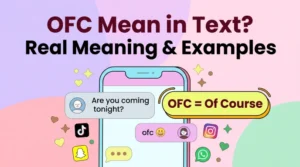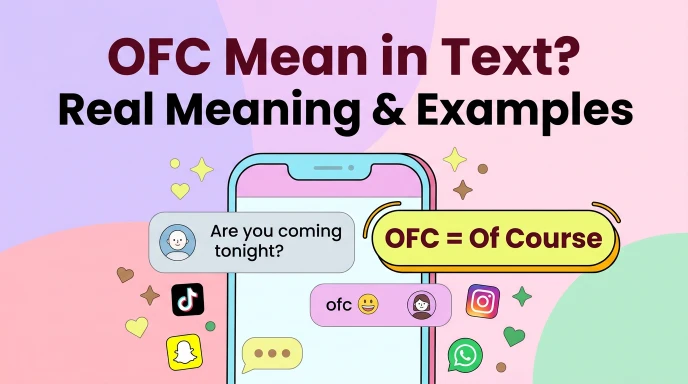
OFC means “of course,” a quick text abbreviation people use to say yes, absolutely, or obviously on TikTok, Snapchat, Instagram, and WhatsApp, like “ofc I’ll be there!”
OFC means “of course.” People type it to say yes, obviously, or absolutely when someone asks a question or makes a request. You will see it on TikTok, Snapchat, Instagram, WhatsApp, and in plain old text messages.
It is one of those tiny abbreviations that appears everywhere once you notice it. Someone asks “Are you coming tonight?” and the reply is just “ofc.” Three letters, full answer.
Most people search for it because they spotted it in a comment, a DM, or a group chat and felt a little lost. Maybe the tone seemed unclear. Was it friendly? Sarcastic? Annoyed?
This guide clears all of that up. You will get the meaning, real chat examples, reply ideas, and a few tips on when to use it and when to skip it.
OFC Meaning in Text
The simple definition
OFC stands for “of course.” That is all there is to it. When a person writes it, they are agreeing with you, confirming something, or saying that the answer is so obvious it barely needs saying.
Think of it as the texting version of a quick nod.
Is it slang, an acronym, or an abbreviation?
Technically, OFC is an abbreviation, not a true acronym. An acronym usually forms a pronounceable word (like NASA), while an initialism uses the first letter of each word (like FBI). OFC sits closer to an initialism, because it takes the first letters of “of” and “course.”
Most people just call it internet slang, and that works fine in everyday talk. Nobody in a group chat is going to correct you on the grammar label.
What it means in everyday chat
In normal conversation, OFC can carry a few shades of meaning depending on how it is used:
- Yes, definitely. “Can you help me move Saturday?” “ofc”
- Obviously. “Did you really think I would forget your birthday?” “ofc not”
- I was already planning to. “Don’t forget to bring snacks.” “ofc”
- A playful or slightly sarcastic tone. “Ofc you ate the last slice.”
The meaning stays the same. The feeling behind it changes with context, punctuation, and who is typing.
Where People Use OFC
OFC is not tied to one app. It travels across almost every place people type. Here is how it tends to show up.
TikTok
On TikTok, OFC lives mostly in the comments section. Someone posts a video about a relatable situation, and the comments fill up with “ofc,” “ofc she did,” or “ofc this is my song.” It works as a quick reaction that says “yes, that makes total sense.”
Creators also use it in captions and on-screen text, usually to add humor or a wink to the audience.
Snapchat
Snapchat is fast and casual, so short replies are king here. OFC fits perfectly in snap replies and chat messages. A friend sends a picture of a pizza and asks “want some?” and the answer comes back “ofc,” usually in lowercase and with zero punctuation.
On Instagram you will spot OFC in DMs, story replies, and comment threads. If someone shares a story asking “who’s going to the concert?” a friend might reply “ofc me.” It also appears under photos, where people agree with a caption or a compliment.
WhatsApp is where many people chat with family, classmates, and coworkers, so the tone is more mixed. Friends might send “ofc,” while a more careful person might write the full “of course” when talking to an older relative or a boss. Group chats lean casual, and OFC pops up often there.
SMS
In plain text messages, OFC is a time saver. Before smartphones had big keyboards, people shortened everything. The habit stuck. Today, many people still type “ofc” simply because it feels natural and quick, even when typing speed is no longer an issue.
Real Chat Examples
Here are ten realistic conversations that show how OFC works in real life.
Example 1: Plans with a friend
A: Are you still coming to the movie tonight?
B: ofc, I already got my ticket
A: Perfect, see you at 7
Example 2: Asking for a favor
A: Can you send me the notes from yesterday’s class?
B: ofc, give me two mins
A: You’re the best
Example 3: Playful teasing
A: Did you really eat the whole pizza by yourself?
B: ofc 😂 what did you expect
A: I expected a slice for me
Example 4: Birthday reminder
A: Don’t forget Maya’s birthday tomorrow
B: ofc I haven’t forgotten, I already bought the gift
A: Wow, you’re organized
Example 5: Group project
A: Are you able to finish your part by Friday?
B: ofc
A: Great, that helps a lot
Example 6: Sarcastic use
A: The Wi-Fi is down again
B: ofc it is, right when I have a deadline
A: Worst timing ever
Example 7: Showing support
A: Will you cheer for me at the match?
B: ofc I’ll be in the front row
A: That means a lot, thank you
Example 8: Casual agreement
A: This song is so good
B: ofc, it’s an absolute classic
A: Turn it up then
Example 9: Making sure
A: Are we still on for coffee on Sunday?
B: ofc, same place as last time?
A: Yep, 11 works for me
Example 10: Double meaning
A: Can I trust you with a secret?
B: ofc, always
A: Okay, sit down, this is big
Notice how the tone shifts. Example 6 is annoyed, Example 7 is warm, and Example 3 is just silly. Same three letters, very different moods.
How to Reply When Someone Says “OFC”
Often you do not need to reply at all, because “ofc” is already an answer. But if the chat keeps going, here are some ways to respond depending on your style.
Funny replies
- “Ofc? Look at you, so confident 😂”
- “I love how you didn’t even hesitate”
- “Ofc, the answer was never in doubt, was it?”
- “Okay legend, noted”
Casual replies
- “Cool, see you then”
- “Nice, thanks”
- “Perfect, that works”
- “Sounds good”
Friendly replies
- “Thanks so much, I really appreciate it”
- “You’re the best, honestly”
- “That makes my day, thank you”
- “Knew I could count on you”
Neutral replies
- “Okay, got it”
- “Alright, thanks for confirming”
- “Understood”
- “Great, let’s go ahead”
If the “ofc” felt sarcastic, a calm reply like “Okay, did I say something wrong?” can clear up any confusion without starting an argument.
Is OFC Rude or Offensive?
Short answer: no, OFC is not rude or offensive. It is a harmless, everyday abbreviation. It does not contain bad language, and it does not target anyone.
That said, tone matters. Like many short replies, it can come across as a bit dismissive if the situation is serious or emotional. Imagine someone pouring their heart out and you reply “ofc.” It may feel cold, even if you meant well.
Is it safe to use?
Yes, with friends, classmates, and people your age, it is completely safe. It is one of the milder slang terms out there.
School and work
At school, it depends on the setting. In a chat with classmates, it is fine. In an email to a teacher, it is better to write “of course.” That small change makes you sound more respectful.
At work, the same idea applies. Many workplaces are casual on messaging tools, and a quick “ofc” to a teammate is usually okay. For clients, managers, or formal emails, stick to the full phrase. When in doubt, spell it out. Nobody ever got in trouble for writing “of course.”
Who Uses This Term?
Age groups
OFC is most common among teenagers and young adults, roughly ages 13 to 30. People in their thirties and forties use it too, especially if they grew up texting on small phone keypads. Older adults use it less, though some pick it up from their kids or grandkids.
Gen Z usage
Gen Z leans heavily on short, lowercase replies. Skipping punctuation and shortening phrases is part of the culture. “ofc” fits this style perfectly, and it often appears alongside other abbreviations like “tbh,” “ngl,” and “fr.”
Common platforms
You will find it most on TikTok comments, Snapchat chats, Instagram DMs, WhatsApp groups, and regular texting. It also appears on Discord, Reddit, and in gaming chats, where fast typing matters.
How often it appears
OFC is quite common. It is not a trending buzzword that disappears after a month. It is a steady, reliable part of casual online writing. You can expect to see it daily if you spend any time in group chats or comment sections.
Origin of the Term
Where it likely came from
OFC is a plain shortening of “of course.” People have been trimming common phrases in written chat for decades, starting with early internet chat rooms, instant messengers, and SMS, where every character counted and typing on number keypads was slow.
Internet culture influence
As social media grew, the habit grew with it. Short replies feel quicker, friendlier, and more natural in a fast chat. Gen Z culture then made lowercase, no-punctuation messaging a style choice instead of just a shortcut.
Is the origin clear?
Partly. The meaning is obvious, but nobody can point to one person, website, or date and say “this is where it started.” It seems to have grown naturally, like many chat abbreviations, with no single creator. That is normal for slang. It spreads because people find it useful, not because someone invented it on purpose.
One small note: in a few specialized areas, OFC can mean something else entirely, such as a poker variant called Open-Face Chinese, or a technical term in networking. If you see it in a card game forum or a tech document, the context will make that clear. In normal texting, it means “of course.”
OFC vs Other Common Abbreviations
Here is how OFC compares with some other abbreviations you probably see every day.
| Term | Meaning | Type | Usage | Popularity |
| OFC | Of course | Abbreviation | Agreeing, confirming, or playful sarcasm | High |
| IDK | I don’t know | Initialism | Showing uncertainty | Very high |
| IDC | I don’t care | Initialism | Showing indifference, sometimes harsh | High |
| IMO | In my opinion | Initialism | Sharing a personal view politely | High |
| BRB | Be right back | Initialism | Stepping away from a chat briefly | Medium (older, still used) |
A quick takeaway from the table: OFC is positive or neutral most of the time, while IDC can sound cold. IDK and IMO are about uncertainty and opinion, and BRB is more about timing. They all do the same basic job, which is saving you a few seconds of typing.
A Real-World Usage Example
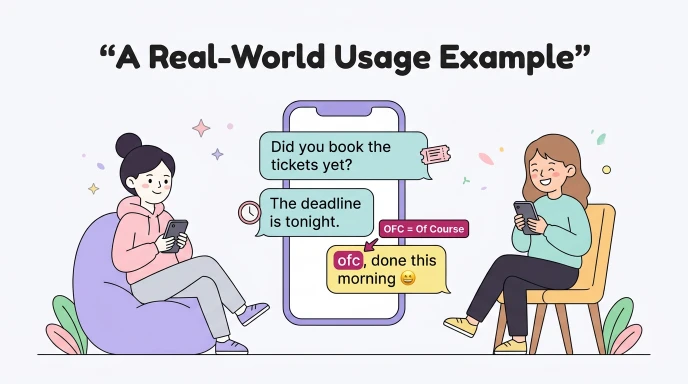
Picture this. Sara and her friend Hira are planning a weekend trip.She is worried Hira will forget to book the tickets.
“Did you book the tickets yet? Don’t forget the deadline is tonight.”
Hira replies: “ofc, done this morning 😄”
Here, “ofc” tells Sara two things at once. First, yes, the tickets are booked. Second, there was never any chance Hira would forget. It is warm and quick, and it keeps the conversation moving.
Now imagine the same scene, but Sara sends the message three times in one hour. Hira might reply “ofc 🙄” and the meaning shifts to “yes, I told you already.” Same word, different feeling. That is why emojis and timing matter so much in texting.
Tips for Using OFC the Right Way
A few simple habits will help you use it smoothly:
- Use it with friends and peers, not with strangers or senior people.
- Add a smiley or emoji if you want to sound warm.
- Avoid it in serious or emotional conversations.
- Write “of course” in formal emails and school messages.
- Be careful with sarcasm, because text does not carry tone of voice.
FAQs:
What does OFC mean in text messages?
OFC means “of course.” People use it to say yes, to agree, or to show that something is obvious. It is a quick way to confirm plans or answer a question.
What does OFC mean on TikTok?
On TikTok, OFC also means “of course.” It usually appears in comments to show agreement with a video, or to joke that something was totally expected, like “ofc she nailed it.”
Is OFC slang?
Yes, it is informal internet slang. More precisely, it is an abbreviation of the phrase “of course,” used mainly in casual chats and social media.
Is OFC rude or offensive?
No, it is not rude or offensive. It only feels rude if the tone is sarcastic or the message is too short for a serious conversation. Between friends, it is perfectly fine.
How should you reply to OFC?
You can reply with a simple “thanks,” “great,” or “see you then.” If the chat is playful, a joke works well. If the “ofc” seemed sarcastic, a calm question like “all good?” helps clear things up.
Conclusion
OFC means “of course,” and it is one of the friendliest little abbreviations in texting. People use it to say yes, to confirm plans, to show support, or to add a bit of playful sarcasm. You will see it on TikTok, Snapchat, Instagram, WhatsApp, and in everyday SMS.
It is safe, common, and easy to use with friends. Just remember that tone is tricky in text, so a short reply can sometimes feel cold. For school emails, work messages, or anything formal, writing the full “of course” is the smarter choice.
Now the next time someone replies “ofc” in your chat, you know exactly what they mean, and you can answer with confidence.
Continue Reading!

Hi, I’m Rebecca Morris, a UK-based freelance writer and editor with a passion for creating clear, engaging, and well-researched content. I write about lifestyle, technology, travel, and consumer topics, with a focus on making complex information simple and useful for everyday readers. I enjoy producing accurate, practical, and trustworthy articles that help people make informed decisions. When I’m not writing, I love exploring the British countryside, discovering independent cafés, and staying up to date with the latest trends in digital media and online publishing