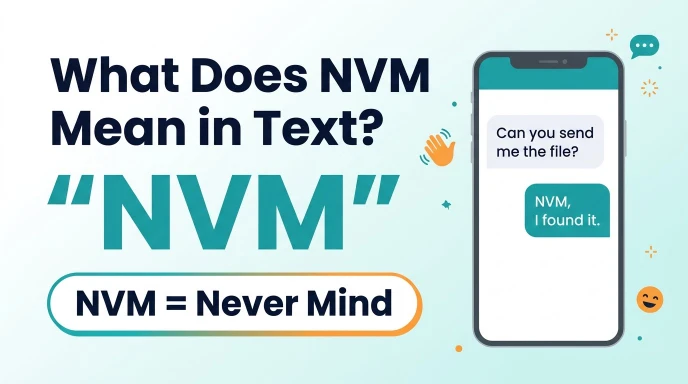
NVM means “Never Mind” in text messages and online conversations
People use it when they want to cancel a question, dismiss something they mentioned earlier, or tell someone not to worry about a previous message. You may see NVM on TikTok, Snapchat, Instagram, WhatsApp, and in everyday texting.
For example, if a friend asks you to explain something and then figures it out alone, they might text, “NVM, I got it.” This means they no longer need your help.
The abbreviation is popular because it makes conversations quicker and more casual. Instead of typing “Never mind,” someone can simply write NVM and move on.
If you have seen this abbreviation in a message and wondered what the sender meant, you are not alone. This guide explains its meaning, how people use it on different platforms, how to reply naturally, and when it might sound dismissive or confusing.
Quick Answer:
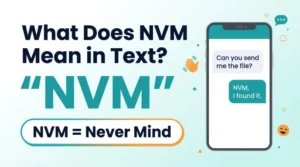
NVM stands for “never mind.” People use it in texts, DMs, and social media chats to cancel a question or request, or to say something no longer matters, for example: “Can you send me the file? NVM, I found it.”
1. NVM Meaning in Text
NVM stands for “Never Mind.” It is a common internet abbreviation used in text messages, social media comments, and online chats.
In everyday conversation, “never mind” can mean several related things. Someone might be telling you to forget a question, explaining that they no longer need help, or indicating that a previous point is no longer important.
NVM carries the same general meaning, but in a shorter form.
What Type of Abbreviation Is NVM?
NVM is an abbreviation of the phrase “Never Mind.” It is often described as internet slang because people use it frequently in informal digital communication.
Technically, it is not an acronym in the strictest sense. An acronym is generally formed from initial letters and pronounced as a word, while an initialism is pronounced letter by letter. NVM is a shortened written form of a phrase, and people usually read it as “never mind” rather than saying the individual letters aloud.
In casual conversations, though, many people simply call it texting slang. The important thing is understanding what it communicates.
What Does NVM Mean in Everyday Chat?
The exact meaning depends on the situation, but NVM commonly communicates one of these ideas:
- Forget what I said: The sender no longer wants to discuss a previous message.
- I figured it out: The sender has solved a problem without needing your help.
- It’s not important anymore: Something that mattered a moment ago is no longer relevant.
- Don’t worry about it: The sender wants you to stop worrying about a particular issue.
- Leave it for now: The sender may want to end a particular discussion.
For example:
A: Do you know what time the shop closes?
B: I think it closes at 9 PM.
A: NVM, I just checked. It closes at 10.
In this conversation, the sender has found the answer independently. There is no negative meaning behind the abbreviation.
Does NVM Always Mean the Same Thing?
The basic meaning remains “Never Mind,” but the tone can change.
If someone writes, “NVM, I found my keys,” they are simply updating you. If they write, “NVM. Forget it,” after an argument, they might be frustrated or disappointed.
It is also possible for someone to use NVM when they feel awkward about asking a question. They might decide that the question is unnecessary and withdraw it.
For that reason, you should consider the surrounding conversation instead of assuming that every use of NVM signals anger.
2. Where Do People Use NVM?
NVM is not limited to one social media platform. It works in most digital conversations because it expresses an everyday idea in a short, recognizable form.
NVM on TikTok
On TikTok, people may use NVM in direct messages, comment replies, and conversations about videos or trends.
For instance, someone might ask a friend if they have seen a particular video. Before the friend responds, they find the video themselves and send, “NVM, I found it.”
It can also appear in comment threads when someone corrects their own question or realizes that another user has already answered it.
Example:
A: What song is playing in this video?
B: It’s the new song by that artist.
A: NVM, I found the title in the caption.
Here, NVM simply tells the other person that the question has been answered.
NVM on Snapchat
Snapchat conversations are often quick and informal, so short abbreviations fit naturally into the messaging style.
A person might send a question and then change their mind. They could also use NVM after finding something they were looking for or realizing that they do not need a reply.
Example:
A: Are you free to talk?
B: Yeah, what’s up?
A: NVM, I’ll tell you tomorrow.
This could mean that the sender has decided to wait. It does not necessarily indicate a problem, although the recipient may wonder why the conversation was postponed.
When the subject is important, adding a brief explanation can prevent misunderstandings.
NVM on Instagram
Instagram users may write NVM in direct messages, group chats, or comment conversations.
For example, someone might ask for the name of a restaurant featured in a post. After reading the caption, they realize the information was already available.
They could reply, “NVM, it’s written in the caption.”
The abbreviation also appears when users correct themselves or withdraw an earlier question.
On Instagram, as on other platforms, the surrounding messages usually make the intended meaning clear.
NVM on WhatsApp
WhatsApp is used for conversations with friends, family members, classmates, and coworkers. NVM is especially convenient when people are exchanging several short messages.
Imagine asking a family member where the spare charger is. Before they reply, you find it in a drawer.
You might text, “NVM, found it!”
This saves time and lets the other person know that they do not need to keep looking.
In group chats, NVM can also correct a previous message or stop an unnecessary discussion. If other people might be confused, a few extra words can help everyone understand what has changed.
NVM in SMS Text Messages
NVM is also common in ordinary text messaging. It does not require a social media account or a specific app.
You might use it when asking a friend for directions, requesting information, or arranging a meeting.
Example:
A: Can you send me the address?
B: Sure, one second.
A: NVM, I found it in our old messages.
The sender has found the information and no longer needs the other person’s help.
In all these situations, the abbreviation serves the same basic purpose: it tells the recipient that a previous question, request, or topic can be set aside.
3. Real Chat Examples of NVM
The following examples show how people might use the abbreviation in everyday conversations. Each one illustrates a slightly different situation.
Example 1: Finding Something
A: Have you seen my headphones?
B: Check the table near the TV.
A: NVM, they were in my bag.
Meaning: The sender found the headphones and no longer needs help looking for them.
Example 2: Solving a Problem
A: How do I change my password?
B: Go to settings and open your account.
A: NVM, I figured it out.
Meaning: The sender solved the problem independently.
Example 3: Asking About Homework
A: Do you know the answer to question five?
B: Not sure, let me check.
A: NVM, the teacher posted the answer.
Meaning: The sender found the answer elsewhere.
Example 4: Changing Plans
A: Can you come over this evening?
B: What time?
A: NVM, let’s meet tomorrow instead.
Meaning: The sender has changed the plan and no longer wants to arrange an evening visit.
Example 5: Finding a Video
A: Can you send me that funny video?
B: Which one?
A: NVM, I found it on your profile.
Meaning: The sender located the video without needing it to be sent again.
Example 6: Correcting a Question
A: What day is the school event?
B: I think it’s Friday.
A: NVM, I checked the notice. It’s Saturday.
Meaning: The sender found the correct information and is correcting the earlier uncertainty.
Example 7: Ending a Small Request
A: Can you lend me a pen?
B: Sure, where are you?
A: NVM, I got one from Ali.
Meaning: The sender no longer needs the pen because another person helped.
Example 8: Changing Their Mind
A: What did you want to ask me?
B: Yeah?
A: NVM, it’s not important right now.
Meaning: The sender has decided not to ask the question at that moment.
Depending on the relationship and conversation, this could sound casual or slightly hesitant.
Example 9: A Friendly Chat
A: Did you watch the match yesterday?
B: Yeah, it was amazing.
A: NVM, I just saw your story about it 😂
Meaning: The sender realizes that they already have some information about the match.
Example 10: During a Busy Conversation
A: Can you call me when you’re free?
B: I’m in a meeting right now.
A: NVM, message me later when you have time.
Meaning: The sender adjusts their request after learning that the other person is busy.
These examples demonstrate that NVM is flexible. It can correct a misunderstanding, end a small request, change plans, or let someone know that their help is no longer needed.
4. How to Reply When Someone Says NVM
The best reply depends on what the person was talking about before sending the abbreviation.
Sometimes, no reply is necessary because the sender has already solved the problem. In other situations, a short acknowledgment can keep the conversation moving.
Funny Replies
If you are chatting with a friend who enjoys joking around, you can respond playfully.
Examples:
- “Too late, I was already investigating 😂”
- “Mystery solved, case closed!”
- “Okay, detective.”
- “You had one job: ask me first 😂”
- “Fine, I’ll save my expert advice for next time.”
These responses work best when the conversation is lighthearted. Avoid joking if the other person seems upset or is discussing something serious.
Casual Replies
Casual replies are suitable for everyday chats with friends and classmates.
Examples:
- “Okay lol.”
- “Alright.”
- “No worries.”
- “Gotcha.”
- “Cool, all good.”
If the person has found an answer or solved a problem, a simple acknowledgment is usually enough.
Friendly Replies
A friendly response can show that you are happy to help, even if the other person no longer needs anything.
Examples:
- “No problem! Let me know if you need anything else.”
- “All good, glad you figured it out.”
- “That’s okay, happy to help anytime.”
- “No worries, we can talk later.”
- “Sure, just message me if you need me.”
These responses are especially useful when the original message involved a request for help.
Neutral Replies
Sometimes, you may want to keep your response short and straightforward.
Examples:
- “Okay.”
- “Understood.”
- “Got it.”
- “That’s fine.”
- “Alright, thanks for letting me know.”
Neutral replies are useful in conversations with acquaintances, classmates, or coworkers when you do not need to add much emotion.
What If Someone Says NVM After an Argument?
This situation requires more care. If someone writes NVM during a disagreement, they may be frustrated, tired of explaining themselves, or simply ready to stop discussing the subject.
Instead of immediately assuming the worst, you can respond calmly.
For example:
“I understand. If you want to talk about it later, I’m here.”
This leaves the door open without forcing the other person to continue.
If the discussion is important and you genuinely do not understand what happened, you can ask if they would prefer to talk another time. Respect their answer if they do not want to continue.
5. Is NVM Rude or Offensive?
NVM is generally not rude or offensive. It is a common abbreviation for an ordinary English phrase, and it is widely suitable for informal conversations.
However, the way it is used can affect how a message feels.
When NVM Sounds Polite or Normal
NVM is usually harmless when someone has found an answer, solved a problem, or changed a small request.
For example:
“Can you tell me where the library is?”
“It’s next to the main building.”
“NVM, I found it. Thanks!”
The sender is simply updating the other person. There is no obvious negative tone.
When NVM Might Sound Rude
A bare “NVM” can occasionally sound dismissive, especially if it follows a personal question or a serious conversation.
For example:
A: Is something bothering you?
B: NVM.
The reply might mean that B does not want to discuss the issue. It could also suggest frustration, embarrassment, or a desire for privacy.
Still, the abbreviation alone cannot prove that the person is angry. Some people naturally send brief messages, even when they are not upset.
If the conversation feels tense, consider the overall context and the person’s usual communication style.
Is NVM Safe to Use?
Yes, NVM is generally safe to use in ordinary online communication. It is not inherently insulting, threatening, or offensive.
It is most suitable for informal chats where both people understand texting abbreviations.
If you are worried that the message might sound too abrupt, add a short explanation. For example, “NVM, I found the answer. Thanks for helping!” feels more complete and appreciative.
Is NVM Appropriate at School or Work?
In casual messages between classmates, NVM is generally acceptable.
In formal emails, academic assignments, professional correspondence, or conversations with someone who may not know internet slang, it is better to write “Never mind” in full.
For example, instead of sending a teacher “NVM,” you might write:
“Never mind, I found the information in the class notes. Thank you.”
This version is clearer and more respectful in a formal setting.
The key is to match your wording to the situation. Abbreviations are convenient, but a complete sentence is sometimes the better choice.
6. Who Uses NVM?
NVM is used by a broad range of people who communicate through digital messages. It is not limited to a particular age group, country, or social media platform.
Teenagers, university students, working adults, and older internet users may all recognize or use it.
Is NVM Popular Among Gen Z?
Gen Z users are often familiar with short digital expressions because messaging and social media are part of their everyday communication.
NVM fits comfortably into this style. It is short, easy to type, and useful when a conversation changes quickly.
However, not every Gen Z user uses the abbreviation regularly. Some prefer writing “never mind,” “forget it,” or “it’s okay” instead.
Individual habits, language preferences, and social circles all influence which expressions people use.
Do Millennials and Older Adults Use NVM?
Yes. People outside Gen Z can also use NVM, especially if they frequently text or participate in online communities.
The abbreviation has a straightforward meaning, so it does not require knowledge of a specific trend or meme.
Some adults use it naturally in family chats and messages with friends, while others prefer complete phrases.
Which Platforms Commonly Use NVM?
You may encounter the abbreviation in:
- Private messages between friends.
- Snapchat conversations and replies.
- TikTok comments and direct messages.
- Instagram chats.
- WhatsApp family and group chats.
- Regular SMS messages.
- Online gaming chats and community discussions.
There is no single reliable measure showing exactly how often NVM appears across all these platforms. Its frequency varies by community and individual messaging habits.
Still, it is a recognizable abbreviation that can be understood in many informal English-language conversations.
7. Origin of NVM
NVM comes from the phrase “Never Mind.” Its precise first use as an internet abbreviation is not firmly established, so it is best not to attribute it to a specific person, website, or date without reliable evidence.
The phrase itself existed long before modern social media. People have used “never mind” in spoken and written English to dismiss a concern, withdraw a question, or indicate that something is no longer important.
As digital communication developed, users began shortening familiar expressions to make typing faster and messages more compact.
How Text Messaging Helped Spread NVM
Early digital conversations often encouraged brief messages. Typing on mobile phone keypads could take time, and users developed shortcuts for common phrases.
Abbreviations such as BRB, IDK, and LOL became familiar in online communication. NVM followed a similar pattern because “Never Mind” is a phrase people use in many everyday situations.
As instant messaging and social media expanded, the abbreviation moved between different platforms and communities.
Is the Origin of NVM Certain?
The meaning of NVM is well established in ordinary texting, but the exact history of the abbreviation is less clear.
It is reasonable to connect its popularity with the broader culture of internet shorthand. However, there is no need to claim that one specific platform created it.
The important distinction is that the expression has a clear modern meaning even though its exact origin as a written abbreviation is uncertain.
8. NVM vs. IDK, IDC, IMO, and BRB
NVM is one of many abbreviations people use to make online conversations faster. Although these expressions may appear together in the same chat, they communicate different ideas.
The following table compares NVM with four other familiar abbreviations.
| Abbreviation | Meaning | Type | Usage | Popularity |
| NVM | Never Mind | Phrase abbreviation | Withdrawing a question or dismissing something as no longer necessary | Widely recognized in casual texting |
| IDK | I Don’t Know | Initialism | Expressing uncertainty or lack of knowledge | Very widely recognized |
| IDC | I Don’t Care | Initialism | Expressing indifference about something | Widely recognized; can sound blunt |
| IMO | In My Opinion | Initialism | Introducing a personal opinion | Widely recognized in online discussions |
| BRB | Be Right Back | Initialism | Indicating a brief absence from a conversation | Very widely recognized |
Popularity descriptions here are general rather than based on a measured ranking across all platforms.
NVM vs. IDK
NVM means “Never Mind,” while IDK means “I Don’t Know.”
NVM usually tells someone that a previous question or request is no longer necessary. IDK communicates that the sender does not know something.
For example:
A: What’s the homework deadline?
B: IDK, I’ll check.
A: NVM, the teacher just posted it.
The first abbreviation expresses uncertainty. The second indicates that the information has been found, so there is no longer a need to ask.
NVM vs. IDC
IDC stands for “I Don’t Care.” It expresses indifference, whereas NVM usually dismisses or withdraws a previous question, request, or topic.
For example:
“NVM, I found another way to get there” means the original request is no longer necessary.
“IDC where we eat” means the sender does not have a strong preference about the restaurant.
IDC can sound blunt depending on the context, while NVM is often a neutral conversational shortcut.
NVM vs. IMO
IMO means “In My Opinion.” It is used to introduce a viewpoint or personal judgment.
For example, “IMO, this movie is better than the first one” introduces the sender’s opinion.
NVM does not introduce an opinion. It usually indicates that something mentioned earlier can be forgotten or set aside.
NVM vs. BRB
BRB means “Be Right Back.” It tells another person that the sender is briefly leaving the conversation.
For example, “BRB, someone is at the door” means the sender expects to return shortly.
NVM has a different purpose. It communicates that a question, request, or subject is no longer necessary or that the sender has changed their mind.
Knowing these differences makes it easier to understand short messages without confusing one abbreviation with another.
9. A Real-World Example of NVM
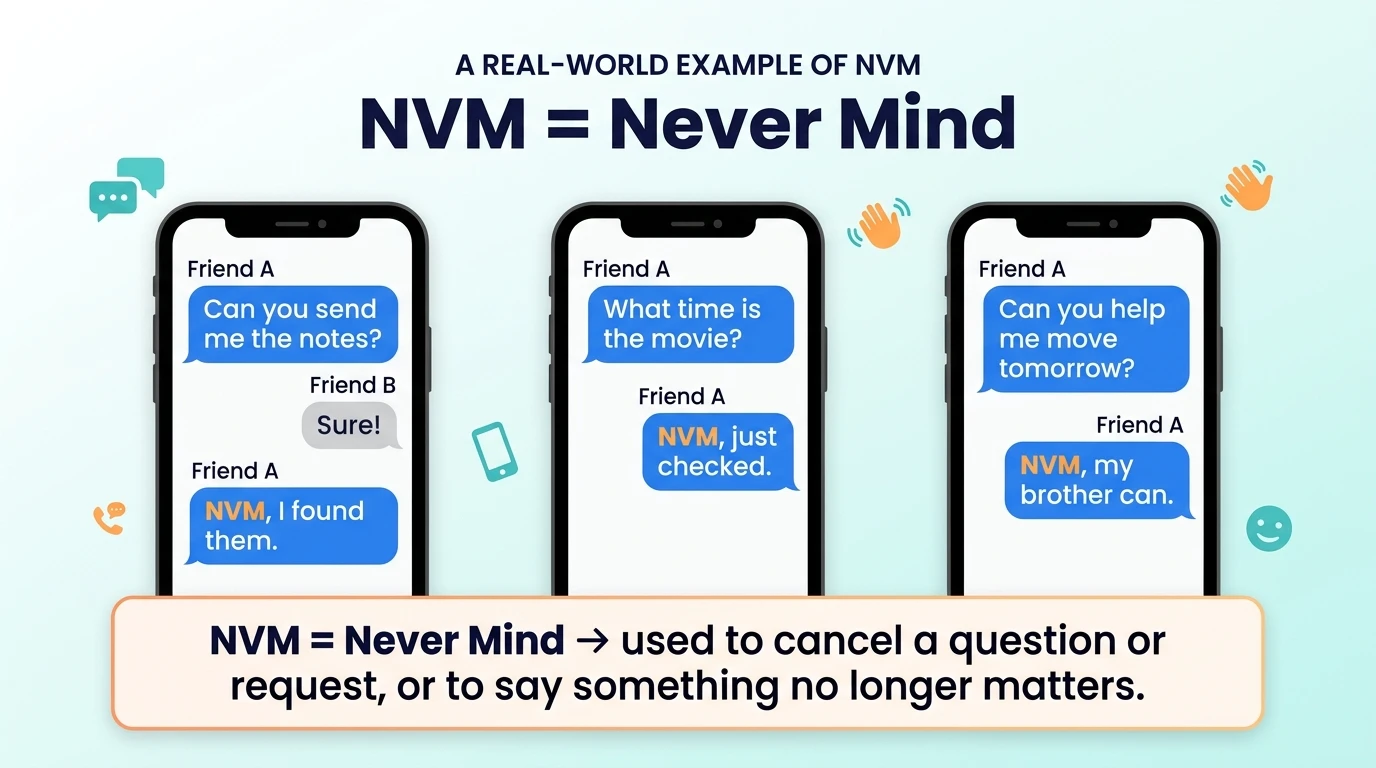
Imagine that you are preparing for an exam and messaging a classmate about an assignment.
You send:
“Hey, do you remember which chapter we need to study?”
Your classmate replies:
“I think it’s chapter six. Let me check the class group.”
While waiting, you open your notebook and find the teacher’s instructions. You realize that the assignment covers chapter seven instead.
You immediately message your classmate:
“NVM, I found the instructions. It’s chapter seven.”
Your classmate no longer needs to search through the group chat. The abbreviation makes it clear that your original question has been resolved.
Now imagine a different situation. You are having a personal conversation with a friend and ask them something important. They respond with “NVM” after you ask for clarification.
In that case, the message may communicate that they do not want to continue the discussion. It could also mean they are unsure how to explain what they feel.
These examples show why context matters. The same abbreviation can be practical in one conversation and emotionally complicated in another.
When you use NVM, consider if the other person will understand why you are ending or changing the discussion. When you receive it, avoid jumping to conclusions before considering the rest of the conversation.
10. Common Mistakes to Avoid When Using NVM
NVM is easy to understand once you know its meaning, but using it thoughtfully can help prevent confusion.
Assuming It Always Means Someone Is Angry
A message containing only NVM can sometimes sound cold, but that does not mean the sender is upset.
They may have found an answer, changed their mind, or decided that their question is unnecessary.
Consider the context before interpreting the message emotionally.
Using It Without Explaining an Important Change
If you cancel a plan or withdraw a significant request, NVM alone might leave the other person wondering what happened.
For example, “NVM, I can’t come today because my schedule changed” provides more useful information than simply writing “NVM.”
The extra explanation is especially helpful when another person is making arrangements for you.
Using It in Formal Communication
Abbreviations are useful in casual messages, but they may be unsuitable for a formal email or official request.
Writing “Never mind, I found the document” is usually clearer than using NVM when communicating with a teacher, supervisor, or professional contact.
Ignoring the Other Person’s Confusion
If someone asks what you mean by NVM, explain your message rather than assuming they understand the abbreviation.
Not everyone uses the same internet expressions, and clear communication is more important than keeping every message short.
Using NVM to Avoid Every Difficult Conversation
Sometimes people use “never mind” because they feel uncomfortable discussing an issue. That is understandable, but repeatedly withdrawing important questions can lead to misunderstandings.
If you genuinely need help or want to discuss a problem, it may be more useful to explain that you are unsure how to bring it up.
NVM works best when it accurately communicates that something is no longer necessary or that you want to move on from a particular point.
FAQs
What does NVM mean in text messages?
NVM means “Never Mind.” People use it when they no longer need an answer, want to withdraw a question, change their mind, or indicate that something is no longer important.
What does NVM mean on TikTok?
On TikTok, NVM generally means “Never Mind.” It may appear in comments or direct messages when someone finds an answer, corrects a previous message, or decides not to continue a particular topic.
Is NVM slang?
NVM is an abbreviation commonly used as internet slang. It is a shortened written form of the everyday English phrase “Never Mind.”
Is NVM rude or offensive?
No, NVM is not inherently rude or offensive. However, it may sound dismissive in a sensitive conversation. Adding a brief explanation can make your intended meaning clearer.
How should you reply to NVM?
You can reply with “Okay,” “No worries,” “Got it,” or “All good.” If the sender seems upset, respond calmly and give them space to continue the conversation later if they wish.
What does NVM mean from a girl or boy?
The basic meaning remains “Never Mind,” regardless of who sends it. The context determines if the person is simply correcting themselves, changing their mind, or avoiding a conversation.
Conclusion
NVM means “Never Mind” and is widely used in casual texting and online conversations. It helps people withdraw a question, change their mind, correct an earlier message, or explain that they no longer need assistance.
You may see it on TikTok, Snapchat, Instagram, WhatsApp, and in regular SMS messages. Although the abbreviation has the same basic meaning across these platforms, its tone can change depending on the conversation.
NVM is generally harmless and useful when a quick response is enough. If someone sends it to you, a simple reply such as “Okay” or “No worries” will usually work.
Use it freely in suitable casual conversations, but consider writing “Never mind” in full when speaking professionally or discussing something important. Most importantly, remember that context matters more than the abbreviation itself.
Useful Resources!

Hi, I’m Rebecca Morris, a UK-based freelance writer and editor with a passion for creating clear, engaging, and well-researched content. I write about lifestyle, technology, travel, and consumer topics, with a focus on making complex information simple and useful for everyday readers. I enjoy producing accurate, practical, and trustworthy articles that help people make informed decisions. When I’m not writing, I love exploring the British countryside, discovering independent cafés, and staying up to date with the latest trends in digital media and online publishing