OBJ in text is short for “object” or “objection,” used to disagree with something or to refer to a specific item, depending on the conversation.
When someone types “OBJ” to push back, it works like a quick “I object!” from a courtroom drama. It tells the other person you disagree without writing a full sentence.
In tech and design chats, the same letters point to an “object,” such as an item in code or a 3D model file. People also use it in work messages to keep things short and clear.
Because one abbreviation carries two meanings, context is your best clue. A heated debate usually means “objection,” while a project or file discussion points to “object.”
Below, you will find the full meaning of OBJ, real texting examples, and simple tips for replying with confidence. By the end, you will know how to read it correctly on WhatsApp, Instagram, Snapchat, and work chats.
Quick Answer:
OBJ in text is short for “objection” or “object.” When someone texts “OBJ,” they usually mean “I object” or “I disagree,” like saying “Objection!” in a courtroom. In work, tech, or design chats, it can also mean “object,” such as an item in code or a 3D model file (.obj).
What Does OBJ Mean in Text?
OBJ usually stands for Object Replacement Character when it appears unexpectedly inside digital text. It is associated with a special Unicode character that can appear when a device, application, or text-processing system cannot display certain content as intended.
In simple terms, your screen may show OBJ because something in the original message could not be displayed correctly.
For example, imagine your friend sends you a message containing an emoji. Instead of seeing the emoji, you see something like this:
“Your reaction was hilarious OBJ”
The OBJ may have appeared because the original content was not handled correctly when the message was created, copied, or displayed.
It does not necessarily mean your friend typed the letters “OBJ” deliberately.
Is OBJ Slang, an Acronym, or an Abbreviation?
OBJ can be an abbreviation in technical contexts, but its appearance in a message does not automatically make it slang.
The most relevant meanings include:
- Object Replacement Character: A technical character associated with text encoding and display.
- Object: A shortened form sometimes used in programming, gaming, or technical conversations.
- Other context-specific meanings: OBJ may represent a name, label, or abbreviation in a particular community.
The important distinction is that OBJ appearing unexpectedly in a sentence is often a display issue rather than a popular texting expression.
Unlike IDK, which commonly means “I don’t know,” OBJ does not have one universally accepted meaning in everyday chat.
What Does OBJ Mean in Everyday Conversations?
When you see OBJ in a conversation, look at the surrounding words and how it appears.
If it appears in the middle of a sentence where an emoji or symbol would make sense, a display problem is a reasonable explanation.
If someone writes “OBJ file” in a discussion about computers or 3D graphics, they are probably referring to a technical file format.
If someone deliberately uses OBJ as part of a username, joke, or group conversation, the meaning may be specific to that context.
The safest interpretation is to treat unexpected OBJ text as a possible formatting problem until the surrounding conversation suggests otherwise.
Where Do People See OBJ on Social Media?
OBJ can appear across different platforms because messages, captions, comments, and copied text may pass through different devices and software systems.
However, there is no universal rule that OBJ means the same thing on every social media platform.
What Does OBJ Mean on TikTok?
On TikTok, you might encounter OBJ in a comment, caption, profile description, or text copied from another source.
Sometimes, the letters appear where an emoji or another symbol should be. This can happen when text containing special characters is processed or displayed incorrectly.
For example:
“Her reaction was so funny OBJ”
If the sentence seems incomplete or the OBJ appears out of place, it may be a technical artifact rather than a word with a hidden meaning.
TikTok users also use abbreviations and inside jokes, so context matters. If the person repeatedly uses OBJ intentionally, you can ask what they mean.
What Does OBJ Mean on Snapchat?
On Snapchat, OBJ may appear in a chat message, a caption, or text copied into a conversation.
One possible explanation is that the original text contains a character that your device or the app cannot display as intended.
For example:
“Look at the picture I sent OBJ”
If OBJ appears unexpectedly, it does not automatically indicate anger, sarcasm, or a secret message.
You can ask the sender if something was supposed to appear in that position.
What Does OBJ Mean on Instagram?
On Instagram, you may see OBJ in comments, direct messages, captions, or copied text.
For example, someone might post a sentence that contains a special symbol. If that symbol is not handled correctly by the software displaying the text, a replacement character may appear instead.
If you see OBJ in an Instagram comment, consider if the surrounding sentence still makes sense without those letters.
It could be a display issue, a copied formatting artifact, or a context-specific abbreviation. There is no reason to assume it is an insult or offensive expression without additional evidence.
What Does OBJ Mean on WhatsApp?
WhatsApp messages can contain ordinary text, emojis, stickers, images, and other types of content.
If OBJ appears unexpectedly in a text message, it may indicate that some content was not displayed correctly during copying, conversion, or processing.
For example:
“Thanks for sending that OBJ”
The sender might have intended to include a symbol or other content that did not transfer properly.
If the message looks unusual, try asking the sender to resend it. A fresh message may display correctly.
What Does OBJ Mean in SMS Text Messages?
Traditional SMS messages have different technical limitations from many modern messaging services. Special characters may be affected by device compatibility, encoding, or the way messages are converted between systems.
If OBJ appears in an SMS conversation, it could be a technical artifact or a manually typed abbreviation.
Unlike widely recognized texting terms such as BRB and IDK, OBJ is not a standard everyday SMS abbreviation with one consistent conversational meaning.
Real Chat Examples: How OBJ May Appear in Messages
The following examples show realistic situations in which someone might encounter OBJ. They are illustrative examples, not evidence that OBJ has a standard slang meaning in each conversation.
Example 1: A Message With a Missing Emoji
A: That video made me laugh so hard.
B: Same, I watched it five times OBJ
A: What does OBJ mean?
B: Maybe something in the message didn’t display properly.
In this situation, the letters may have appeared because a character was not processed correctly. The conversation alone does not prove what content was originally intended.
Example 2: An Instagram Comment
A: Your new post is amazing.
B: Thank you!
A: I noticed OBJ at the end of your caption. Did you type that?
B: No, I didn’t notice it before.
Here, the sender may need to check the caption’s formatting or edit the text.
Example 3: A Snapchat Message
A: Did you see the picture I sent?
B: Yes, but your message has OBJ in it.
A: Really? I didn’t type that.
B: It might be a display issue.
This example shows why it is useful to ask instead of assuming that the letters have a special meaning.
Example 4: A WhatsApp Conversation
A: Can you send me the notes again?
B: Sure, here they are OBJ
A: Something looks strange at the end.
B: I’ll resend them.
If the unusual text disappears after the message is resent, the original issue may have involved formatting or character handling.
Example 5: A Text Copied From Another App
A: I copied the caption into my notes.
B: Does it look the same?
A: Not really. It has OBJ between two words.
B: The text might not have transferred properly.
Copying text between apps can sometimes change how special characters are represented.
Example 6: A Programming Discussion
A: Why does this file have an OBJ extension?
B: Are you working with a 3D model?
A: Yes.
B: In that case, OBJ probably refers to a 3D object file format.
Here, the context clearly differs from casual texting. The term is technical rather than conversational slang.
Example 7: A Confusing TikTok Comment
A: What did that comment mean?
B: I don’t know. It just says OBJ.
A: Maybe the original symbol didn’t show up.
B: That’s possible. I’ll check the rest of the sentence.
The surrounding comment may provide clues, but the letters alone are not enough to determine the original content.
Example 8: A Friend Uses It Repeatedly
A: Why do you keep writing OBJ?
B: That’s what appears when I paste my text.
A: Oh, so you aren’t using it as slang?
B: No, I didn’t even notice it until now.
This is an example of why it is important to distinguish intentional abbreviations from unexpected characters.
Example 9: A Work Message
A: I received your report, but one line contains OBJ.
B: Thanks for telling me. I’ll check the original document.
A: No problem.
B: I’ll send a clean copy shortly.
In professional communication, it is better to clarify the problem and correct the document than to guess at the intended meaning.
Example 10: A Gaming Chat
A: Your username shows some strange characters.
B: Does it show OBJ?
A: Yes, right before your name.
B: Maybe the game isn’t displaying one of the characters properly.
Games sometimes handle fonts, symbols, and character sets differently, so a display problem is one possible explanation.
How Should You Reply When Someone Sends OBJ?
Your response should depend on the situation. If OBJ appears unexpectedly, you do not need to invent a slang meaning or respond as though it were an insult.
Here are a few natural ways to handle it.
Funny Replies
If you are chatting with a friend and want to keep things light, you could say:
- “OBJ? Is your keyboard speaking another language?”
- “I think your message glitched.”
- “Did your emoji turn into OBJ?”
- “My phone has no idea what that means either.”
These replies work best when the conversation is casual and both people understand that you are joking about the confusing text.
Casual Replies
If you simply want to understand the message, try:
- “What does OBJ mean here?”
- “Did you mean to type OBJ?”
- “I see OBJ in your message. Is something missing?”
- “Could you send that again?”
These questions are straightforward without sounding judgmental.
Friendly Replies
If you think the sender may have a technical problem, you can say:
- “I think something didn’t display correctly.”
- “Your message has a strange symbol in it.”
- “Maybe the text didn’t copy properly.”
- “Can you resend that part?”
This approach is especially helpful when the original message contains other unusual characters.
Neutral Replies
In a school, work, or unfamiliar conversation, keep your response simple:
- “Could you clarify what OBJ refers to?”
- “I’m not sure what that abbreviation means in this context.”
- “Can you explain that term?”
- “Was OBJ intended to be part of the message?”
Asking for clarification is generally more reliable than guessing.
Is OBJ Rude or Offensive?
OBJ is not inherently rude or offensive. When it appears as an object replacement character, it is a technical symbol rather than an insult or swear word.
Nevertheless, the letters can be used deliberately in a private joke, gaming group, or online community. If someone assigns OBJ a special meaning within a particular conversation, that local meaning may differ from its technical use.
Is OBJ Safe to Use in Text Messages?
Generally, there is nothing offensive about the letters themselves.
However, if you are trying to communicate clearly, avoid inserting OBJ into a message unless you know why you are using it. An unexpected technical character may confuse the recipient or make your message look broken.
If you notice it in a message you received, there is usually no need to worry. Check the context or ask the sender for clarification.
Is OBJ Appropriate at School or Work?
The abbreviation itself is not automatically inappropriate. The important question is what it represents in the particular situation.
In a computer science class, OBJ may be relevant technical terminology. In a report, presentation, or professional email, an unexpected OBJ character may simply be a formatting issue that needs correction.
If the term is being used as a private joke or has a meaning specific to a group, consider if that meaning is appropriate for the audience.
Who Uses OBJ in Text Messages?
OBJ does not belong exclusively to any age group or social media community.
Teenagers, adults, students, programmers, content creators, and ordinary messaging users may all encounter it. The reason for seeing it depends more on the technology and context than on the person’s age.
Does Gen Z Use OBJ as Slang?
Gen Z frequently uses abbreviations, memes, and short expressions in online conversations. However, that does not mean every unusual group of letters is Gen Z slang.
OBJ may appear in a conversation involving younger users simply because they share screenshots, copy captions, use different devices, or communicate through multiple platforms.
It is important not to confuse a technical character with a recognized generational expression.
Is OBJ Common on TikTok and Instagram?
People may encounter OBJ on these platforms, but seeing it does not establish that it is a widely used slang term.
There is a difference between a term being visible online and being a popular expression with a shared definition. Some unusual text appears because of formatting problems rather than because people intentionally use it.
Without reliable evidence, it would be misleading to claim that OBJ is one of the most popular texting abbreviations or that it has a single meaning across social media.
Where Did OBJ Come From?
The technical meaning of OBJ is connected to digital text representation.
Computers do not store every character as a visual picture. Instead, text is represented using character-encoding systems and Unicode, which assigns standardized values to characters and symbols.
When text contains a special character that cannot be represented or displayed properly by a particular process, a replacement character may be used.
The Unicode Object Replacement Character, represented by U+FFFC, is associated with embedded objects in text. It can serve as a placeholder for content that is not represented as ordinary text.
This is different from the Unicode replacement character, U+FFFD, which is commonly associated with decoding errors or invalid character sequences.
The distinction matters because people sometimes use the phrase “OBJ character” loosely to describe several kinds of strange text. Seeing the letters OBJ on your screen does not prove that a specific Unicode character caused the issue.
How Did It Become Visible in Messages?
When text moves between applications, devices, or formats, special characters and embedded content may not always transfer as intended.
For example, a document might contain an embedded object, or a piece of copied text might include a character that another application handles differently. Depending on the software, you may see a placeholder, an unusual symbol, or unexpected text.
That is one reason OBJ can appear in places where ordinary words are expected.
Does OBJ Have a Clear Slang Origin?
There is no single, well-established origin for OBJ as a universal internet slang expression.
Its technical use has a clear connection to digital text handling, but a person or online community could use the same letters in another way.
If someone claims OBJ means a specific phrase in every text message, be cautious. The meaning cannot reliably be established from the letters alone.
OBJ vs. IDK, IDC, IMO, and BRB
OBJ differs from common texting abbreviations because it does not have one standard conversational definition across everyday messaging.
IDK, IDC, IMO, and BRB are established shorthand expressions that usually have recognizable meanings in casual chat.
Comparison:
| Term | Meaning | Type | Usage | Popularity |
| OBJ | Often an object-related technical placeholder when unexpected; context-dependent otherwise | Technical abbreviation or character label | Display issues, technical discussions, or specialized contexts | Less standardized as everyday slang |
| IDK | I don’t know | Texting abbreviation | Expressing uncertainty | Widely recognized |
| IDC | I don’t care | Texting abbreviation | Expressing indifference | Widely recognized |
| IMO | In my opinion | Texting abbreviation | Sharing a personal view | Widely recognized |
| BRB | Be right back | Texting abbreviation | Temporarily leaving a conversation | Widely recognized |
The popularity descriptions are qualitative rather than measured statistics.
OBJ vs. IDK
IDK is a familiar abbreviation that directly communicates uncertainty.
For example, “IDK what time the movie starts” means the sender does not know the time.
OBJ does not communicate uncertainty by itself. If it appears in a sentence, you need to examine the context to understand if it is technical, intentional, or a display artifact.
OBJ vs. IDC
IDC commonly means “I don’t care.” Depending on tone, it can sound neutral, dismissive, or rude.
OBJ does not automatically communicate indifference. If someone sends you OBJ, you should not assume they are saying they do not care about your message.
OBJ vs. IMO
IMO means “in my opinion.” It is commonly used before a personal view or judgment.
For example, “IMO, this is the best option” makes the sender’s opinion clear.
OBJ has no equivalent standard function in ordinary chat, so the surrounding sentence matters much more.
OBJ vs. BRB
BRB means “be right back” and usually indicates that someone will return to the conversation shortly.
OBJ does not normally communicate that someone is leaving or returning. Treating it as interchangeable with BRB would be misleading.
What Should You Do If OBJ Keeps Appearing?
If OBJ repeatedly appears in your messages, a few simple checks may help you identify the cause.
Check the Original Message
Ask the sender if they typed OBJ intentionally or if it appeared automatically.
If the sender did not type it, the issue may involve the way the text was created, copied, or displayed.
Try Copying the Text Again
If you copied the message from another application, try copying it again or pasting it as plain text if your app offers that option.
Removing unusual formatting may help when the issue comes from a document or rich-text source.
Check Another Device or Application
If the text looks different on another device, the issue may be related to how the applications handle the content.
For example, a message might look normal in one editor but display unusual characters when pasted into another.
Ask for a Clearer Version
If the meaning remains uncertain, request a screenshot or ask the sender to rewrite the sentence.
Do not assume the sender intended to offend you simply because the message contains OBJ.
Real-World Example: Understanding OBJ in a Conversation
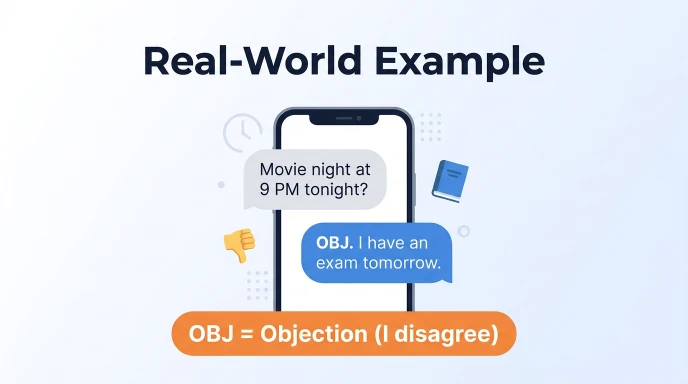
Imagine that a classmate sends you a message about a group project:
“Your presentation looks great OBJ”
You might wonder if OBJ is a compliment, a joke, or a hidden abbreviation.
The sentence itself suggests that the classmate is complimenting your presentation. However, OBJ does not have a standard meaning that turns the message into a more specific statement.
You could reply, “Thanks! What does OBJ mean at the end of your message?”
Your classmate might explain that they copied the text from another application and did not notice the extra characters.
Alternatively, they might tell you that OBJ is an inside joke in your group.
The important lesson is that context can help you interpret a message, but it cannot always tell you exactly why OBJ appeared. When the meaning is unclear, asking the sender is the most reliable solution.
FAQs
What Does OBJ Mean?
OBJ is a short form of “objection” or “object.” In casual messages, it means “I disagree” or “I object.” In technical settings, it points to an object, such as an item in code, a design project, or a 3D model file.
The meaning depends on who is typing and where. A friend teasing you in a group chat means “objection,” while a developer sharing a file means “object.”
What Does “OBJ” Mean in Chat?
In chat, OBJ usually means “objection,” a quick way to push back on a plan or opinion without writing a long reply. It is often playful, borrowed from the dramatic “Objection!” moment you see in courtroom movies and TV shows.
Examples:
- “Skipping the gym again? OBJ.”
- “Pineapple on pizza is amazing.” / “OBJ, that is a crime.”
In team chats on Slack or Discord, the same letters can refer to an “object” in a project, so check the topic before replying.
What Does OBJ Mean from a Girl?
When a girl texts OBJ, it almost always carries the same meaning: “objection” or “I disagree.” The tone makes the difference. With emojis or a joke, it is usually light teasing or playful banter, while a short, dry “OBJ” can signal real disagreement.
Examples:
- “You’re leaving the party already? OBJ 😂” (playful)
- “OBJ. I never agreed to that.” (serious)
Instead of reading too much into it, look at the emojis, her usual texting style, and the topic. If you are unsure, a simple “Why the objection?” clears it up.
What Does “OBJ” Mean in Text Messages?
In text messages, OBJ stands for “objection” most of the time. People use it to disagree quickly, to tease a friend, or to challenge a plan while keeping the mood light.
It works best in informal chats with friends, family, and classmates. In professional emails or formal messages, it is better to write the full word “objection” to avoid confusion.
What Is OBJ in English?
In English, “obj.” is a standard abbreviation of “object” or “objection.” In grammar, it also appears in dictionaries and textbooks as shorthand for the object of a sentence, such as the direct object, or for the objective case of a pronoun.
Examples:
- “She read the book.” (the book is the object)
- “Him” is the objective form of “he.”
So the abbreviation travels well beyond texting. You will see it in dictionaries, language lessons, and academic writing.
What Is OBJ in Word?
In Microsoft Word, “object” refers to anything you can insert into a document, such as a chart, an Excel table, an equation, or a PDF, using Insert > Object. Separately, OBJ is also a file extension (.obj) for 3D models, and newer Microsoft 365 versions can insert supported 3D models through Insert > 3D Models.
Quick tip: if you see “OBJ” while opening or saving a file, it is most likely the 3D model format used in design tools like Blender, not a regular document.
Where You Might See OBJ Besides Texting
Beyond chats, you can come across OBJ in several places:
- Courtrooms and debates: a formal “objection”
- Programming: “obj” is a common variable name for an object in languages like JavaScript and Python
- 3D design: the .obj format used by Blender, Maya, and 3D printing software
- Language lessons: shorthand for “object” in grammar
Conclusion
OBJ in text usually refers to the Object Replacement Character when it appears unexpectedly, although its precise meaning depends on the context. It may be connected to embedded content, character handling, or a formatting issue rather than intentional internet slang.
You might encounter it on TikTok, Snapchat, Instagram, WhatsApp, in SMS messages, or when copying text between applications. Unlike common abbreviations such as IDK, IDC, IMO, and BRB, OBJ does not have one universally recognized meaning in everyday conversation.
If you see OBJ in a message, look at the surrounding words, consider if the text may have been copied from another source, and ask the sender for clarification when necessary.
Understanding the context is the key to interpreting unusual online language correctly. You do not need to assume that OBJ is rude, offensive, or a hidden message simply because it looks unfamiliar.

Hi, I’m Rebecca Morris, a UK-based freelance writer and editor with a passion for creating clear, engaging, and well-researched content. I write about lifestyle, technology, travel, and consumer topics, with a focus on making complex information simple and useful for everyday readers. I enjoy producing accurate, practical, and trustworthy articles that help people make informed decisions. When I’m not writing, I love exploring the British countryside, discovering independent cafés, and staying up to date with the latest trends in digital media and online publishing