Victorian slang insults were witty, theatrical put-downs like “bounder,” “cad,” and “blackguard” that Britons used in the 1800s to mock someone’s manners, intelligence, or character.
Born in the age of Queen Victoria (1837 to 1901), these insults turned politeness into a weapon. Instead of shouting, people used sharp wordplay that stung and still sounded respectable.
You can find them in the novels of Charles Dickens, in London street talk, and in old slang dictionaries of the period. Each one shows how class, etiquette, and reputation shaped everyday speech.
Many of these old-fashioned insults sound hilarious today, which is why they are popular in writing, trivia, and even funny comebacks. Some are so creative that no modern insult can match their charm.
Below, you will find 30+ clever and funny Victorian insults, along with their meanings and simple examples. Use them for fun, for fiction, or just to add a little 19th-century flair to your vocabulary.
Quick Answer
Victorian slang insults are witty, old-fashioned put-downs used in 19th-century Britain (1837 to 1901) to mock someone’s character, manners, or intelligence. Popular examples include “bounder,” “cad,” “blackguard,” “dunderhead,” and “guttersnipe.” They were polite on the surface but sharp in meaning.
What Are Victorian Slang Insults?
Victorian slang insults are informal or humorous expressions used during the Victorian era, which lasted from 1837 to 1901 under Queen Victoria’s reign in Britain.
These expressions were used to criticize someone’s intelligence, manners, appearance, honesty, or behavior. Some were common conversational insults, while others appeared in popular literature, newspapers, theatrical performances, and street slang.
Unlike many modern insults, Victorian expressions often relied on humor, exaggeration, and colorful descriptions.
Why Were Victorian Insults Different?
Victorian society placed considerable importance on manners, reputation, and social position. As a result, insults often attacked a person’s character or behavior rather than relying entirely on vulgar language.
For example:
- Calling someone a bounder suggested that they behaved badly or lacked respectable manners.
- Calling someone a nincompoop meant that they were foolish or unintelligent.
- Describing someone as a cad suggested that they were dishonorable or behaved badly toward others.
These words could communicate strong disapproval while still sounding old-fashioned and entertaining.
30+ Victorian Slang Insults and Their Meanings
The following Victorian-era and historically associated insults range from mild teasing to serious criticism. Not every expression originated during Queen Victoria’s reign, but each has a connection to older English usage.
1. Nincompoop
A nincompoop is a foolish person who frequently makes silly decisions or fails to understand something obvious.
Example: “You absolute nincompoop! You left the front door open all night.”
This insult is relatively mild and can sound humorous rather than aggressive.
2. Ninny
A ninny is someone considered silly, weak-minded, or easily fooled.
Example: “Don’t be such a ninny. It’s only a little rain.”
It is usually less harsh than calling someone ignorant directly.
3. Bounder
A bounder is an unpleasant or disrespectful person who behaves badly, particularly in social situations.
Example: “He flirted with every woman at the party. What a bounder!”
This word is especially useful when describing someone with poor manners.
4. Cad
A cad is a man who behaves dishonorably, selfishly, or disrespectfully toward others.
Example: “He promised to help her and then disappeared. What a cad!”
The word often carries a sense of betrayal or bad character.
5. Scoundrel
A scoundrel is a dishonest, untrustworthy, or morally unpleasant person.
Example: “That scoundrel took the money and never returned.”
Although the word sounds old-fashioned, it remains familiar in modern English.
6. Rascal
A rascal is someone who behaves mischievously or dishonestly. Depending on the situation, it can be affectionate or insulting.
Example: “You little rascal! You ate the last biscuit.”
This is one of the gentler expressions on the list.
7. Knave
A knave is a dishonest or deceitful person.
Example: “Only a knave would cheat his own business partner.”
The word has older English roots and was used long before the Victorian era.
8. Blackguard
A blackguard is a person considered dishonorable, cruel, or morally corrupt.
Example: “That blackguard abandoned his responsibilities and blamed everyone else.”
This expression sounds more dramatic and severe than rascal or ninny.
9. Cadger
A cadger is someone who habitually begs, borrows, or obtains things from others, often without giving anything in return.
Example: “He’s always asking his friends for money. What a cadger!”
The word can be useful when criticizing someone who takes advantage of generosity.
10. Blighter
A blighter is an annoying, troublesome, or unpleasant person.
Example: “That blighter has broken another one of my tools.”
Its tone depends on context. It can express irritation without sounding extremely offensive.
11. Fool
A fool is someone who acts without good judgment or understanding.
Example: “Only a fool would ignore such an obvious warning.”
Although this word is much older than the Victorian period, it was also common in nineteenth-century English.
12. Simpleton
A simpleton is someone perceived as lacking intelligence or good judgment.
Example: “The simpleton believed every rumor he heard.”
It is generally more dismissive than calling someone a ninny.
13. Dolt
A dolt is a foolish or slow-thinking person.
Example: “You dolt! The answer was written right in front of you.”
This short insult is direct and easy to understand.
14. Blockhead
A blockhead is a stubborn or unintelligent person.
Example: “Stop acting like a blockhead and listen to the instructions.”
The expression compares someone’s head to a solid block, suggesting a lack of understanding.
15. Buffoon
A buffoon is someone who behaves foolishly and makes themselves look ridiculous.
Example: “He turned a serious meeting into a circus. What a buffoon!”
It is particularly suitable for describing someone whose behavior is embarrassing or theatrical.
16. Ninnyhammer
A ninnyhammer is an old-fashioned term for a foolish or inept person.
Example: “You ninnyhammer, you’ve put the wrong address on every envelope!”
It sounds playful today, making it a fun choice for historical dialogue and humorous writing.
17. Muttonhead
A muttonhead is a silly or unintelligent person.
Example: “That muttonhead forgot his own appointment.”
The expression uses the image of a sheep’s head to create a humorous insult.
18. Popinjay
A popinjay is a vain, boastful person who cares too much about appearance or showing off.
Example: “He spent an hour admiring his clothes. What a popinjay!”
It is particularly effective when criticizing arrogance and excessive vanity.
19. Fop
A fop is a man who pays excessive attention to fashionable clothing, appearance, and manners.
Example: “The fop refused to leave the house until his coat was perfect.”
The word was especially associated with fashionable, affected men in earlier British society.
20. Coxcomb
A coxcomb is a vain, conceited person who believes they are more important or attractive than they really are.
Example: “That coxcomb thinks everyone in the room admires him.”
Like popinjay, this insult focuses on vanity rather than intelligence alone.
21. Humbug
A humbug refers to deception, nonsense, or fraudulent behavior. It can also be used as a label for someone considered dishonest or insincere.
Example: “His promises are nothing but humbug.”
The word is strongly associated with Victorian literature, including Charles Dickens’s A Christmas Carol, in which Ebenezer Scrooge famously uses it to dismiss Christmas.
22. Skunk
Calling someone a skunk means treating them as a dishonest, contemptible, or unpleasant person.
Example: “He lied to everyone and stole the credit. The skunk!”
The word has older associations with bad character, although its precise usage has varied over time.
23. Varlet
A varlet is an old-fashioned term for a dishonest, untrustworthy, or contemptible person.
Example: “Away with you, you treacherous varlet!”
It is particularly useful for writers who want dialogue to sound historical or theatrical.
24. Wretch
A wretch is a miserable, unfortunate, or despicable person, depending on context.
Example: “That wretch left his family without a word.”
The word can express anger, pity, or disgust, making its meaning strongly dependent on tone.
25. Miscreant
A miscreant is someone who behaves badly or breaks accepted moral or social rules.
Example: “The guards finally caught the miscreant responsible for the theft.”
This word is more formal and dramatic than many everyday insults.
26. Rapscallion
A rapscallion is a mischievous or dishonest person.
Example: “You cheeky rapscallion, you’ve hidden my hat again!”
It is often used humorously and works well in stories featuring mischievous characters.
27. Scapegrace
A scapegrace is a reckless or irresponsible person who frequently gets into trouble.
Example: “His parents were tired of rescuing the young scapegrace from trouble.”
This expression is especially suitable for describing a troublesome young person.
28. Ruffian
A ruffian is a violent, rough, or aggressive person.
Example: “A gang of ruffians started a fight outside the tavern.”
Unlike ninny or rascal, this term can imply a genuine threat.
29. Rogue
A rogue is a dishonest or mischievous person. It can also describe someone who is charming despite their questionable behavior.
Example: “You charming rogue, you knew exactly how to persuade everyone.”
This word can be affectionate, critical, or playful depending on context.
30. Black Sheep
A black sheep is someone considered different from or disapproved of by their family or community.
Example: “He became the black sheep of the family after years of dishonest behavior.”
Although the expression is not exclusive to the Victorian period, it remains useful when describing someone with a poor reputation.
31. Wet Blanket
A wet blanket is someone who spoils other people’s enjoyment or enthusiasm.
Example: “Don’t be a wet blanket. Everyone is enjoying the celebration.”
It is an informal expression that works well in both historical and modern dialogue.
32. Humbugging Fellow
A humbugging fellow is a descriptive phrase for a man who deceives others, talks nonsense, or behaves insincerely.
Example: “He’s a humbugging fellow who promises everything but delivers nothing.”
This is a constructed example using historical vocabulary, rather than a claim that the complete phrase was a standardized Victorian insult.
Comparison of Victorian Slang Insults
Not all insults communicate the same message. Some attack intelligence, while others criticize honesty, appearance, or behavior.
Table 1: Victorian Insults by Meaning
| Insult | Meaning | Severity |
| Ninny | Silly or foolish person | Mild |
| Nincompoop | Unintelligent person | Mild |
| Bounder | Person with bad manners | Moderate |
| Cad | Dishonorable person | Moderate |
| Scoundrel | Dishonest person | Moderate to strong |
| Blackguard | Morally unpleasant person | Strong |
| Ruffian | Aggressive or violent person | Strong |
| Popinjay | Vain or boastful person | Mild to moderate |
| Miscreant | Wrongdoer | Moderate to strong |
| Wretch | Miserable or despicable person | Context-dependent |
These severity levels are approximate. A word can sound playful among friends but offensive when used during a serious disagreement.
Victorian Insults Compared with Modern Slang
Victorian insults often sound more theatrical than contemporary expressions. However, many serve the same purpose as modern slang: criticizing behavior, expressing frustration, or joking with friends.
Table 2: Old-Fashioned Insults and Modern Equivalents
| Victorian expression | Approximate modern equivalent | Main idea |
| Nincompoop | Idiot | Foolishness |
| Bounder | Jerk | Bad manners |
| Cad | Disrespectful guy | Dishonorable behavior |
| Scoundrel | Crook | Dishonesty |
| Popinjay | Show-off | Vanity |
| Blockhead | Dummy | Lack of understanding |
| Wet blanket | Party pooper | Spoiling the fun |
| Rogue | Troublemaker | Mischief or dishonesty |
| Ruffian | Bully or thug | Aggression |
| Humbug | Nonsense or fake behavior | Deception |
The modern equivalents are approximate rather than exact translations. Their meaning can change with the speaker, situation, and relationship between the people involved.
Where Were Victorian Slang Insults Used?
Victorian insults appeared in different settings, from everyday conversation to popular entertainment.
Everyday Conversations
People could use words such as fool, cad, and rascal to criticize relatives, neighbors, colleagues, or strangers.
A mild insult might express annoyance, while a stronger term could damage someone’s reputation.
Victorian Literature
Writers used colorful language to make characters memorable and reveal their personalities.
Charles Dickens, for example, used distinctive expressions and sharp descriptions to portray social behavior, greed, hypocrisy, and foolishness. Other nineteenth-century writers also used insults to distinguish characters by class, education, and temperament.
Theaters and Popular Entertainment
Comic plays, stage performances, and humorous writing benefited from exaggerated expressions such as buffoon, fop, and nincompoop. These terms could make an audience laugh without requiring modern profanity.
Newspapers and Public Criticism
Public debates and printed commentary sometimes used words such as scoundrel and miscreant to condemn behavior. Such language was not unique to Victorian Britain, but it suited the formal and dramatic style of many nineteenth-century texts.
Real-Life Examples of Victorian Slang Insults
The following examples show how these expressions can be used in different tones today. They are newly written examples, not historical quotations.
Friendly and Playful Examples
- “You little rascal! You ate the last piece of cake.”
- “Stop being a ninny and come join us.”
- “You cheeky rapscallion, where did you hide my keys?”
- “You charming rogue, you always know how to get your way.”
These examples are best suited to relationships where both people understand the joke.
Casual Conversation Examples
- “That fellow is a bit of a bounder.”
- “He’s acting like a complete nincompoop.”
- “What a popinjay! He talks about nothing but his expensive clothes.”
- “Don’t be a wet blanket. Let’s enjoy the evening.”
These expressions can make everyday conversation sound humorous or old-fashioned.
Argumentative Examples
- “You scoundrel! You knew the information was false.”
- “Only a blockhead would make that decision without checking the facts.”
- “That cad has betrayed everyone who trusted him.”
- “You blackguard, you have no respect for anyone.”
These examples are more confrontational and may escalate an argument.
Gaming and Social Media Examples
- “That nincompoop walked straight into the trap.”
- “Well played, you cheeky rogue!”
- “Our teammate is acting like a complete buffoon.”
- “That player is a proper scoundrel for stealing everyone’s loot.”
- “Stop being a wet blanket and join the next match.”
Old-fashioned insults can add humor to gaming chats, captions, memes, and role-playing games. However, they should not be used to harass other players.
Victorian Insults Related to Intelligence, Manners, and Character
Understanding the difference between these categories can help you choose the right expression.
Table 3: Choosing the Right Victorian Insult
| Situation | Suitable expression | Why it fits |
| Someone makes a silly mistake | Nincompoop | Mild criticism of judgment |
| Someone behaves rudely | Bounder | Focuses on poor manners |
| Someone breaks a promise | Cad | Suggests dishonorable behavior |
| Someone constantly shows off | Popinjay | Criticizes vanity |
| Someone causes trouble | Scapegrace | Suggests recklessness |
| Someone behaves violently | Ruffian | Emphasizes aggression |
| Someone spoils the fun | Wet blanket | Describes negative behavior |
| Someone cheats others | Scoundrel | Suggests dishonesty |
Choosing a word that matches the behavior makes your meaning clearer and avoids unnecessary hostility.
When Should You Avoid Using Victorian Slang Insults?
Even humorous historical language can offend someone. An unfamiliar word does not automatically make an insult harmless.
Avoid using these expressions when:
- Speaking in professional settings: Calling a colleague a nincompoop can sound disrespectful, even as a joke.
- Discussing sensitive matters: Serious disagreements are rarely improved by personal insults.
- Communicating with strangers: People may misunderstand your tone or assume you are being hostile.
- Writing formal messages: Reports, applications, and professional emails should focus on actions and facts rather than name-calling.
- Interacting online: Repeated insults can become harassment, even when the words sound old-fashioned.
- Speaking across cultural boundaries: Some expressions may be unfamiliar or have different associations for different readers.
If you want to criticize someone’s behavior, it is often more effective to explain what they did and why it was a problem.
For example, instead of saying, “You’re a scoundrel,” you could say, “I was disappointed that you broke your promise.”
Polite Alternatives to Victorian Insults
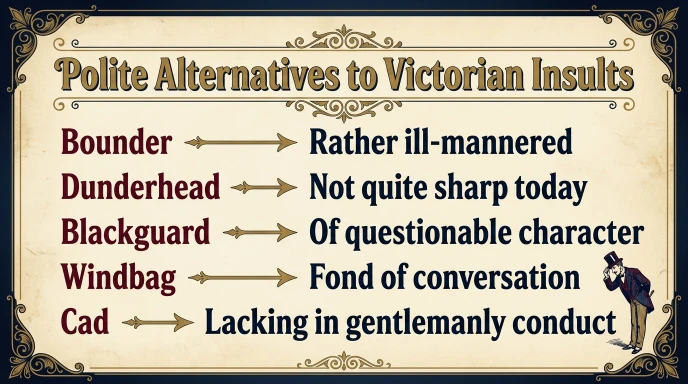
You can preserve the humor of Victorian language without making someone feel attacked.
Consider these alternatives:
- Instead of nincompoop, say “That was a silly mistake.”
- Instead of bounder, say “That behavior was rather rude.”
- Instead of cad, say “He acted dishonorably.”
- Instead of scoundrel, say “That person was dishonest.”
- Instead of popinjay, say “He seems rather full of himself.”
- Instead of wet blanket, say “You’re not very enthusiastic about this.”
- Instead of blockhead, say “I think you’ve misunderstood the situation.”
These alternatives focus on specific actions rather than labeling someone’s entire character.
Why Do People Still Enjoy Victorian Slang Insults?
Victorian slang remains appealing because it combines humor, history, and expressive language.
They Make Writing More Interesting
Authors can use words such as rapscallion, bounder, and scapegrace to create memorable characters. These expressions help establish a historical atmosphere without requiring lengthy explanations.
They Offer Alternatives to Modern Profanity
Some people prefer clever, old-fashioned insults because they sound less vulgar than modern swear words. Their exaggerated style can make a complaint entertaining rather than aggressive.
However, the effect depends on context. A word like blackguard may still sound deeply insulting.
They Help People Explore History
Learning old expressions offers insight into the language, social expectations, and humor of earlier generations. It can also help readers understand historical novels and period dramas.
They Work Well in Creative Content
Victorian insults can add personality to:
- Historical fiction and dialogue
- Comedy sketches and scripts
- Social media captions
- Tabletop role-playing games
- Costumes and themed parties
- Educational content about English vocabulary
Using them accurately is more effective than adding old-fashioned words randomly.
FAQs:
What Are Some Rude Victorian Slang Terms?
Rude Victorian slang terms include “blighter,” “scoundrel,” “reprobate,” “ruffian,” and “charlatan.” They were used to call someone dishonest, ill-mannered, or morally rotten without using a single vulgar word.
- Blighter: an annoying or contemptible man
- Scoundrel: a person with no honour or principles
- Reprobate: someone with immoral, shameless habits
- Ne’er-do-well: a lazy person who never amounts to anything
- Ruffian: a violent, rough character
- Cur: a cowardly, low-bred fellow, borrowed from the word for a mongrel dog
- Charlatan: a fraud who pretends to have skill or knowledge
- Mountebank: a smooth-talking trickster, often a fake doctor selling cures
- Pettifogger: a petty lawyer who argues over trivial details
- Hooligan: a rowdy street troublemaker, a term that spread in London in the 1890s
- Humbug: a fraud or sham, made famous by Ebenezer Scrooge in Charles Dickens’s A Christmas Carol (1843)
What Are Some 1800s Insults?
Popular 1800s insults mocked intelligence, vanity, and laziness. Common examples are “dolt,” “simpleton,” “popinjay,” “coxcomb,” and “windbag,” all of which show how Victorian society judged people by wit, manners, and class.
Foolish insult:
- Dolt: a slow, foolish person
- Simpleton: someone easily fooled
- Blockhead: a person with a head “as thick as wood”
- Muttonhead: a dull, dim-witted person
- Dullard: someone painfully boring and slow to learn
- Bumpkin: an unsophisticated country person
Vain and pompous Insults:
- Coxcomb: a conceited, showy man
- Fop: a man obsessed with his clothes and looks
- Windbag: someone who talks endlessly and says nothing
- Fusspot: a person who complains over small things
Insults for the idle:
- Sluggard: a habitually lazy person
- Gudgeon: a gullible person who falls for anything
Together with classics like bounder, cad, blackguard, dunderhead, and guttersnipe, that already gives you well over 30 clever Victorian-era put-downs.
What Were Cuss Words in the Victorian Era?
Victorian cuss words were much milder than modern swearing. People used “damn,” “bloody,” “blast,” “drat,” and “confound it,” while strong language was considered shocking in polite company, and many writers replaced it with dashes like “d___n.”
Because of strict etiquette, Victorians often relied on softened oaths:
- Drat it! a mild way to say “damn it”
- Blast! an exclamation of annoyance
- Confound it! a polite expression of frustration
- Dash it all! a “safe” replacement for stronger words
- Bloody: considered quite offensive in the 1800s, unlike today’s casual use in Britain
What Are Some Common Victorian Slang Phrases?
Common Victorian slang phrases include “gone to pot,” “bob’s your uncle,” “dressed to the nines,” “taking the biscuit,” and “hold your horses.” Many are still used in British English today.
- Bob’s your uncle: and there you have it, everything is sorted
- Dressed to the nines: wearing your very best clothes
- Hold your horses: be patient and wait
- Gone to pot: something has been ruined or has declined
- Bits and bobs: small, random items
- Spend a penny: a polite way to say you need the toilet, linked to pay toilets introduced at the Great Exhibition of 1851 in London
How Do You Say “Sorry” in Victorian English?
In Victorian English, people said “I beg your pardon,” “pray forgive me,” “my sincerest apologies,” or “I humbly ask your forgiveness.” These phrases showed good manners and respect, especially across social classes.
Examples in a sentence:
- “I beg your pardon, madam, I did not see you there.”
- “Pray forgive my clumsiness, sir.”
- “Please accept my deepest apologies for the inconvenience.”
What Are Some Hilarious British Phrases?
Some of the funniest British phrases are “taking the mickey,” “reckless as a brush,” “gobsmacked,” “faffing about,” and “knackered.” They sound quirky to outsiders, and many descend from older slang traditions that grew from Victorian street talk.
- Taking the mickey: teasing or making fun of someone
- Ignirant as a brush: extremely silly
- Gobsmacked: completely astonished
- Faffing about: wasting time on trivial things
- Knackered: utterly exhausted
Why Victorian Insults Still Feel So Funny Today?
Part of the charm is the contrast: the words are elegant, but the meaning is brutal. Writers like Charles Dickens and the satirical magazine Punch (founded in 1841) helped popularise this style, and period slang dictionaries recorded how everyday Londoners really talked. Today, these insults are popular with fiction writers, history fans, and anyone who wants a smarter way to say “you fool.”
Conclusion
Victorian slang insults reveal how English speakers used humor, wit, and colorful vocabulary to criticize foolishness, bad manners, dishonesty, and troublesome behavior. Expressions such as nincompoop, bounder, cad, scoundrel, and rapscallion remain useful examples of the language associated with nineteenth-century Britain.
Some insults are mild and playful, while others communicate serious disapproval. Their meanings also depend on context, tone, and the relationship between the speaker and listener.
r you are writing historical fiction, exploring old English vocabulary, creating entertaining social media posts, or simply learning something new, Victorian slang insults offer plenty of memorable expressions to discover.
The key is to use them thoughtfully. A clever old-fashioned phrase can make people smile, but the right word in the right context is always more effective than an insult chosen simply to offend.
Additional Resources!

I am Alisha Abbas, a slang expert and language enthusiast specializing in modern slang, internet expressions, and everyday language trends. I study the meanings, origins, and cultural influences behind slang words to make them easy to understand for readers. My work focuses on exploring how language evolves and helping people communicate better in today’s fast-changing digital world.