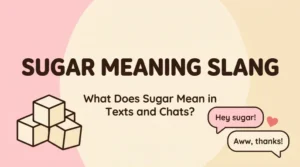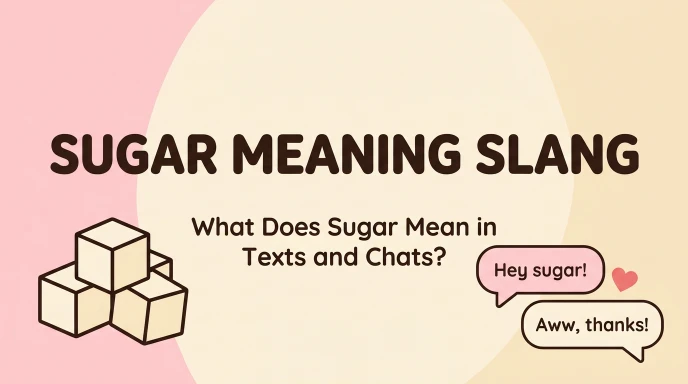
In slang, sugar is most often an affectionate nickname like “sweetie” or “darling,” but it can also mean a kiss, a mild exclamation, or a gift-giving relationship as in “sugar daddy.”
Sugar sounds like a simple word, yet its meaning shifts with who says it and where. A warm “hey, sugar” from a waitress in the American South means something very different from a headline about a sugar baby.
As a term of endearment, it works like honey or sweetheart, and Southern speakers also say “give me some sugar” to ask for a kiss or a hug. In films and sitcoms, characters use “oh, sugar!” as a polite stand-in for a curse word.
Online and in dating talk, sugar appears in sugar daddy, sugar mama and sugar baby, which describe relationships built around gifts or financial support. In some drug-related slang, it can also point to certain illegal substances, so context matters.
This guide breaks down each meaning with simple examples and the clues that help you tell them apart. You will also learn when the word can sound outdated, flirtatious or inappropriate.
Quick Answer:
In slang, sugar can be a term of affection, a friendly nickname, a euphemism, or part of expressions such as “sugar daddy.” Its exact meaning depends on the context and tone.
Sugar Slang Full Form and Definition
Does Sugar Have a Slang Full Form?
Sugar does not have a standard slang full form. It is a normal English word, not an acronym or abbreviation. Its slang meanings developed from the literal idea of sweetness and gradually became associated with kindness, affection, attractiveness, and pleasant behavior.
People may use “sugar” in expressions such as:
- “Hey, sugar!”
- “Thanks, sugar.”
- “Sweet as sugar.”
- “Sugarcoat it.”
- “Sugar daddy.”
- “Sugar baby.”
- “Sugar mama.”
These expressions do not all have the same meaning.
Common Meanings of Sugar
| Expression | Meaning | Typical Tone |
| Sugar | Sweet or affectionate nickname | Friendly |
| Hey, sugar | Friendly or affectionate greeting | Casual |
| Sugarcoat | Make something sound less harsh | Neutral |
| Sugar daddy | Person providing financial support in a relationship | Context-dependent |
| Sugar baby | Person receiving financial support in such a relationship | Context-dependent |
| Sugar mama | Female equivalent of sugar daddy | Context-dependent |
So, if someone asks “what does sugar stand for?”, there is no single expanded form. The intended meaning comes from the phrase and situation.
Is Sugar Slang Rude, Offensive, or Neutral?
Is Sugar a Bad Word?
Usually, sugar is not rude or offensive. In many situations, it is a warm and friendly word.
For example:
“Thank you, sugar!”
may be a kind way of showing appreciation.
However, the word can feel different depending on who uses it and who receives it. Some people may find terms such as “sugar” overly familiar, especially when used by a stranger.
The phrase can also become sensitive when it appears in expressions related to relationships or money.
Tone Can Change the Meaning
| Example | Meaning | Tone |
| “Thanks, sugar.” | Affectionate thanks | Warm |
| “Hey, sugar!” | Friendly greeting | Casual |
| “Don’t sugarcoat it.” | Don’t make it sound nicer than it is | Direct |
| “She’s his sugar baby.” | Relationship involving financial support | Sensitive |
| “He is a sugar daddy.” | Financially supportive relationship role | Context-dependent |
The word itself is generally harmless, but context, relationship, and tone matter.
Where Is Sugar Slang Commonly Used?
Everyday Conversations
“Sugar” can be used as a term of affection in everyday speech.
Examples include:
- “How are you, sugar?”
- “Come here, sugar.”
- “Thanks, sugar.”
- “Are you okay, sugar?”
This type of usage is more common in some regional varieties of English than others.
Texting and Social Media
On social media, people may use “sugar” as a cute or affectionate nickname.
For example:
“Good morning, sugar!”
or:
“Thanks for helping me, sugar!”
In online conversations, however, you should consider if the other person is comfortable with affectionate language.
Relationships
The word appears frequently in relationship-related phrases such as:
- Sugar daddy
- Sugar mama
- Sugar baby
These expressions have specific meanings and should not automatically be treated as simple terms of affection.
Southern and Regional English
In some parts of the United States and other English-speaking communities, sugar can be used as a warm form of address. It may be similar to words such as “dear,” “honey,” or “sweetheart.”
This does not necessarily indicate a romantic relationship.
Real-Life Examples of Sugar Slang
Friendly Example
“Thanks for helping me, sugar!”
Here, sugar is simply an affectionate or friendly nickname.
Casual Example
“Hey, sugar, how’s your day going?”
The speaker is using sugar as a warm form of address.
Romantic Example
“Good night, sugar. Sleep well.”
Here, sugar may be a romantic term of affection.
Argumentative Example
“Don’t sugarcoat the truth. Just tell me what happened.”
In this sentence, sugar has a completely different meaning. Sugarcoat means to make something unpleasant sound less serious or harsh.
Social Media Example
“Morning, sugar! Hope you have an amazing day.”
This is a casual and affectionate online greeting.
Gaming Example
“Nice job, sugar! You carried the whole team.”
Here, sugar is simply being used as a playful nickname. The exact tone depends on the relationship between the players.
What Does “Sugarcoat” Mean in Slang?
Meaning of Sugarcoat
One of the most common figurative expressions involving sugar is sugarcoat.
To sugarcoat something means to make an unpleasant, difficult, or negative situation sound more pleasant than it really is.
For example:
“Don’t sugarcoat the results.”
This means:
“Tell me the truth without making it sound better than it is.”
Another example is:
“She sugarcoated the bad news.”
This means she presented the bad news in a softer or less upsetting way.
Sugarcoat vs Be Honest
| Expression | Meaning | Tone |
| Sugarcoat it | Make something sound less harsh | Informal |
| Be honest | Give the truth directly | Neutral |
| Be blunt | Speak very directly | Strong |
| Soften the message | Make something easier to hear | Neutral |
| Hide the truth | Prevent someone from knowing the facts | Negative |
Sugarcoating is not always dishonest. Sometimes people soften difficult information to be considerate. However, excessive sugarcoating can make important facts unclear.
Origin and Background of Sugar Slang
How Did Sugar Become a Term of Affection?
The literal meaning of sugar is connected with sweetness. Over time, sweetness became a metaphor for pleasant personality, kindness, affection, and attractiveness.
This is similar to expressions such as:
- Sweetheart
- Sweetie
- Honey
- Sweetie pie
People began using words associated with sweetness as affectionate names for others.
The figurative use of sugar therefore developed naturally from the idea that someone can be “sweet” in personality or behavior.
This also helps explain the expression sugarcoat. Something covered in sugar sounds more pleasant than something harsh or bitter, so the word became a metaphor for making unpleasant information easier to accept.
Sugar vs Similar Slang Terms
Common Terms of Affection
| Term | Common Meaning | Tone |
| Sugar | Affectionate nickname | Warm/Casual |
| Honey | Term of affection | Warm |
| Sweetie | Friendly or affectionate name | Casual |
| Sweetheart | Affectionate name | Warm |
| Babe | Romantic or friendly nickname | Casual |
| Dear | Affectionate or polite form of address | Neutral/Warm |
These words can overlap, but they are not always interchangeable.
For example, “dear” can sound polite and traditional, while “babe” is more strongly associated with romantic or casual relationships.
Sugar vs Honey and Sweetheart
How Are They Different?
Sugar, honey, and sweetheart can all be terms of affection, but the social meaning depends on the speaker and situation.
“Sugar” can sound playful or regional.
“Honey” is widely used as an affectionate nickname and can sometimes be used toward someone without a romantic relationship.
“Sweetheart” usually sounds more openly affectionate, although it can also be used by older speakers when addressing someone kindly.
| Word | Common Use | Possible Interpretation |
| Sugar | Friendly or affectionate | Warm/playful |
| Honey | Affectionate or familiar | Warm |
| Sweetheart | Affectionate | Caring |
| Babe | Romantic or casual | Familiar |
| Dear | Polite or affectionate | Formal/warm |
Sugar Daddy, Sugar Baby, and Sugar Mama
What Does Sugar Daddy Mean?
Sugar daddy is an informal term for a person, traditionally a man, who provides money, gifts, or financial support to another person in a relationship or arrangement.
The term has a specific social and relationship meaning, so it should not be confused with the simple affectionate use of “sugar.”
What Does Sugar Baby Mean?
A sugar baby is a person who receives financial support, gifts, or other benefits from a sugar daddy or sugar mama under a particular relationship arrangement.
The details and expectations of these relationships vary.
What Does Sugar Mama Mean?
A sugar mama generally refers to a woman who provides financial support to a younger or financially dependent partner.
These terms are often used casually online, but they can carry different implications depending on the conversation.
When Should You Avoid Using Sugar Slang?
With Strangers
Calling a stranger “sugar” may feel overly personal to some people.
For example, saying:
“Here you go, sugar.”
could sound friendly in one community but inappropriate or patronizing in another.
In Professional Communication
Avoid affectionate slang in formal emails, business reports, job applications, and official communication.
Instead of:
“Thanks, sugar!”
use:
“Thank you for your help.”
This is clearer and more professional.
When Discussing Relationships
Be careful with terms such as sugar daddy and sugar baby. They have specific meanings and can easily create misunderstandings if used incorrectly.
Polite Alternatives to Sugar Slang
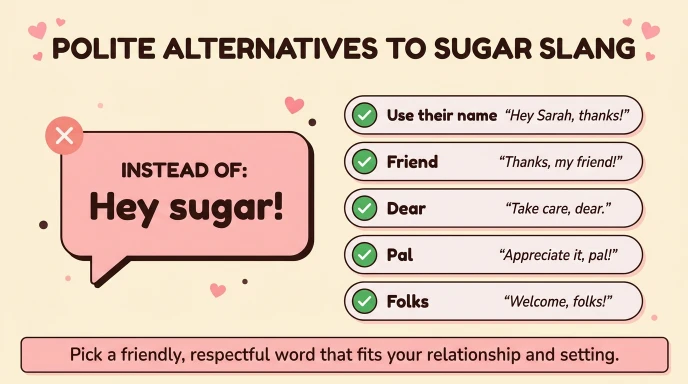
Better Words for Different Situations
If you want to sound friendly without being overly familiar, consider alternatives such as:
- Thank you
- Dear
- Friend
- My friend
- Everyone
- Sweetie
- Kindly
- I appreciate your help
For professional communication, simple words are usually best.
Instead of:
“Can you help me, sugar?”
you could say:
“Could you please help me?”
The second version is appropriate for almost any professional situation.
Why Do People Use Sugar Slang?
It Shows Affection
People often use sugar because it sounds warm and caring.
A person may say:
“Good morning, sugar.”
to make the greeting feel more personal.
It Creates a Friendly Atmosphere
Affectionate nicknames can make conversations feel relaxed and welcoming.
It Reflects Regional Culture
Some communities use words like “sugar,” “honey,” and “darling” much more frequently than others. Someone unfamiliar with that culture may interpret the expression as romantic when it is actually just friendly.
It Adds Personality
Using a nickname instead of someone’s name can make a message feel more personal and expressive.
Impact of Sugar Slang in Communication
Positive Effects
Sugar slang can make communication:
- Warm
- Friendly
- Personal
- Playful
- Affectionate
- Less formal
Possible Negative Effects
However, it can also create confusion.
Some people may interpret “sugar” as flirtatious or romantic. Others may consider it too familiar, especially when used by a stranger.
This is why relationship and cultural context matter.
A phrase that sounds perfectly normal between close friends may sound inappropriate in a workplace.
Is Sugar Slang Safe for Social Media?
Can You Use Sugar on Social Media?
Yes, ordinary uses of sugar are generally fine on social media.
For example:
“Good morning, sugar!”
or:
“Thanks, sugar! You’re the best.”
These are normal affectionate expressions when used appropriately.
However, terms such as sugar daddy and sugar baby have specific relationship meanings. If you use them publicly, make sure the context is clear.
Also remember that social media audiences can be broad. A word intended as a joke or affectionate nickname may be interpreted differently by people from other cultures or age groups.
How to Understand Sugar Meaning in Text
Context Is the Key
The easiest way to understand sugar meaning slang is to look at the entire sentence.
Consider these examples:
“Thanks, sugar!”
Meaning: An affectionate or friendly thank-you.
“Don’t sugarcoat the truth.”
Meaning: Don’t make the truth sound nicer than it is.
“He’s looking for a sugar daddy.”
Meaning: Refers to a specific type of financially supported relationship.
“She called everyone sugar.”
Meaning: She uses sugar as a general friendly form of address.
The same word can therefore produce very different meanings.
FAQs
What Is Sugar a Slang For?
Sugar is mostly slang for an affectionate nickname, like “sweetie” or “darling.” It can also mean a kiss or a hug (“give me some sugar”), a mild stand-in for a curse word (“oh, sugar!”), and part of dating terms like sugar daddy and sugar baby. In some drug-related slang, it points to certain illegal substances, so context matters.
What Are 5 Other Names Used for Sugar?
On food labels, sugar often hides behind names like sucrose, glucose, fructose, dextrose and maltose. Many added sugars also appear as syrups, molasses, malts, agave nectar, maltodextrin or juice concentrate, and a handy clue is that many sugar names end in “ose.” If you mean sugar as a pet name, common alternatives are honey, sweetie, babe, darling and sweetheart.
What Does “Sugar Girl” Mean?
“Sugar girl” usually means a sugar baby, a young woman in a relationship where an older, wealthier partner gives gifts or financial support. Less often, it is simply a sweet nickname for a girl, similar to “sweetheart.” The setting is the best clue: on dating sites it refers to the arrangement, while in casual chats it is more likely an endearment.
What Does Sugar Mean in Texting?
In texting, sugar is usually a sweet, flirty or friendly nickname, like “hey, sugar.” It is especially common among speakers from the American South. Some people also write “sending sugar” to mean kisses or affection, and “oh, sugar” works as a polite exclamation instead of a stronger word.
What Does “Sugar Code” Mean in Slang?
“Sugar code” has no widely recognized slang meaning, so it is better not to assume one. In science, the term comes from glycobiology, where it describes how sugar chains carry biological information, an idea compared to the genetic code. In nutrition circles, people sometimes use “code names for sugar” to mean the many different words that hide added sugar on labels. If you see it in a chat, the surrounding conversation will usually reveal which of these ideas the writer has in mind.
What Does Sugar Mean in a Relationship?
In a relationship, sugar can be a pet name, a way to ask for affection, or a label for a sugar dating arrangement. As a pet name, it works like honey or babe, and “give me some sugar” means a kiss. In sugar relationships, one partner (the sugar daddy or sugar mama) offers money or gifts, and the other (the sugar baby) offers companionship. Arrangements vary widely, so it helps to talk openly about expectations from the start.
Conclusion
The sugar meaning slang can change significantly depending on the sentence, relationship, and situation. In many everyday conversations, sugar is simply a warm and affectionate nickname similar to “honey,” “sweetie,” or “dear.”
However, the word can also appear in expressions such as sugarcoat, sugar daddy, sugar baby, and sugar mama, each of which has a different meaning. This is why context is essential when interpreting sugar in a text message or social media post.
There is no official sugar slang full form because sugar is not an acronym. Its informal meanings developed from the idea of sweetness and gradually became associated with kindness, affection, and pleasant behavior.
Overall, sugar is usually neutral or positive, but it can feel overly personal when used with strangers or in professional settings. If you are unsure if someone will appreciate the nickname, using a person’s name or a simple polite expression is safer.
When you encounter sugar meaning slang in text, always look at the complete sentence and consider the relationship between the people involved. Context, tone, and culture are the most important factors for understanding what “sugar” really means. :::

I am Alisha Abbas, a slang expert and language enthusiast specializing in modern slang, internet expressions, and everyday language trends. I study the meanings, origins, and cultural influences behind slang words to make them easy to understand for readers. My work focuses on exploring how language evolves and helping people communicate better in today’s fast-changing digital world.