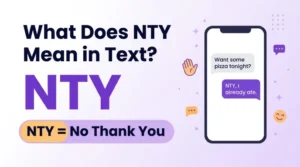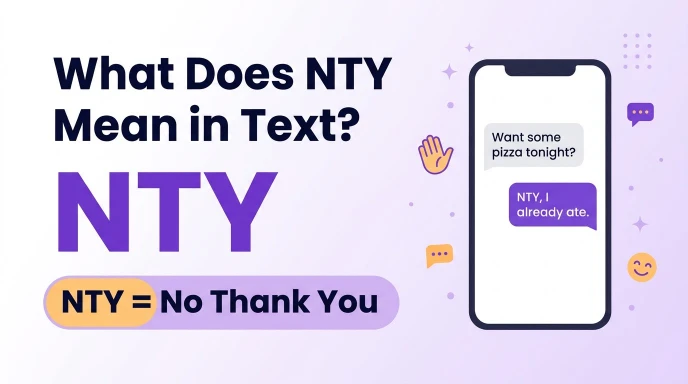
NTY in text means “no thank you,” a quick and polite way to decline an offer, invitation, or suggestion in chats.
NTY means “No, Thank You” in text messages and online conversations. People use it to politely decline an offer, invitation, or suggestion without writing a full sentence. You may see NTY on TikTok, Snapchat, Instagram, WhatsApp, and in everyday text messages.
If someone sends you NTY, they are usually saying that they do not want something. The abbreviation can sound polite, casual, or slightly distant, depending on the conversation and how the other person uses it.
Internet slang often makes conversations faster and easier. Instead of typing “No, thank you,” someone can simply write NTY and move on with the conversation.
In this guide, you will learn what NTY means, how people use it on different social media platforms, how to reply to it, and how to tell if it sounds friendly or rude. You will also find realistic chat examples to help you understand its meaning in everyday situations.
Quick Answer:
NTY stands for “no thank you.” People use it in texts, DMs, and social media chats to politely turn down an offer, invitation, or suggestion, for example: “Want to join us tonight?” → “NTY, I’m staying in.”
1. NTY Meaning in Text
NTY stands for “No, Thank You.” It is a common abbreviation used in digital communication when someone wants to decline an offer, invitation, request, or suggestion.
For example, imagine that a friend asks if you want to borrow their headphones. If you already have your own, you might reply, “NTY, I’m good.”
This response means that you appreciate the offer but do not need the headphones.
What Type of Abbreviation Is NTY?
NTY is an internet abbreviation rather than a traditional word. It is formed from the first letters of “No” and “Thank” and the letter Y from “You.”
People use it because typing a few letters is quicker than writing the entire phrase. Like IDK, BRB, and IMO, it belongs to the wider collection of abbreviations used in online conversations.
Although NTY is sometimes described as slang, it is more accurately an abbreviation of an everyday English expression. Its meaning is not especially complicated or exclusive to younger internet users.
What Does NTY Mean in Everyday Chat?
In most conversations, NTY is a simple way to say no while acknowledging the other person’s offer.
Here are a few examples:
- “Want some pizza?”: “NTY, I already ate.”
- “Do you need help with your homework ?”: “NTY, I’ve finished it.”
- “Want to join our game?”: “NTY, maybe tomorrow.”
- “Would you like another coffee?”: “NTY, I’m full.”
Notice that NTY does not automatically mean the person is upset or annoyed. They might simply have a different preference or be busy at the moment.
The context matters. A short response such as “NTY” may feel perfectly normal between friends, while the same response in a sensitive conversation could seem a little cold.
Does NTY Always Mean No, Thank You?
In ordinary texting and social media conversations, “No, Thank You” is the most common interpretation of NTY.
However, abbreviations can occasionally have different meanings in specialized communities, private jokes, or professional settings. If the surrounding conversation does not involve an offer or invitation, it is worth considering the context before assuming what the sender means.
For everyday messaging, though, understanding NTY as “No, Thank You” is generally the safest starting point.
2. Where Do People Use NTY?
NTY can appear on almost any platform that allows people to send short messages. Its purpose remains similar across apps, although the tone may change depending on the conversation.
NTY on TikTok
On TikTok, NTY may appear in comments, direct messages, or conversations about videos and trends.
For example, someone might recommend a particular product or invite another user to participate in a trend. The other person could respond with “NTY” to decline.
Example:
“Try this challenge with me!”
“NTY lol, I’m too shy.”
Here, the abbreviation communicates a friendly refusal. The addition of “lol” makes the message sound more relaxed, although the exact tone depends on the relationship between the users.
TikTok comments are often brief, so abbreviations can help people express their reactions without writing lengthy responses.
NTY on Snapchat
Snapchat conversations are often casual and fast-paced, making short abbreviations convenient.
A friend might ask if you want to meet up, send a picture, or join a group activity. If you are not interested, you could answer with NTY.
Example:
“Wanna come over later?”
“NTY, I have plans tonight.”
The message is straightforward and gives a simple reason for declining.
On Snapchat, NTY may also appear without punctuation or additional explanation. That does not necessarily indicate anger. Some people naturally prefer short messages.
NTY on Instagram
Instagram users may use NTY in direct messages, comments, or conversations about recommendations and invitations.
For example, a friend might send you a message asking if you want to attend an event. If you cannot go or simply do not want to attend, NTY can be an easy response.
Example:
“There’s a party this weekend. You coming?”
“NTY, I’m staying home this time.”
It can also appear in conversations about suggested posts, online trends, or products. As with other platforms, the meaning usually becomes clear from the surrounding messages.
NTY on WhatsApp
WhatsApp is commonly used for personal chats, family groups, school discussions, and workplace communication.
In private conversations with friends, NTY is a convenient way to turn down an offer without sounding overly formal.
Example:
“Should I order you a burger too?”
“NTY, I’ve already had dinner.”
In family or group chats, a slightly longer answer may sometimes be clearer, especially if the other person needs to make arrangements.
For example, “No, thank you! Please order without me” communicates the decision more completely than NTY alone.
NTY in SMS Text Messages
NTY also works in regular SMS conversations. Unlike platform-specific expressions, it does not depend on a particular social media app.
Someone might use it when responding to a dinner invitation, an offer of help, or a suggestion from a friend.
Example:
“Need a ride home?”
“NTY, my brother is picking me up.”
SMS messages can be more practical than social media comments, so adding a short explanation can help avoid confusion.
The main point is that NTY has the same basic meaning across TikTok, Snapchat, Instagram, WhatsApp, and traditional texting: the sender is declining something.
3. Real Chat Examples of NTY
The easiest way to understand an abbreviation is to see how people use it in natural conversations. Here are ten realistic examples covering different situations.
Example 1: Declining Food
A: I’m ordering pizza. Want some?
B: NTY, I already ate.
A: Okay, no problem.
Meaning: B does not want pizza because they have already eaten.
Example 2: Turning Down an Invitation
A: Wanna go shopping with us tomorrow?
B: NTY, I need to finish some work.
A: Maybe next time!
Meaning: B politely declines the invitation and explains why.
Example 3: Refusing Help
A: Do you want me to help you with that assignment?
B: NTY, I think I can handle it.
A: Cool, let me know if you need anything.
Meaning: B appreciates the offer but prefers to work independently.
Example 4: Declining a Game Invitation
A: Join our game tonight!
B: NTY, I’m tired today lol.
A: All good, rest up.
Meaning: B is not interested in playing at that moment.
Example 5: Responding to a Product Suggestion
A: You should buy these shoes. They’re really nice.
B: NTY, I’m saving my money.
A: Fair enough.
Meaning: B does not want to buy the shoes, possibly because of their budget.
Example 6: Turning Down a Drink
A: Want some coffee?
B: NTY, tea is fine.
A: Sure, I’ll make some tea.
Meaning: B declines coffee but suggests an alternative.
Example 7: Declining a Last-Minute Plan
A: We’re going out in ten minutes. Coming?
B: NTY, I’m already in bed.
A: Haha, maybe tomorrow.
Meaning: B does not want to join because they are already settling down for the night.
Example 8: Responding to Repeated Suggestions
A: Come on, just try it once.
B: NTY, I’m really not interested.
A: Okay, I won’t push it.
Meaning: B is firmly declining. The wording makes it clear that the decision should be respected.
Example 9: A Friendly Conversation
A: Want me to save you a seat?
B: NTY, I’ll sit with Sara.
A: Okay, see you there.
Meaning: B does not need the reserved seat because they have another arrangement.
Example 10: Declining an Online Offer
A: I can send you my notes if you want.
B: NTY, I’ve got everything already. Thanks though!
A: No worries.
Meaning: B declines the offer while expressing appreciation.
These examples show that NTY does not have one fixed emotional tone. It can be friendly, practical, casual, or firm. The words around it usually help explain the sender’s intention.
4. How to Reply When Someone Says NTY
If someone sends you NTY, you usually do not need to make a big deal out of it. They are most likely declining an offer, so the simplest response is to acknowledge their decision.
Your reply can depend on if you are chatting with a close friend, talking to someone you do not know well, or handling a more formal situation.
Funny Replies
If you and the other person joke around regularly, a playful response may fit the situation.
Examples:
- “Okay, more for me 😂”
- “Your loss lol.”
- “Fine, I’ll enjoy it myself.”
- “Haha, offer expires in five seconds!”
- “No worries, I’ll ask again in 2030.”
Use these responses only when the relationship makes joking appropriate. A person who is setting a serious boundary may not appreciate a joke about their refusal.
Casual Replies
Casual replies work well in everyday conversations with friends and classmates.
Examples:
- “Okay, no problem.”
- “All good.”
- “Sure thing.”
- “That’s fine!”
- “Cool, maybe next time.”
These messages acknowledge the answer without making the conversation awkward.
Friendly Replies
If someone declines an invitation or offer, you can respond warmly to show that you understand.
Examples:
- “No worries, hope you have a good day!”
- “That’s okay. We can do it another time.”
- “Thanks for letting me know.”
- “Anytime if you change your mind.”
- “All good, take care!”
A friendly reply can keep the conversation comfortable even when the other person is not interested in your suggestion.
Neutral Replies
Sometimes a simple, direct answer is best, especially if you are communicating with a colleague, acquaintance, or someone you do not know well.
Examples:
- “Understood.”
- “Okay, thanks.”
- “No problem.”
- “Got it.”
- “That’s fine.”
Neutral responses are useful when you want to acknowledge the message without adding unnecessary emotion.
Should You Ask Why They Said NTY?
Not usually. If someone declines an offer, they are not necessarily required to explain their decision.
If the reason matters for making plans, you can ask politely. For example, “No problem. Would another day work better?” gives the other person room to respond without pressuring them.
If they seem uninterested or do not continue the conversation, it is usually best to respect their answer and move on.
5. Is NTY Rude or Offensive?
NTY is generally not considered rude or offensive. Since it stands for “No, Thank You,” it can be a polite way to decline an offer.
However, a message’s tone depends on more than its abbreviation. The relationship between the people, the subject being discussed, and the surrounding words can all influence how the message is understood.
When NTY Sounds Polite
NTY often sounds polite when someone is declining a simple offer.
For example:
“Would you like another slice of cake?”
“NTY, thank you!”
The response communicates that the person does not want more cake while acknowledging the offer.
Adding a reason or a friendly phrase can make the message feel warmer.
When NTY Might Sound Rude
If someone replies with only “NTY” to a thoughtful invitation or a sensitive question, the recipient might interpret the message as distant or dismissive.
For example, a friend could spend time arranging an outing and receive only “NTY” in response. The friend might wonder if something is wrong, especially if the sender normally writes longer messages.
That does not automatically mean the sender intended to be rude. They may be busy, distracted, or simply accustomed to short messages.
If you are unsure how a message was meant, consider the broader conversation instead of judging it from three letters alone.
Is NTY Safe to Use?
Yes. NTY is generally safe to use in ordinary conversations because it does not contain an insult or offensive expression.
It is especially suitable for casual situations in which a short response is enough.
Still, clarity matters. If you are turning down something important, such as a formal invitation or a professional opportunity, a complete sentence may communicate your decision more respectfully.
Can You Use NTY at School or Work?
Among friends and classmates, NTY is usually fine.
In school assignments, formal emails, job applications, or professional messages, it is better to write “No, thank you” in full. Standard language is generally clearer and more appropriate in formal settings.
For example, instead of replying to a teacher with “NTY,” you could write, “No, thank you. I appreciate the offer.”
The longer response sounds more considerate and avoids any uncertainty about your intended tone.
6. Who Uses NTY?
NTY is used by people who communicate through digital messages, including teenagers, university students, working adults, and other internet users.
It is not limited to one age group. Anyone familiar with common texting abbreviations may recognize it.
Is NTY Popular Among Gen Z?
Gen Z users often communicate through a mix of abbreviations, emojis, memes, and short expressions. NTY fits naturally into that style because it is quick to type and easy to understand.
However, it would be inaccurate to say that every Gen Z user frequently uses NTY. Some people prefer full sentences, while others use different abbreviations depending on their habits and social circles.
The popularity of any particular expression also varies across countries, languages, and online communities.
Do Millennials and Older Adults Use NTY?
Yes, they may use it too. People who regularly text or participate in online communities can become familiar with internet abbreviations regardless of age.
Some users might prefer NTY because they are accustomed to concise messages. Others might choose “No thanks,” “No, thank you,” or another familiar expression instead.
The abbreviation is not exclusive to young people.
Where Is NTY Most Commonly Seen?
You may encounter NTY in:
- Private messages between friends.
- Social media comments and replies.
- Group chats about plans or activities.
- Conversations about food, shopping, and recommendations.
- Online communities where short messages are common.
There is no single reliable measure that establishes exactly how often NTY appears across all these platforms. Its visibility can differ considerably between communities.
The practical takeaway is that NTY is recognizable internet shorthand, but it is not necessarily used in every conversation.
7. Origin of NTY
The exact origin of NTY is not clearly established. It is best understood as part of the broader development of abbreviations used in digital communication.
Before social media became widespread, people were already shortening everyday expressions in written messages. Text messaging encouraged concise language because early mobile phones could be cumbersome to type on, and some users wanted to keep messages short.
Abbreviations such as LOL, BRB, and IDK became familiar ways to communicate quickly. NTY follows the same general pattern by reducing a common phrase to a few letters.
How Internet Culture Influenced NTY
As texting expanded into instant messaging, chat rooms, forums, and social networks, short expressions became part of everyday online communication.
People began carrying these habits from one platform to another. An abbreviation that worked in a private text could also be used in a group chat or social media comment.
NTY fits this pattern because the phrase it represents is already familiar to most English speakers. Users do not need to learn a new concept; they only need to recognize the shortened form.
Is There a Confirmed First Use of NTY?
There is no widely established, definitive first use of NTY that can be confidently identified here.
It would be misleading to assign the abbreviation to a particular person, website, or year without reliable historical evidence.
The most reasonable explanation is that NTY developed as a convenient shorthand for an everyday expression and spread through ordinary digital communication. Its exact history remains uncertain.
8. NTY vs. IDK, IDC, IMO, and BRB
NTY belongs to the same general category of texting abbreviations as IDK, IDC, IMO, and BRB. However, these expressions serve different purposes.
The following table compares their meanings, types, uses, and general familiarity in online communication.
| Abbreviation | Meaning | Type | Usage | Popularity |
| NTY | No, Thank You | Polite refusal abbreviation | Declining an offer or invitation | Recognizable in casual chats |
| IDK | I Don’t Know | Initialism | Expressing uncertainty or a lack of knowledge | Very widely recognized |
| IDC | I Don’t Care | Initialism | Expressing indifference | Widely recognized; tone can be blunt |
| IMO | In My Opinion | Initialism | Introducing a personal opinion | Widely recognized in online discussions |
| BRB | Be Right Back | Initialism | Telling someone you will briefly leave a conversation | Very widely recognized |
NTY vs. IDK
NTY means “No, Thank You,” while IDK means “I Don’t Know.”
Use NTY when declining something. Use IDK when you do not know the answer to a question.
Example:
A: Want to go out tonight?
B: NTY, I’m tired.
In contrast:
A: What time does the movie start?
B: IDK. Let me check.
The two abbreviations communicate entirely different things.
NTY vs. IDC
IDC stands for “I Don’t Care.” Although it may be used casually between friends, it can sound dismissive depending on the situation.
NTY usually expresses a refusal, often with an element of politeness.
For example, “NTY, I don’t need another drink” is a clear refusal. “IDC what you choose” expresses indifference about a decision and may sound blunt.
NTY vs. IMO
IMO means “In My Opinion.” People use it to introduce a personal view rather than accept or reject an offer.
Example:
“IMO, this is the best song on the album.”
NTY would not communicate the same idea because it is used to decline something.
NTY vs. BRB
BRB stands for “Be Right Back.” It tells someone that the sender is temporarily leaving the conversation.
For example, “BRB, someone is at the door” indicates a short absence.
NTY, on the other hand, communicates that the sender does not want what has been offered. Both abbreviations save typing time, but their purposes are different.
9. A Real-World Example of NTY
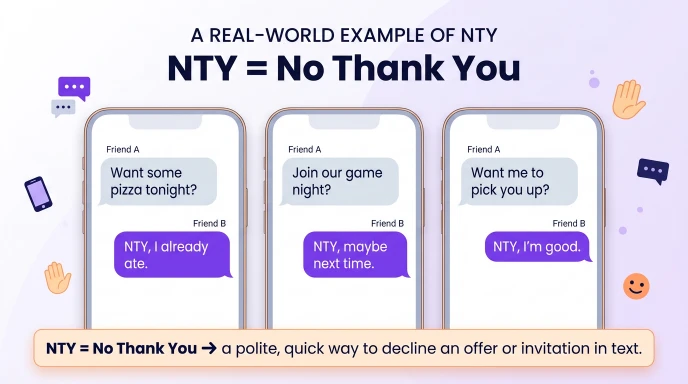
Imagine that your classmates are planning a group lunch after school.
One friend sends a message to the group chat:
“I’m getting burgers after class. Does anyone want one?”
Several classmates respond that they would like a burger. Another student has already eaten lunch and does not want anything.
Instead of writing a full explanation, the student replies:
“NTY, I already ate.”
The friend understands that no burger is needed and orders food for the others.
Later, someone offers the student some fries. The student replies, “NTY, I’m good, thanks!”
In this situation, NTY makes the conversation faster without causing confusion. It is appropriate because the discussion is informal and everyone understands the context.
Now imagine the same abbreviation being used in a formal email to a teacher who has offered an important opportunity. A short “NTY” might sound less considerate than a complete sentence.
This illustrates the main lesson: NTY works well when the situation is casual and the meaning is obvious. When the conversation requires more explanation or courtesy, using the full phrase is often the better choice.
10. Common Mistakes to Avoid When Using NTY
Although NTY is simple, a few small mistakes can make your message less clear.
Assuming NTY Means Anger
A short reply does not automatically mean someone is annoyed with you. The sender may simply be declining the offer or typing quickly.
Look at the surrounding conversation before assuming there is a problem.
Using NTY Without Enough Context
If someone asks a complicated question, replying only with NTY may leave them unsure about what you are refusing.
For example, if a friend asks if you want to change your plans, it may be clearer to say, “NTY, I’d rather keep our original plan.”
Using It in Every Situation
Abbreviations are convenient, but not every conversation benefits from them.
A formal message, a serious discussion, or an important invitation may deserve a complete response. Choose the wording that suits the situation rather than shortening everything automatically.
Forgetting That Tone Can Be Misunderstood
Text messages do not always communicate emotion clearly. A message that sounds normal to one person might seem cold to another.
Adding a few words can help. “NTY, but thanks for asking!” sounds warmer than a bare abbreviation in many situations.
Pressuring Someone After They Decline
If someone says NTY, respect their decision. Repeatedly asking them to reconsider can make a friendly conversation uncomfortable.
If the offer is important, you can ask once if they would prefer another option. Otherwise, acknowledge their answer and move on.
FAQs
What does NTY mean in text messages?
NTY means “No, Thank You.” It is a short abbreviation people use to decline an offer, invitation, or suggestion in text messages and online chats.
What does NTY mean on TikTok?
On TikTok, NTY generally means “No, Thank You.” Users may write it in comments or direct messages when turning down an invitation, recommendation, or suggestion.
Is NTY slang?
NTY is an internet abbreviation rather than a traditional slang word. It shortens the familiar phrase “No, Thank You” for convenient use in digital conversations.
Is NTY rude or offensive?
No, NTY is generally not rude or offensive. However, a very short reply may sound distant in some situations. Adding a friendly phrase can make your intention clearer.
How should you reply to NTY?
You can respond with “No problem,” “All good,” or “Maybe next time!” If the conversation is playful, a funny reply may also work. The best response is one that respects the other person’s decision.
Does NTY mean the same thing as no thanks?
Yes. In ordinary texting, NTY is a shortened form of “No, Thank You.” Both expressions are used to decline an offer or suggestion.
Should I use NTY in professional messages?
It is generally better to write “No, thank you” in full in professional emails and formal messages. This makes your response clear and maintains an appropriate tone.
Is NTY used only by Gen Z?
No. People of different ages may use NTY in text messages and online conversations. Its use depends more on individual communication habits and familiarity with internet abbreviations than on age alone.
Conclusion
NTY means “No, Thank You” in everyday texting and online communication. It is a convenient abbreviation for declining an offer, turning down an invitation, or expressing that you do not want something.
You may encounter it on TikTok, Snapchat, Instagram, WhatsApp, and in regular SMS messages. Its meaning generally stays the same across these platforms, although the tone depends on the conversation.
NTY is usually harmless and appropriate in casual chats with friends, classmates, and familiar contacts. If someone sends it to you, a simple response such as “No problem” is usually enough.
The most important thing to remember is that context matters. Use NTY when a short, informal response fits the situation, and choose the complete phrase “No, thank you” when you want to sound more formal, thoughtful, or professional.

Hi, I’m Rebecca Morris, a UK-based freelance writer and editor with a passion for creating clear, engaging, and well-researched content. I write about lifestyle, technology, travel, and consumer topics, with a focus on making complex information simple and useful for everyday readers. I enjoy producing accurate, practical, and trustworthy articles that help people make informed decisions. When I’m not writing, I love exploring the British countryside, discovering independent cafés, and staying up to date with the latest trends in digital media and online publishing