“Freaky” in Spanish slang usually translates to “friki” or “freaky,” used informally to describe someone unusual, eccentric, or obsessed with niche interests like anime, gaming, or comics.
The word “freaky” has crossed over from English into everyday Spanish conversation, especially among younger speakers and online communities. In fact, it’s a great example of how modern slang travels across languages through social media and pop culture.
In most Spanish-speaking countries, for instance, “friki” (the adapted spelling) is used similarly to how English speakers use “geek” or “nerd.” Specifically, it often describes someone deeply passionate about a specific hobby, fandom, or subculture.
However, context matters a lot. In some regions and informal settings, for example, “freaky” can also carry a flirtatious or suggestive undertone, similar to its use in English slang. As a result, the meaning shifts depending on tone, audience, and situation.
In this article, we’ll break down the different meanings of “freaky” in Spanish slang, regional variations, common usage examples, and how to understand the word correctly based on context.
Quick Answer:
In Spanish slang, freaky can mean raro, extraño, atrevido, intenso, or sexually adventurous, depending on context. There is no single Spanish translation that works in every situation.
What Does “Freaky” Mean in Spanish Slang?
Common Spanish Meanings of Freaky
The closest Spanish word depends on what the speaker means by “freaky.”
For example:
- Raro = weird or strange
- Extraño = unusual or strange
- Loco = control or wild
- Atrevido = daring or bold
- Pervertido = sexually perverted, depending on context
- Picante = spicy, suggestive, or sexually playful
- Excéntrico = eccentric or unusual
- Intenso = intense
A person might say someone is raro if they behave strangely, but atrevido may be more appropriate if “freaky” means daring or adventurous.
This is why the phrase freaky in Spanish slang needs context before you choose the correct translation.
Freaky Spanish Slang Full Form and Definition
Does Freaky Have a Spanish Full Form?
No. Freaky is not a Spanish acronym, so it does not have a traditional “full form.” It is an English adjective that has entered online conversations and popular culture in many Spanish-speaking communities.
The English word comes from freak, which can describe someone or something unusual. The ending “-y” turns it into an adjective describing a quality or characteristic.
In Spanish, the meaning is usually communicated through a different word rather than a direct translation.
| English “Freaky” Meaning | Possible Spanish Word | Meaning in English |
| Weird | Raro | Strange |
| Strange | Extraño | Unusual |
| Wild | Loco | Crazy/Wild |
| Daring | Atrevido | Bold |
| Eccentric | Excéntrico | Unusual |
| Suggestive | Picante | Spicy/Suggestive |
| Sexually adventurous | Pervertido or atrevido | Context-dependent |
The best translation depends on what the speaker intends.
Is Freaky in Spanish Rude, Offensive, or Neutral?
When Freaky Is Neutral
If “freaky” simply means strange or unusual, it may be neutral.
For example:
“Ese video está raro.”
This means:
“That video is weird.”
There is no necessarily sexual or offensive meaning.
When Freaky Can Be Suggestive
In dating, flirting, or adult conversations, freaky can describe someone who is sexually adventurous or open to unusual experiences.
In Spanish, the translation could be more suggestive depending on the words used.
For example:
“¿Eres atrevido?”
can mean:
“Are you adventurous/bold?”
A stronger word such as pervertido can sound judgmental or insulting, so it should not be used automatically as a translation.
Tone Matters
| Meaning | Spanish Example | Tone |
| Weird | Raro | Neutral |
| Strange | Extraño | Neutral |
| Wild | Loco | Casual |
| Daring | Atrevido | Casual/Positive |
| Suggestive | Picante | Playful |
| Perverted | Pervertido | Negative/Offensive |
This shows why freaky meaning slang cannot be translated correctly without understanding the situation.
Where Is Freaky Commonly Used in Spanish?
Social Media
Spanish-speaking users may use freaky in memes, captions, comments, and online conversations.
For example:
“Ese video está muy freaky.”
The speaker may mean:
“That video is really weird.”
The exact interpretation can depend on the community.
Texting
In private messages, people may use “freaky” as an English slang word even while the rest of the conversation is in Spanish.
This kind of language mixing is common online.
For example:
“Tu amigo es un poco freaky.”
The speaker may be using freaky to mean strange, unusual, or socially unconventional.
Dating and Flirting
In romantic conversations, freaky can have a more suggestive meaning.
Someone may use the word to describe a person who is adventurous or sexually open-minded.
Because this meaning is more personal, you should consider the relationship and tone before interpreting it.
Gaming and Internet Culture
Gamers and internet communities frequently borrow English slang.
Words such as:
- Freaky
- Cringe
- Random
- Weird
- Toxic
- severe
can appear in Spanish conversations without being translated.
Real-Life Examples of Freaky in Spanish Slang
Friendly Example
“Tu disfraz está muy freaky.”
Possible meaning:
“Your costume is really weird/crazy.”
The speaker may simply be complimenting how unusual the costume looks.
Casual Example
“Ese lugar está medio freaky.”
Meaning:
“That place is kind of strange.”
This is a casual description.
Flirty Example
“¿Qué tan freaky eres?”
Depending on the conversation, this could mean:
“How adventurous are you?”
It may have a romantic or sexually suggestive meaning.
Argumentative Example
“Eso es demasiado freaky para mí.”
Meaning:
“That’s way too weird for me.”
Here, the speaker is expressing discomfort.
Gaming Example
“Ese personaje está freaky.”
This may mean:
“That character looks weird or creepy.”
Social Media Example
“Este meme está súper freaky 😂”
Here, the word probably means weird, unusual, bizarre, or funny in an unconventional way.
Freaky vs Similar Spanish Slang Terms
Comparing Common Spanish Words
| Spanish Word | Basic Meaning | Possible English Equivalent |
| Raro | Strange | Weird/Freaky |
| Extraño | Unusual | Strange/Freaky |
| Loco | Crazy/Wild | Freaky/Wild |
| Atrevido | Bold/Daring | Adventurous/Freaky |
| Picante | Spicy/Suggestive | Flirty/Freaky |
| Pervertido | Perverted | Sexually inappropriate |
| Excéntrico | Eccentric | Unusual/Freaky |
These words are not perfect synonyms.
For example, raro is usually safer when you simply mean “weird.” Pervertido is much stronger and can insult someone.
Freaky vs Weird, Creepy, and Wild
How Are They Different?
English itself gives “freaky” several possible meanings.
| Word | Common Meaning | Tone |
| Freaky | Strange, unusual, wild, or sexually adventurous | Context-dependent |
| Weird | Strange or unusual | Usually neutral |
| Creepy | Uncomfortable or frightening | Negative |
| Wild | Uncontrolled, exciting, or extreme | Casual |
| Strange | Unusual or unfamiliar | Neutral |
| Kinky | Sexually unconventional | Adult/Suggestive |
Because these words overlap, the best Spanish translation depends on the exact intention.
For example, creepy is usually closer to “inquietante” or “escalofriante” than “raro,” while wild may be translated as “loco” in casual speech.
Origin and Background of Freaky
Where Did the Word Freaky Come From?
The English word freaky comes from freak, a word historically associated with something unusual, unexpected, or abnormal.
Over time, “freak” developed several meanings. It could describe someone unusually interested in a particular subject, someone unconventional, or something strange.
Modern slang expanded the meaning further. Today, freaky can describe something bizarre, unusual, creepy, exciting, or sexually adventurous.
Because English-language entertainment and internet culture have a strong international influence, the word has also appeared in Spanish-language online communication.
Why Do Spanish Speakers Use the English Word Freaky?
Internet and Pop Culture Influence
Social media, music, movies, gaming, and online communities constantly introduce English expressions to Spanish speakers.
Some English slang words become recognizable without being translated.
This can make a sentence appear as a mixture of Spanish and English, often called Spanglish or informal language mixing.
It Can Feel More Playful
Sometimes people choose “freaky” because it sounds playful or modern.
For example:
“Ese meme está freaky.”
may feel more internet-friendly than using a formal Spanish adjective.
Different Meanings Are Possible
Another reason is that “freaky” can be vague. It may describe something weird without explaining exactly why it is weird.
That ambiguity can be useful in casual conversations.
When Should You Avoid Using Freaky in Spanish?
Formal Situations
Avoid slang such as freaky in formal documents, academic writing, official emails, and professional communication unless the word is specifically relevant.
Instead, use a precise Spanish word such as:
- Raro
- Extraño
- Inusual
- Excéntrico
- Atrevido
When Talking to Someone You Do Not Know
If you describe someone as freaky, they may interpret it as an insult.
If you simply mean “unusual,” saying raro or diferente may be clearer.
In Romantic Conversations
Be particularly careful because “freaky” can have a sexual meaning in dating conversations.
Do not automatically translate it as pervertido, because that word can sound strongly negative.
Polite Alternatives to Freaky in Spanish
Choosing a Softer Word
If you want to describe something unusual without sounding insulting, consider these alternatives:
| Intended Meaning | Polite Spanish Alternative |
| Weird | Raro |
| Unusual | Inusual |
| Different | Diferente |
| Eccentric | Excéntrico |
| Strange | Extraño |
| Adventurous | Atrevido |
| Playfully suggestive | Picante |
| Uncomfortable | Incómodo |
The safest option is to select the word that accurately expresses your intended meaning rather than using “freaky” as a general description.
Why Do People Use Freaky Slang?
It Is Short and Expressive
One English slang word can communicate an idea that may require several Spanish words to explain.
It Is Common Online
Internet users regularly mix languages, particularly when discussing memes, music, gaming, fashion, and entertainment.
It Can Sound Playful
“Freaky” can sound less direct than some stronger Spanish words. Depending on the speaker, it can be humorous rather than insulting.
It Can Create Ambiguity
Sometimes people intentionally use vague slang because they do not want to explain exactly what they mean.
This is particularly common in jokes, memes, and flirting.
Impact of Freaky Slang in Communication
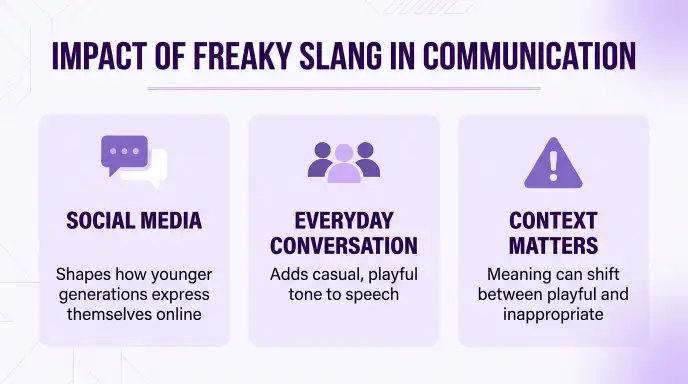
Positive Effects
Using “freaky” can make online communication:
- More casual
- More expressive
- More humorous
- More modern
- More connected to internet culture
Possible Problems
However, the word can also cause misunderstandings.
A Spanish speaker may interpret it as:
- Weird
- Strange
- Creepy
- Wild
- Sexually adventurous
- Perverted
These meanings are not identical.
Therefore, the speaker’s tone and the surrounding conversation are essential.
Is Freaky in Spanish Safe for Social Media?
Can You Use Freaky Online?
Generally, using freaky on social media is fine when the meaning is harmless, such as describing something strange, unusual, or funny.
For example:
“This meme is freaky 😂”
is usually casual and harmless.
However, the word can have a sexual meaning, especially in dating or adult conversations. If you are posting publicly, remember that different readers may interpret the word differently.
For professional or family-friendly content, clearer words such as raro, extraño, inusual, or diferente may be better choices.
How to Understand Freaky in Spanish Text
Look at the Full Sentence
Context is the most important factor.
Consider these examples:
“Ese gato está freaky.”
Likely meaning: The cat looks strange or unusual.
“Ese lugar se siente freaky.”
Likely meaning: The place feels strange, creepy, or unusual.
“¿Eres freaky?”
Possible meaning: Are you unusual, wild, adventurous, or sexually adventurous?
“Ese meme está freaky.”
Likely meaning: The meme is bizarre, strange, or funny in an unusual way.
The same word can therefore have very different meanings.
FAQs
What does “freaky” mean in Spanish slang?
In Spanish slang, “freaky” (often spelled “friki”) is commonly used to describe someone who is quirky, obsessive about niche interests, or passionately into things like anime, gaming, or comics: similar to how English speakers use “geek” or “nerd.” It’s a borrowed term that has become part of everyday informal Spanish, especially among younger generations online.
What does “freaky” mean in slang?
In general English slang, “freaky” typically describes something unusual, strange, or outside the norm. Depending on context, it can refer to someone’s eccentric personality, an odd situation, or: in more casual or adult conversations: a flirtatious, bold personality or behavior.
How do you say “freaky girl” in Spanish?
There isn’t a direct one-word translation, but common equivalents include “chica atrevida” (bold/daring girl) or “chica freaky”, which is often used informally in modern Spanish, especially influenced by English pop culture and music. The exact phrase used can vary by country and context.
What does “freaky girl” mean in slang?
In slang, “freaky girl” generally describes a woman seen as confident, adventurous, or bold : often used in a flirtatious or playful context. The term is frequently used in music and social media, where it can carry different tones depending on how it’s used.
What does “freaky” mean in Gen Z slang?
Among Gen Z, “freaky” is often used lightly to describe someone fun, unpredictable, or slightly wild in personality: not necessarily anything serious. It’s frequently used in a joking or teasing way in everyday conversations, memes, and social media captions.
What’s another word for freaky in bed?
Common alternative terms people use in casual conversation include “adventurous,” “wild,” or “bold.” These words are generally used to describe personality traits in a playful tone rather than explicit detail, and are often found in relationship or lifestyle-related content.
Conclusion
Understanding freaky in Spanish slang requires more than translating the word directly. Depending on the situation, freaky can mean strange, unusual, wild, eccentric, daring, suggestive, or sexually adventurous.
In everyday Spanish conversations, words such as raro, extraño, loco, atrevido, picante, and excéntrico may communicate different meanings of the English word “freaky.” The best choice depends on what the speaker actually intends.
There is no official freaky Spanish slang full form because the word is not an acronym. It is an English slang term that has become familiar in many Spanish-speaking online communities through social media, entertainment, gaming, music, and internet culture.
If you encounter freaky in Spanish slang in a text message, comment, meme, or dating conversation, always consider the context. A casual social media post may use it simply to mean “weird,” while a private romantic conversation could give it a much more suggestive meaning.
The safest approach is to focus on context, tone, relationship, and the surrounding words. Once you understand those details, it becomes much easier to determine what “freaky” actually means in Spanish slang. :::
Key Insights!

I am Alisha Abbas, a slang expert and language enthusiast specializing in modern slang, internet expressions, and everyday language trends. I study the meanings, origins, and cultural influences behind slang words to make them easy to understand for readers. My work focuses on exploring how language evolves and helping people communicate better in today’s fast-changing digital world.