NP stands for “no problem” in text messages, and people use it to say they are happy to help or that everything is fine.
You send a quick thank-you and the reply comes back as just two letters. That tiny reply saves time, sounds relaxed and keeps the chat moving.
Like most texting shorthand, NP has more than one meaning depending on where you see it. In online games, for example, players use it to say “nice play” after a good move.
The abbreviation fits best in casual chats with friends, family and classmates. In a formal email or a message to your boss, writing out “no problem” or “you’re welcome” is the safer choice.
In this guide, you will find clear meanings, real chat examples and tips on when to use NP and when to skip it. By the end, you will know exactly how to read it and how to reply.
Quick Answer:
NP stands for “no problem.” In texts and chats, people use it to say “you’re welcome,” “it was no trouble,” or “that’s totally fine.” It is a short, friendly reply, mostly sent after someone says thanks or sorry.
NP Meaning in Text
The most common meaning of NP in texting is “no problem.”
It is an abbreviation rather than a traditional slang word. The letters come from the first letters of No Problem. Like many texting abbreviations, it saves time and makes a reply feel quick and casual.
For example:
A: Thanks for helping me with that.
B: NP!
Here, NP means “No problem!” It tells the other person that helping them was not a burden.
You might also see it after an apology:
A: Sorry I replied so late.
B: NP, don’t worry about it.
In this case, the person is saying that the late reply is not a big deal.
What does NP stand for?
NP stands for “no problem.”
It can communicate several closely related ideas:
- No problem.
- It’s okay.
- That’s fine.
- Don’t worry about it.
- You’re welcome.
- I don’t mind.
- It’s not a big deal.
The exact feeling depends on the conversation.
For example, if someone asks, “Can you send me the notes later?” and you answer “NP,” you mean “No problem, I can do that.”
If someone says, “Sorry I forgot to call,” and you answer “NP,” you mean “It’s okay.”
If someone says, “Thanks for picking me up,” and you reply “NP,” it can work like “You’re welcome.”
Is NP a slang word?
Not exactly. NP is better described as an abbreviation used in informal communication.
It belongs to the same general family of short online expressions as IDK (“I don’t know”), IDC (“I don’t care”), and BRB (“be right back”).
People use these expressions because typing a few letters is faster than writing the complete phrase.
NP is also easy to understand because “no problem” is such a common phrase in everyday English.
What does NP mean in everyday chat?
In normal conversation, NP usually means that the speaker is relaxed about something.
Imagine that your friend asks:
“Can I borrow your charger?”
You might respond:
“NP.”
That means:
“No problem. You can borrow it.”
The abbreviation does not usually add a hidden meaning. It is mostly a short, convenient response.
One thing to remember is that context matters. Abbreviations can occasionally have different meanings in specialist communities, workplaces, games, or technical conversations. But when you are simply texting a friend, “NP” overwhelmingly refers to “no problem.”
Where People Use NP
You can find NP across many forms of digital communication. It is not limited to one social media platform.
NP on TikTok
On TikTok, NP may appear in comments, direct messages, captions, or replies.
For example:
“Thanks for explaining the trend!”
“NP!”
Someone may also use it in a conversation about sharing content:
“Can I repost this?”
“NP, just tag me.”
The meaning is still “no problem.”
TikTok conversations often move quickly, so short abbreviations can be convenient. However, not every person uses texting abbreviations regularly. If someone writes in complete sentences, replying with “NP” may feel more casual than their style.
NP on Snapchat
Snapchat is heavily based on quick conversations, so abbreviations such as NP can fit naturally.
A friend might say:
“Sorry, I accidentally opened your snap.”
“NP lol.”
Here, NP means that the person is not bothered.
It can also be used after a favor:
“Can you send me that picture?”
“NP.”
Again, it means “no problem.”
NP on Instagram
On Instagram, you may see NP in DMs or comments.
For example:
“Thanks for sending me the link!”
“NP!”
You might also see it when people coordinate something:
“Can you post the story tonight?”
“NP.”
The meaning is straightforward, although the tone depends on the rest of the conversation.
NP on WhatsApp
WhatsApp conversations commonly contain abbreviations because people use the app for both casual and practical communication.
A typical exchange could be:
“Can you remind me about the meeting tomorrow?”
“NP.”
Or:
“Sorry, I forgot to send the document.”
“NP. Send it when you can.”
In both cases, NP keeps the conversation relaxed.
NP in SMS and regular texting
NP is also common in ordinary text messages.
It can be useful when someone thanks you:
“Thanks for picking me up!”
“NP.”
Or when someone apologizes:
“Sorry for bothering you.”
“NP.”
It is especially useful when the full phrase “no problem” feels unnecessarily formal or long.
Real Chat Examples
Seeing the abbreviation in context is often the easiest way to understand it. Here are ten realistic examples.
Example 1: Responding to thanks
A: Thanks for sending me the homework.
B: NP!
A: You saved me 😂
Here, NP simply means “no problem.”
Example 2: After an apology
A: Sorry I missed your call.
B: NP, you were probably busy.
A: Yeah, I’ll call you later.
The response reassures the other person that there is no issue.
Example 3: Asking for a favor
A: Can you bring my book tomorrow?
B: NP.
A: Thanks!
Here, NP means “Sure, no problem.”
Example 4: Instagram DM
A: Can you send me that reel?
B: NP 😂
A: Thanks!
The abbreviation keeps the exchange short and casual.
Example 5: Snapchat
A: Sorry, I sent that snap to you by mistake.
B: NP lol
A: 😂
The person is saying that they do not mind.
Example 6: WhatsApp
A: Can you remind me at 8?
B: NP, I’ll text you.
A: Perfect.
Here, NP means the person agrees to help.
Example 7: Making plans
A: Is it okay if I’m 10 minutes late?
B: NP. Take your time.
A: Thanks!
In this situation, NP means “That’s fine.”
Example 8: Asking permission
A: Mind if I share this with the group?
B: NP.
A: Appreciate it.
The speaker is giving casual permission.
Example 9: After a small mistake
A: I accidentally deleted your message.
B: NP, just send it again.
A: Will do.
The reply shows that the mistake is not considered serious.
Example 10: A very casual exchange
A: Thanks!!
B: NP 🙂
A: You’re the best.
Here, NP functions almost exactly like “you’re welcome.”
How to Reply When Someone Says “NP”
Usually, you do not need a complicated response. If someone says NP, they are often simply telling you that everything is fine.
Your reply can depend on the mood of the conversation.
Funny replies
If you’re talking to a close friend, you can make the response playful:
- “You’re too kind 😂”
- “I owe you one!”
- “Legend.”
- “You’re a lifesaver 😂”
- “Noted, boss.”
- “Appreciate you!”
These work best when the conversation is already casual.
Casual replies
For everyday conversations, keep it simple:
- “Thanks!”
- “Got it.”
- “Cool!”
- “Okay, thanks.”
- “Appreciate it.”
- “Sounds good.”
Sometimes you do not need to reply at all, especially if the conversation has naturally ended.
Friendly replies
If someone helped you or reassured you, you could say:
- “Thanks, I appreciate it.”
- “That means a lot.”
- “Thank you!”
- “You’re awesome.”
- “I appreciate you.”
These are warmer than simply saying “okay.”
Neutral replies
If you want to stay polite without sounding overly casual:
- “Thank you.”
- “Understood.”
- “Sounds good.”
- “Thanks for letting me know.”
- “Okay, thank you.”
This can be useful when you are talking to someone you do not know very well.
Is NP Rude or Offensive?
NP is generally not rude or offensive. It is normally a friendly or neutral abbreviation for “no problem.”
In casual texting, it is perfectly ordinary.
However, tone can change how any short message feels. A one-word response such as “NP” can sometimes seem brief or slightly distant, particularly if the other person expected a warmer response.
For example:
“Thank you so much for helping me today!”
A reply of:
“NP.”
is polite, but it may feel less enthusiastic than:
“No problem at all! 😊”
That does not make NP rude. It simply means that short messages can sometimes appear less expressive.
Is NP safe to use?
Generally, yes, in casual communication.
It is especially suitable for:
- Friends
- Family
- Classmates
- Online friends
- Casual group chats
- Social media DMs
Can you use NP at school?
Usually, NP is fine in informal messages to classmates.
However, if you are writing a formal assignment, email, application, or official school communication, spelling out “no problem” or using a more appropriate phrase may be better.
For example, instead of:
“NP, sir.”
you could write:
“You’re welcome.”
The second version is more appropriate for a formal situation.
Can you use NP at work?
It depends on the workplace and the relationship.
A quick “NP” may be completely normal in an informal team chat. But in a formal email to a client, manager, or professional contact, a complete phrase such as “You’re welcome” or “No problem at all” can sound more polished.
The key point is not that NP is unprofessional in every situation. It is simply informal.
Who Uses This Term?
NP is used by people who communicate through texting and online messaging. It is not restricted to one age group.
Teenagers and young adults may use it frequently in casual digital conversations, especially when communicating with friends. It can also be used by older adults who are familiar with common texting abbreviations.
Gen Z usage
Gen Z uses a wide range of abbreviations, but that does not mean every Gen Z person uses every abbreviation.
Someone may write “np,” “NP,” “no problem,” or another response depending on their personal texting style.
The lowercase version can feel particularly casual:
“np!”
The uppercase version can feel slightly more direct:
“NP!”
But there is no universal rule. Capitalization often comes down to the keyboard, personal preference, and the tone of the conversation.
Common platforms
You can encounter NP on:
- TikTok
- Snapchat
- Instagram
- WhatsApp
- Facebook Messenger
- Discord
- Reddit
- SMS
- Other messaging apps
It is not tied to one particular platform.
How often does NP appear online?
There is no single reliable percentage that tells us how often every internet user writes NP. Usage varies by age, platform, country, language, and personal texting habits.
What is clear is that “no problem” is a common everyday expression, and NP is a familiar shorthand for it in informal digital communication.
Origin of the Term
The exact moment when people first started using NP as shorthand for “no problem” is difficult to pinpoint.
It developed as part of a broader culture of shortening words and phrases in digital communication.
Before smartphones became central to everyday communication, people were already looking for faster ways to type messages. Internet chat rooms, forums, instant messaging services, and early mobile texting all encouraged concise communication.
Abbreviations such as LOL, BRB, IDK, and NP became recognizable because they were easy to type and easy to understand within context.
The origin is therefore better understood as part of internet and texting culture rather than as a slang term created by one particular person or platform.
There is also nothing especially new about shortening “no problem.” People naturally shorten familiar phrases when communicating informally. Digital messaging simply made that habit much more visible.
Today, NP is established enough that many people understand it immediately without needing an explanation.
NP vs. IDK vs. IDC vs. BRB
These abbreviations are easy to confuse if you are new to texting slang. They do not mean the same thing, though.
| Abbreviation | Meaning | Type | Usage | Popularity |
| NP | No problem | Abbreviation | Reassuring someone, accepting thanks, agreeing to a request | Common |
| IDK | I don’t know | Abbreviation | Showing uncertainty or lack of information | Common |
| IDC | I don’t care | Abbreviation | Saying something does not matter to you | Common |
| BRB | Be right back | Abbreviation | Telling someone you are temporarily leaving a chat | Common |
The most important difference is the purpose of each expression.
If someone asks:
“Do you know what time the store closes?”
You might answer:
“IDK.”
That means “I don’t know.”
If someone says:
“Thanks for helping me!”
You could answer:
“NP.”
That means “No problem.”
If someone says:
“Which movie should we watch?”
and you answer:
“IDC.”
you are saying “I don’t care” or that you have no preference.
And if you are leaving a conversation briefly, you might say:
“BRB.”
That means “Be right back.”
One small warning: IDC can sometimes sound blunt, depending on context. NP is generally softer and more reassuring.
Real-World Usage Example
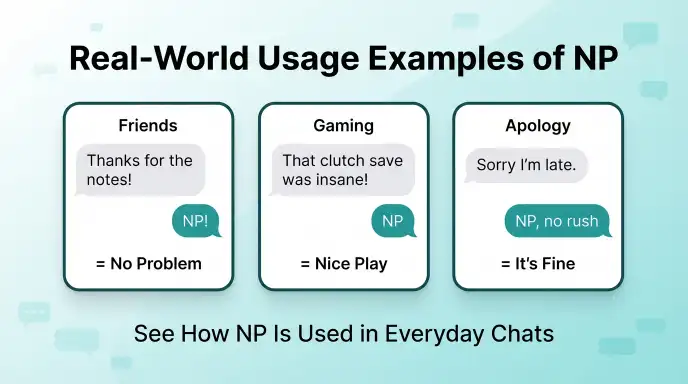
Imagine two classmates are working on a group project.
One student realizes they forgot to bring a printed worksheet. They message their classmate:
“Hey, can you bring an extra copy tomorrow?”
The other person replies:
“NP, I’ll bring one.”
The first student responds:
“Thanks!”
And the conversation ends.
In this situation, NP does not mean anything complicated. It simply tells the other person that the request is fine and that they are willing to help.
A similar situation can happen at work. A colleague might ask:
“Can you send me the updated file?”
You could answer:
“NP, I’ll send it after lunch.”
Again, the meaning is “No problem.”
The important thing is that NP usually works best when the situation is informal and the meaning is obvious from context.
FAQs
What Does the Acronym NP Stand For?
NP most commonly stands for “no problem,” used in texts and chats to say “you’re welcome” or “it’s fine.”
What Is NP in Gen Z Slang?
In Gen Z slang, NP means “no problem,” usually typed in lowercase as a relaxed, low-effort reply.
Younger users tend to drop capital letters and punctuation, so you will often see a plain “np” instead of “NP!” That style signals a laid-back mood, as if the favor was nothing at all. In gaming circles on Discord and Twitch, Gen Z players also use it to mean “nice play.”
What Is NP in Text Slang?
In text slang, NP is shorthand for “no problem,” used to answer thanks or an apology.
It sits alongside other quick replies like NW (no worries) and YW (you’re welcome). All of them grew out of the habit of keeping messages short on apps like WhatsApp, iMessage and Snapchat. The meaning stays the same across platforms, though the surrounding words can add warmth or flatness.
What Does “NP” Mean in a Chat?
In a chat, NP means “no problem” in everyday conversations and “nice play” in game chats.
The platform gives you the clue. On WhatsApp, Instagram or a Slack message between coworkers, it almost always means “no problem.” In a Valorant lobby or a Discord voice channel, it is usually praise for a good move, so check what just happened in the match.
What Does NP Mean in a Relationship?
In a relationship, NP means “it’s okay” or “no problem,” and it usually works as a gentle reassurance.
If you apologize for being late or forgetting something small, a partner replying “np” is saying the matter is closed. It can feel different after a bigger conflict, though, because a flat “np” may be a way to avoid the conversation rather than a sign that everything is fine. When the topic matters, talking it through in person or on a call is more honest than relying on shorthand.
A Few Things to Remember About NP
If you are new to texting abbreviations, the easiest way to remember NP is this:
NP = No Problem.
It is usually a response rather than something you use to start a conversation.
Someone thanks you? You can say NP.
Someone apologizes? You can say NP.
Someone asks if a small request is okay? You can say NP.
Someone asks for permission? NP may work if you are agreeing.
The surrounding message tells you exactly how the phrase should be understood.
Also remember that tone matters. “NP 😊” can feel warm and friendly, while simply “NP.” can look more abrupt. The abbreviation itself is not necessarily responsible for that difference; punctuation, context, and the relationship between the people also affect how a message is interpreted.
When Should You Avoid Using NP?
There is no need to avoid NP in ordinary casual texting. Still, there are situations where writing the full phrase is a better choice.
If you are sending a formal email, applying for a job, communicating with a customer, or writing an academic message, use standard language unless the context is clearly informal.
For example:
Casual:
“NP! See you tomorrow.”
More formal:
“You’re welcome. I look forward to seeing you tomorrow.”
Neither is inherently better. They simply belong to different communication settings.
The same principle applies to other abbreviations. A message to your best friend and a message to a professor do not necessarily need the same style.
Conclusion
NP means “no problem” in most text messages and online conversations. It is a short, informal abbreviation used to reassure someone, accept a request, respond to an apology, or say “you’re welcome.”
You can find it on TikTok, Snapchat, Instagram, WhatsApp, SMS, and many other messaging platforms.
If someone sends you “NP,” there is usually no hidden meaning to decode. They are simply saying that something is okay or that they do not mind.
Use it freely in casual conversations, especially with friends and people who already communicate informally with you. For school, work, or other formal situations, consider writing “no problem,” “you’re welcome,” or another complete phrase instead.
Once you know that NP = no problem, this common texting abbreviation is pretty easy to understand.
You May Also Like!

I am Alisha Abbas, a slang expert and language enthusiast specializing in modern slang, internet expressions, and everyday language trends. I study the meanings, origins, and cultural influences behind slang words to make them easy to understand for readers. My work focuses on exploring how language evolves and helping people communicate better in today’s fast-changing digital world.