It means informal words like swole, jacked, ripped and gains that people use in texts and social media to describe strong, muscular bodies or fitness progress.
Your friend texts “bro is getting swole” and you wonder if that is a compliment. It almost always is, and the gym vocabulary behind it is easier to learn than it looks.
Most of these words grew out of gym and bodybuilding culture before spreading through TikTok, Instagram and group chats. “Gains” refers to muscle growth or physical progress from working out, while terms like buff, shredded and hench describe how muscular someone looks.
Tone changes everything, because the same word can be praise, a friendly joke or playful teasing about someone’s gym habit. Some terms also have a social meaning, such as “muscle mommy,” which describes a strong, fit woman who is proud of lifting weights.
In this guide, you will find the most common muscle slang terms, real text examples and simple ways to reply. You will also learn which words are safe to use and when it is better to skip the slang.
Quick Answer:
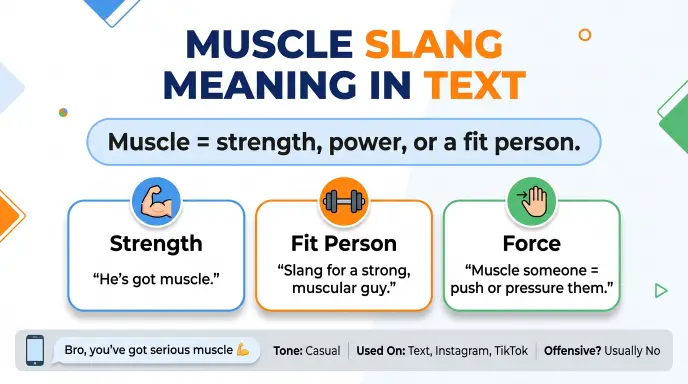
In slang and informal English, muscle can mean physical strength, power, influence, or a strong person who provides protection or intimidation. The exact meaning depends on the context.
Muscle Slang Full Form and Definition
Does Muscle Have a Full Form?
No, muscle does not have a special full form. It is not an acronym like LOL, OMG, or ASAP. It is an ordinary English word that has developed several informal and figurative meanings.
The basic meaning of muscle is related to physical strength. From that idea, people began using the word to describe other types of strength and power.
For example:
- Physical muscle means bodily strength.
- Financial muscle means financial power or resources.
- Political muscle means political influence.
- Bringing muscle can mean bringing strong people for support or protection.
- Using muscle can mean using force or pressure.
So, if you search for “what does muscle stand for?”, the answer is that it normally does not stand for a group of words. Its meaning changes according to how it is used.
Basic Meanings of Muscle
| Expression | Meaning | Example |
| Physical muscle | Body strength | “He has built a lot of muscle.” |
| Financial muscle | Financial power | “The company has financial muscle.” |
| Political muscle | Political influence | “The organization has political muscle.” |
| Bring muscle | Bring strong support | “They brought muscle to the meeting.” |
| Muscle in | Force your way into something | “He tried to muscle in.” |
Is Muscle Slang Rude, Offensive, or Neutral?
Is the Word Muscle Offensive?
Generally, muscle is not a rude or offensive word. It is a normal English word, and using it to talk about physical strength is completely acceptable.
For example:
“She has gained muscle after months of training.”
This is a normal statement.
However, the word can have a more aggressive meaning when it is used to describe people who are brought in to intimidate or threaten others.
For example:
“They brought some muscle to the negotiation.”
In this situation, “muscle” may suggest people who are physically strong and are there to create pressure.
Tone Depends on Context
The same word can therefore have different tones:
- Neutral: “He is building muscle.”
- Positive: “The team needs more muscle.”
- Casual: “That guy has serious muscle.”
- Aggressive: “They brought muscle to scare him.”
- Negative: “He tried to muscle his way into the group.”
The word itself is not necessarily offensive. The surrounding sentence determines the tone.
Where Is Muscle Slang Commonly Used?
Fitness and Gym Conversations
Fitness is one of the most common places where people use the word muscle informally.
You may hear:
- “I want to gain more muscle.”
- “He’s putting on muscle.”
- “She has impressive muscle definition.”
- “I need to build more muscle.”
- “The workout really targets your muscles.”
In this context, muscle usually has a literal meaning and is not considered slang.
Sports Conversations
Sports fans may also use muscle to describe physical strength, toughness, or power.
For example:
“Our team needs more muscle in the defense.”
Here, the speaker may not literally mean bigger muscles. They may mean the team needs stronger, tougher, or more physically powerful players.
Business Conversations
In business, muscle can represent power, resources, or influence.
For example:
“The company has enough financial muscle to enter the international market.”
The phrase does not refer to physical strength. It means the company has enough money and resources to compete.
Movies and Crime Stories
The slang meaning becomes more noticeable in action movies, crime dramas, and fictional stories.
When a character says:
“Bring some muscle.”
they may mean:
“Bring some strong people who can provide protection or intimidation.”
This use is usually informal and can have a negative or threatening tone.
Real-Life Examples of Muscle Slang
Friendly Example
“You’ve been working out a lot. You’re getting some serious muscle!”
This is usually a friendly compliment about someone’s physical development.
Casual Example
“Can you bring some muscle? We need to move this table.”
Here, muscle simply means someone strong enough to help.
Argumentative Example
“You can’t solve every problem with muscle.”
In this sentence, muscle represents physical force or intimidation.
Business Example
“The company has the financial muscle to compete with larger brands.”
Here, muscle means financial strength.
Gaming Example
“Our team needs some muscle for the final level.”
In gaming, muscle can describe a powerful character or player who can deal with difficult opponents.
Social Media Example
“Three months of training and the muscle gains are finally showing!”
Here, the word is related to fitness and body development.
Muscle Slang in Different Contexts
| Context | Meaning of Muscle | Example |
| Gym | Physical development | “I’m trying to gain muscle.” |
| Sports | Physical strength | “We need more muscle on defense.” |
| Business | Financial power | “They have financial muscle.” |
| Politics | Influence | “The group has political muscle.” |
| Movies | Strong support or enforcers | “They brought muscle.” |
| Social media | Muscular appearance or strength | “The muscle gains are real.” |
| Everyday conversation | Strength or force | “We need some muscle to move it.” |
Origin and Background of Muscle Slang
Where Did the Word Muscle Come From?
The word muscle has a long history. Its origins can be traced through French to the Latin word musculus, which was associated with the idea of a small mouse.
Over time, the word became associated with the physical structures in the body that create movement and strength.
As people connected physical strength with power, the word gradually developed figurative meanings. This is why modern English can use muscle to describe not only the body but also influence, authority, resources, and force.
The development is easy to understand:
Physical strength → power → influence → force or authority
This progression explains many modern expressions involving muscle.
What Does “Muscle In” Mean?
Meaning of Muscle In
Muscle in is a common informal expression. It means forcing your way into a situation, conversation, group, activity, or opportunity.
For example:
“He tried to muscle in on their conversation.”
This means he tried to involve himself in a conversation where he was not invited.
Another example is:
“The company is muscling in on the market.”
This suggests that the company is aggressively trying to enter or gain influence in a market.
Unlike the simple word “muscle,” muscle in often has a negative or disapproving tone.
Muscle vs Similar Slang Terms
Comparison of Muscle, Brawn, and Strength
| Word | Main Meaning | Tone | Common Use |
| Muscle | Physical power or general power | Neutral/Informal | Fitness, sports, business |
| Brawn | Physical strength | Informal | Strength and physical work |
| Strength | Physical or mental power | Neutral | General communication |
| Power | Ability to control or influence | Neutral | Business, politics, society |
| Force | Physical pressure or power | Neutral/Formal | Conflict, authority, science |
These words can sometimes be used in similar sentences, but they are not always interchangeable.
For example, financial muscle sounds natural, while “financial brawn” does not.
Muscle vs Fitness Slang
Common Fitness Terms
| Term | Meaning | Example |
| Muscle | Developed body tissue or strength | “I want to gain muscle.” |
| Buff | Muscular and physically fit | “He’s really buff.” |
| Jacked | Very muscular | “He looks jacked.” |
| Ripped | Lean with clearly visible muscles | “He is completely ripped.” |
| Swole | Noticeably muscular | “He’s getting swole.” |
| Shredded | Extremely lean and muscular | “His physique is shredded.” |
These terms are mostly associated with fitness culture.
For example, calling someone jacked usually focuses on their muscular appearance. Saying someone has muscle can refer to physical strength more generally.
When Should You Avoid Using Muscle Slang?
Formal and Professional Situations
Although muscle slang is common in everyday English, it is not always suitable for formal writing.
You may want to avoid it in:
- Academic essays
- Official reports
- Legal documents
- Professional presentations
- Business contracts
- Formal workplace communication
Instead of saying:
“The company used its muscle to win the deal.”
you could write:
“The company used its resources and influence to secure the deal.”
The second version is more precise and professional.
When the Meaning Could Be Misunderstood
You should also be careful when “muscle” could suggest intimidation.
For example:
“They brought muscle to the meeting.”
A reader might wonder if you mean security personnel, powerful executives, or physically intimidating people.
If clarity matters, explain exactly what you mean.
Polite Alternatives to Muscle Slang
Better Words for Different Situations
If you want to make your communication clearer, choose an alternative based on the intended meaning.
| If You Mean… | Use This Instead |
| Physical ability | Strength |
| Financial power | Resources |
| Social influence | Influence |
| Political power | Authority or influence |
| Security | Protection |
| Organizational power | Capacity |
| Physical force | Physical strength |
| Unwanted involvement | Interference |
For example:
Informal: “They have a lot of muscle.”
Clearer: “They have a lot of influence.”
Or:
Informal: “Bring some muscle.”
Clearer: “Bring someone who can help with the heavy work.”
Why Do People Use Muscle Slang?
It Makes Communication Shorter
Slang can communicate a complicated idea in only a few words.
Instead of saying:
“We need people who are physically strong and capable of handling this difficult situation.”
someone might simply say:
“We need some muscle.”
The shorter expression feels more natural in casual conversation.
It Creates a Strong Image
The word muscle immediately creates an image of strength and power. That makes it useful in movies, sports, advertising, social media, and everyday conversations.
It Sounds Informal and Conversational
People often use slang because it makes communication feel relaxed and natural. Friends are more likely to say “muscle” than use a long formal explanation.
Impact of Muscle Slang in Communication
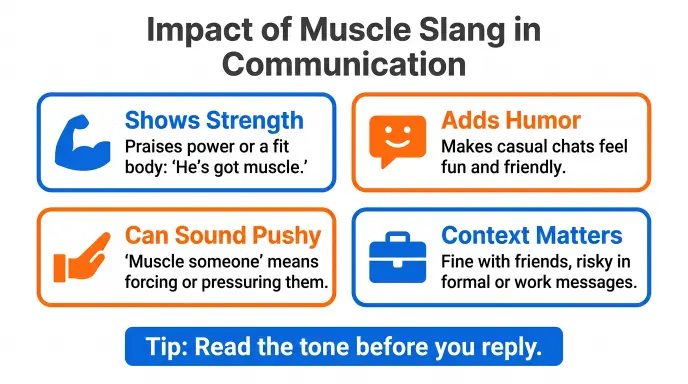
Positive Impact
Using muscle slang can make communication:
- More conversational
- More expressive
- Shorter
- Easier to understand in familiar groups
- More energetic
Possible Negative Impact
However, it can also:
- Create confusion
- Sound aggressive
- Be misunderstood by non-native speakers
- Look unprofessional in formal writing
- Suggest intimidation when that was not intended
For this reason, context is extremely important.
A phrase that sounds perfectly normal among gym friends may sound inappropriate in a business meeting.
Is Muscle Slang Safe for Social Media?
Can You Use Muscle on Social Media?
Yes. The word muscle is generally safe and common on social media.
Fitness posts frequently use the word when discussing:
- Muscle growth
- Strength training
- Workout routines
- Bodybuilding
- Fitness progress
- Exercise results
For example:
“Working hard to build more muscle.”
is a normal social media caption.
However, context matters when the word is connected with violence, threats, or intimidation. In those cases, the complete message: not simply the word muscle: determines how the post may be interpreted.
Muscle Slang vs Muscle Meaning in Text
Why Context Matters
The meaning of muscle can change significantly depending on the sentence.
| Text Message | Likely Meaning |
| “I need to build muscle.” | Physical muscle |
| “He has serious muscle.” | Physical strength |
| “They have financial muscle.” | Financial power |
| “Bring some muscle.” | Strong support or protection |
| “He muscled in.” | Forced his way into a situation |
| “The team needs muscle.” | Strength or toughness |
This is why there is no single definition that works for every example.
When interpreting muscle slang in text, look at the words around it and consider who is speaking, where the conversation is happening, and what topic they are discussing.
FAQs
What Does “Muscle” Mean in Slang?
In slang, “muscle” usually means a strong, well-built physique, or the person who has one. People use it for bodybuilders, athletes and fitness enthusiasts who have worked hard on their bodies. Outside the gym, “muscle” can also mean hired strength, as in a bodyguard or enforcer brought in to intimidate someone.
What Are Some Slang Terms for Muscles?
Common slang for muscles includes guns, abs, glutes, gains and cuts. “Guns” refers to biceps, “abs” to the stomach muscles, “gains” to muscle growth or fitness progress, and “cuts” to well-defined muscles. “Gains” is also used for the quick growth beginners often see when they first start training. Captions and texts often pair these with “six pack,” which describes very toned abs.
What Does “Muscle Up” Mean in Slang?
“Muscle up” has two common meanings: building strength and size, or a demanding gym exercise. In everyday talk, it means getting stronger or bulking up, as in “I need to muscle up before summer.” In calisthenics, a muscle-up is a move where you pull yourself over a bar or rings until your upper body rises above it, and it is often treated as a milestone in bodyweight training.
What Is Slang for a Muscle Guy?
Popular slang for a muscular man includes jacked, swole, buff, ripped, yoked and, in British English, hench. Other common words are diesel and shredded, which stress strength and leanness. “Meathead” is also used, but it usually carries a teasing or negative tone, suggesting someone who is overly obsessed with lifting weights. Casual options like “gym rat” and “beefcake” exist too, though the first points to habit and the second to looks.
What Does It Mean to Muscle Someone?
To muscle someone means to push, force or pressure them using physical strength or intimidation. You will see it in phrases like “he muscled me out of the way” or “they muscled him into signing.” A close cousin is “muscle in,” which means forcing your way into a situation, such as a business or a conversation, where you were not invited.
Conclusion
Muscle slang is an interesting example of how an ordinary English word can develop several informal meanings. While muscle literally refers to body tissue responsible for movement and strength, its slang and figurative meanings can refer to physical power, influence, financial resources, authority, or a strong person brought in for support or intimidation.
The meaning of muscle slang in text depends heavily on context. In a fitness conversation, it will probably refer to physical development.It is main in business, it may mean financial power.Also in sports, it can describe toughness or physical strength.
It is also important to remember that muscle has no special full form because it is not an acronym. Expressions such as “financial muscle” and “muscle in” simply use the original idea of strength in a figurative way.
Overall, muscle is generally a safe and neutral word, but its tone can change depending on the situation. If you are communicating formally, using clearer words such as strength, influence, authority, resources, or protection can prevent confusion.
When you see muscle slang in a text or online conversation, always consider the surrounding words and the speaker’s intention. Context and tone are the keys to understanding what “muscle” really means. :::

I am Alisha Abbas, a slang expert and language enthusiast specializing in modern slang, internet expressions, and everyday language trends. I study the meanings, origins, and cultural influences behind slang words to make them easy to understand for readers. My work focuses on exploring how language evolves and helping people communicate better in today’s fast-changing digital world.