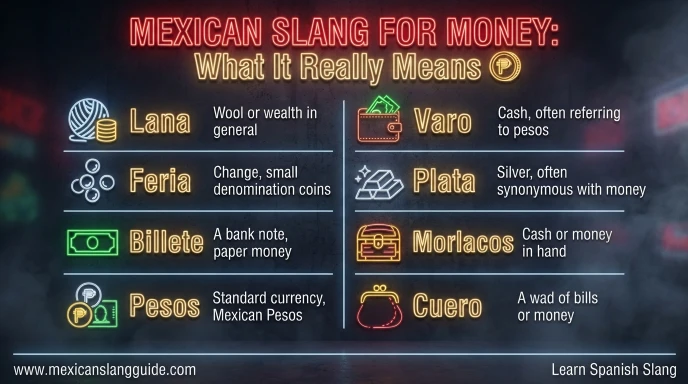
The most common Mexican slang words for money are “lana” (wool), “varo,” “feria,” and “plata”: used instead of the formal word “dinero” in everyday conversation.
Walk into any market or conversation in Mexico, and you’ll rarely hear the word “dinero” for money instead, Mexicans use a whole vocabulary of colorful slang terms. Understanding these words helps you sound more natural and actually follow everyday conversations.
The most iconic term is “lana,” which literally means wool: as in what comes off a sheep: and it became slang for cash so long ago that most people have forgotten it ever meant anything else.
Other common terms include “varo,” “feria,” and “plata,” each with its own texture: varo has a rougher edge tied to a younger, more urban, working-class register, while feria technically means “fair” but refers to small bills and loose change in everyday cash slang.
Because these terms are so common in real conversations, this article breaks down each one: its origin, meaning, and how to use it correctly so you can talk about money like a native Mexican Spanish speaker.
Quick Answer:
Mexican slang for money includes words such as lana, feria, varo, billete, and plata. Among these, lana is one of the most widely recognized informal Mexican expressions for money.
What Does Mexican Slang for Money Mean in Text?
When someone uses Mexican slang for money in a text message, they are usually talking about cash, income, payment, or financial resources in an informal way.
For example:
- “No traigo lana.” = “I don’t have any money.”
- “¿Cuánto varo necesitas?” = “How much money do you need?”
- “Ya junté la feria.” = “I already saved/got the money.”
- “Pásame un billete.” = “Give me some cash.”
- “No tengo plata.” = “I don’t have money.”
The important thing to understand is that these expressions are generally informal vocabulary rather than secret codes. Their meaning becomes clear from the surrounding conversation.
Mexican Spanish is also highly regional. A slang word that sounds completely normal in one part of Mexico may be less common somewhere else. Therefore, context matters when interpreting Mexican slang.
Mexican Slang for Money Full Form
Unlike abbreviations such as POS, which can have several technical meanings, Mexican money slang usually does not have a “full form.” These are ordinary Spanish words or expressions that have developed informal meanings.
Here are some of the most useful terms to know:
| Slang term | Basic meaning | Typical tone |
| Lana | Money, cash | Informal and common |
| Feria | Money, cash/change | Informal |
| Varo | Money | Very casual |
| Billete | Cash/money | Casual |
| Plata | Money | Informal and widely understood |
| Pasta | Money | Informal, less distinctly Mexican |
Lana
Lana literally means “wool,” but in Mexican informal speech it is commonly used to mean money.
Example:
“No tengo lana para salir esta noche.”
This means:
“I don’t have money to go out tonight.”
Because of its widespread use, lana is one of the safest Mexican slang terms to recognize when you encounter informal conversations about money.
Varo
Varo is another informal Mexican expression for money.
You might see:
“Me faltan 200 varos.”
This means:
“I’m short 200 pesos.”
The plural varos is especially common when someone is talking about a specific amount of money.
Feria
Feria can also refer to money in Mexican slang. Depending on context, it may refer to cash or smaller amounts/change.
For example:
“¿Traes feria?”
can mean:
“Do you have any cash?”
The surrounding conversation determines exactly what the speaker intends.
Is Mexican Money Slang Rude, Offensive, or Neutral?
Most common Mexican slang for money is not inherently rude or offensive.
Words such as lana, varo, feria, and plata are generally casual. Native speakers can use them with friends, family members, coworkers, or other people in informal situations.
However, tone can change the meaning.
For example:
- “¿Tienes lana?”: casual
- “Necesito varo.”: casual
- “Pásame la lana.”: informal and direct
- “Dame la lana ya.”: potentially aggressive depending on tone
The word itself may be harmless, while the sentence can sound demanding or disrespectful.
In professional writing, formal Spanish words such as dinero are usually more appropriate.
Where Is Mexican Slang for Money Commonly Used?
These expressions are most likely to appear in informal communication.
Common places include:
- Text messages
- WhatsApp conversations
- Social media
- YouTube comments
- TikTok comments
- Online gaming chats
- Memes
- Music and entertainment
- Conversations between friends
- Casual workplace conversations
You may also encounter these expressions in Mexican movies and television programs.
If you are learning Spanish, recognizing slang can make conversations easier to understand because native speakers do not always use textbook vocabulary.
Real-Life Examples of Mexican Money Slang
Different words can express similar ideas while creating slightly different impressions.
Friendly Example
“¿Ya tienes lana para el viaje?”
Meaning:
“Do you already have money for the trip?”
This sounds casual and friendly.
Casual Example
“Me quedé sin varo.”
Meaning:
“I ran out of money.”
This is a natural informal expression.
Asking for Money
“¿Me prestas unos varos?”
Meaning:
“Can you lend me some money?”
The word varos makes the sentence sound casual.
Talking About Payment
“Necesito juntar la feria para pagar la renta.”
Meaning:
“I need to get/save the money to pay the rent.”
Social Media Example
“Cuando cobras y al día siguiente ya no tienes lana.”
Meaning:
“When you get paid and the next day you have no money left.”
This kind of wording works naturally in memes and social media posts.
Gaming Example
“No tengo varo para comprar el nuevo skin.”
Meaning:
“I don’t have money to buy the new skin.”
Here, varo gives the sentence a relaxed, conversational tone.
Argumentative Example
“¿Dónde está la lana que te di?”
Meaning:
“Where is the money I gave you?”
The vocabulary is informal, but the sentence can sound confrontational because of the situation.
Mexican Slang for Money vs Similar Terms
Several Spanish-speaking countries have their own informal vocabulary for money. A word that is common in Mexico may sound unusual elsewhere.
| Expression | Common association | Meaning |
| Lana | Mexico | Money |
| Varo | Mexico | Money/cash |
| Feria | Mexico | Money/change |
| Plata | Several Latin American countries | Money |
| Pasta | Spain and other contexts | Money |
| Billete | Spanish-speaking regions | Cash/money |
This does not mean that each word belongs exclusively to one country. Spanish is a diverse language, and slang travels across borders through music, movies, social media, gaming, and migration.
Lana vs Varo vs Feria: What’s the Difference?
Understanding the difference between common terms can make your Spanish sound more natural.
| Term | Meaning | Tone | Example |
| Lana | Money | Casual | “No tengo lana.” |
| Varo | Money/cash | Very casual | “Me faltan 100 varos.” |
| Feria | Money/change | Casual | “¿Traes feria?” |
| Dinero | Money | Standard/formal | “No tengo dinero.” |
Dinero is the standard Spanish word for money. If you are unsure which slang term to use, dinero is the safest option because it works in both formal and informal situations.
Origin and Background of MMS
The history of slang is often complicated because words change meaning gradually through everyday speech.
One interesting example is lana. In standard Spanish, lana refers to wool. Over time, the word developed an association with money in Mexican colloquial speech.
There are different explanations for why particular slang terms acquired financial meanings, but informal vocabulary does not always have one universally accepted origin. This is why it is better to distinguish between the modern meaning of a slang term and theories about its historical origin.
Varo is another established Mexican colloquialism for money, while feria has a broader history as a Spanish word and acquired specific informal uses in Mexican speech.
The most important point for learners is not memorizing an uncertain origin story. It is understanding how native speakers use these words today.
Why Do People Use Mexican Slang for Money?
People use slang because language is more than a collection of dictionary definitions. Informal expressions can make communication feel more natural, relaxed, humorous, or culturally familiar.
Someone may choose lana instead of dinero because it sounds more conversational.
Other reasons include:
- Building a friendly tone
- Sounding natural in casual conversations
- Creating humor
- Showing familiarity with Mexican Spanish
- Communicating quickly
- Matching the language used by friends
- Participating in online culture
Slang is also constantly influenced by music, entertainment, memes, and social media.
When Should You Avoid Mexican Money Slang?
Although these words are usually harmless, slang is not appropriate for every situation.
Consider using standard Spanish instead when:
- Writing a formal business email
- Preparing an academic document
- Speaking during a formal presentation
- Writing a legal or financial document
- Communicating with someone you do not know well
- Translating official information
- Applying for a job
For example, instead of:
“Necesito lana para el proyecto.”
a professional document would normally use:
“Necesito dinero para el proyecto.”
The second version is more neutral and professional.
Polite Alternatives to Mexican Money Slang
If you are worried about sounding too informal, use standard Spanish.
Useful alternatives include:
- Dinero: money
- Efectivo: cash
- Recursos: financial resources
- Fondos: funds
- Cantidad: amount
- Pago: payment
For example:
Very casual:
“¿Tienes lana?”
Neutral:
“¿Tienes dinero?”
More specific:
“¿Tienes efectivo?”
Choosing the right word depends on the situation rather than simply deciding that one expression is “better.”
Mexican Money Slang in Social Media
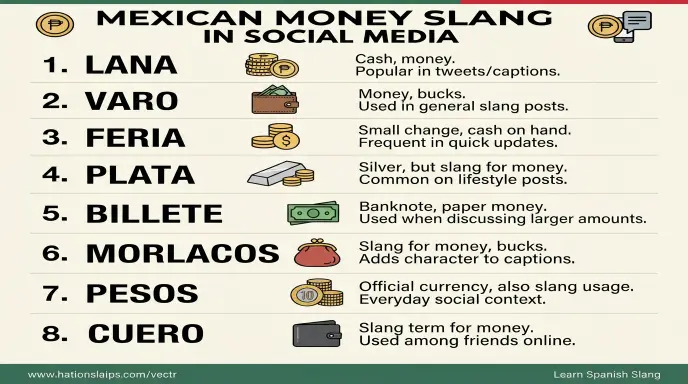
Mexican slang is especially common online because social media favors short, conversational language.
You may see phrases such as:
“No hay lana.”
“Ya no traigo varo.”
“¿Cuántos varos te costó?”
“Se fue toda la feria.”
These expressions can make captions, comments, and memes feel more authentic.
However, slang can sometimes be misunderstood by international audiences. If your content is intended for a global audience, standard words may communicate the message more clearly.
Is Mexican Slang for Money Safe for Social Media?
Yes, common Mexican money slang is generally safe for social media because the words themselves are not inherently offensive.
The important factor is context.
A harmless word can appear in an inappropriate sentence, just as standard vocabulary can be used rudely.
For brands and businesses, it is best to consider the target audience. A Mexican-focused social campaign may benefit from natural colloquial language, while an international financial brand may prefer neutral Spanish.
Common Mistakes English Speakers Make
People learning Mexican Spanish sometimes translate slang word-for-word.
For example, lana literally means wool in standard Spanish, but saying “wool” when the speaker means money would obviously be incorrect in English.
Other common mistakes include:
- Assuming every slang term is offensive
- Using slang in formal situations
- Assuming Mexican slang works identically throughout Latin America
- Translating individual words without considering the sentence
- Using a slang expression without understanding its tone
The best approach is to learn the expression together with examples and context.
Mexican Money Slang Comparison With Standard Spanish
| Situation | Informal Mexican Spanish | Standard Spanish | English |
| Talking about money | Lana | Dinero | Money |
| Talking about cash | Varo | Efectivo | Cash |
| Asking about money | ¿Traes feria? | ¿Tienes dinero? | Do you have money? |
| Talking about a small amount | Unos varos | Una cantidad de dinero | Some money |
| Talking about finances | Lana | Dinero/recursos | Money/resources |
This comparison shows why slang should be understood as a matter of register and context, not simply as a different dictionary definition.
Is Mexican Slang for Money the Same Everywhere in Mexico?
Not necessarily.
Mexico is a large country with many regional accents and expressions. Slang can vary between cities, states, generations, and social groups.
A younger person who spends a lot of time online may use expressions differently from an older speaker. Someone from northern Mexico may also have different vocabulary preferences from someone in central or southern Mexico.
This is normal in any living language.
Therefore, if you hear a new money-related expression, consider:
- Who said it?
- Where are they from?
- What was the conversation about?
- Was the situation serious or humorous?
- Was the communication formal or casual?
These clues can help you understand the intended meaning.
FAQs
Q1: How do Mexicans say money in slang?
Mexicans commonly use words like “lana” (wool), “varo,” “feria,” and “plata” instead of the formal word “dinero” in everyday, casual conversation.
Q2: What is slang for money in Mexico?
The most widely used slang terms for money in Mexico include (cite index=”44-1″>lana, varo, feria, and morralla,</cite> each carrying a slightly different tone or context, from general cash to loose change.
Q3: What is Gen Z slang for money?
Gen Z slang for money often includes terms like “bag,” “bread,” “bands,” “cash money,” and “cheddar” in English-speaking contexts: casual, trend-driven terms popularized through social media and hip-hop culture.
Q4: What’s a slang term for money?
Common English slang terms for money include “cash,” “dough,” “bread,” “bucks,” and “loot”: widely used across casual conversations and pop culture.
Q5: What are the top 7 slang terms for money?
Some of the most recognized slang terms for money (across English and Spanish) include: dough, bread, cash, bucks, loot, lana, and varo: each popular within its own cultural or linguistic context.
Q6: What does money mean in slang?
In slang, “money” is often represented through casual, everyday substitutes rather than formal terms: words like “cash,” “bread,” or “lana” that reflect informal, conversational speech rather than technical or financial language.
Q7: What is a slang term for cash?
Common slang terms for cash include “dough,” “bread,” “bucks,” and in Mexican Spanish, “lana” or “varo.”
Q8: What are Gen Z slang words?
Popular Gen Z slang words include terms like “rizz,” “no cap,” “bet,” “slay,” “mid,” and “bussin'”: casual expressions widely used in text messages and social media captions.
Conclusion
Mexican slang for money is an important part of understanding everyday Mexican Spanish. Expressions such as lana, varo, feria, billete, and plata can all refer to money or cash, but their exact use depends on context, region, and tone.
Among these expressions, lana is especially useful to recognize because it is widely associated with money in informal Mexican Spanish. Varo is another highly casual term, while feria can refer to money or change depending on the situation.
If you are learning Mexican Spanish, do not focus only on memorizing a Mexican slang for money full form or dictionary translation. Pay attention to how native speakers use the words in real conversations.
Most importantly, remember that slang is best suited to casual situations. For business, academic, legal, or other formal communication, dinero is usually the safer and clearer choice.
You May Also Like!

I am Alisha Abbas, a slang expert and language enthusiast specializing in modern slang, internet expressions, and everyday language trends. I study the meanings, origins, and cultural influences behind slang words to make them easy to understand for readers. My work focuses on exploring how language evolves and helping people communicate better in today’s fast-changing digital world.