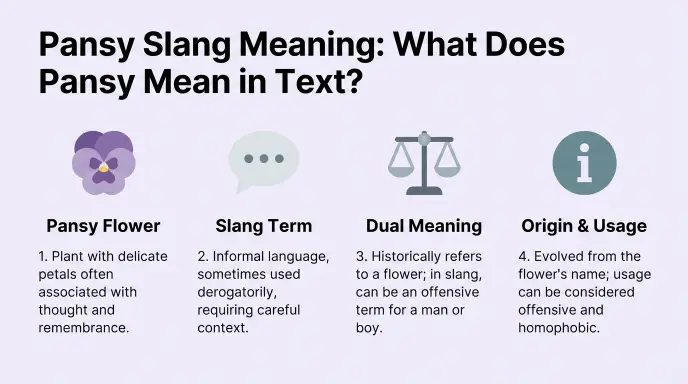
People typically use “pansy” as slang to describe someone weak, cowardly, or overly sensitive, though it has historically also served as an offensive term targeting effeminate or gay men.
If you’ve come across “pansy” in a text, comment, or conversation, you’ve probably wondered exactly what the person meant by it. Like many slang terms, its meaning shifts depending on tone and context.
In its most common casual use today, “pansy” describes someone viewed as weak, timid, or overly sensitive: often used half-jokingly among friends.
However, “pansy” also carries a heavier history: people have used it as a derogatory slur aimed at effeminate or gay men, and that usage still lingers in some contexts today.
Because this term can range from lighthearted teasing to genuinely offensive, this article breaks down both meanings clearly so you understand exactly how people use it before you read or use: it yourself.
Quick Answer:
In slang, “pansy” is usually an insulting term for a person perceived as weak, timid, delicate, or lacking courage. It is generally not neutral when used to describe a person and can sound rude or dismissive.
What Does Pansy Slang Mean in Text?
How people use the word heavily determines the pansy slang meaning in text.
When someone calls another person a “pansy,” they are normally criticizing that person’s toughness, courage, behavior, or reaction to a situation. For example, someone might say, “Don’t be such a pansy” when they think another person is being too nervous or cautious.
Friends can sometimes use the word jokingly, but that does not make it universally harmless. A close friend may use it playfully, while the same word from a stranger can sound insulting.
Simple Definition of Pansy Slang:
As slang, “pansy” describes a person others view as weak, timid, overly delicate, or lacking toughness.
It is important to distinguish this slang use from the ordinary meaning of pansy, which is also the name of a colorful flowering plant.
Is Pansy Rude, Offensive, or Neutral?
When applied to a person, people generally consider “pansy” rude, insulting, or derogatory rather than neutral.
The level of offensiveness depends on context. A joking conversation between friends may make the word sound less serious, while using it to humiliate someone can make it clearly offensive.
Historically, people have also used the term as a derogatory label for men perceived as feminine or homosexual. Because of this history, some uses can carry an additional discriminatory or homophobic tone.
Is Pansy a Bad Word?
People do not usually treat “pansy” as a profanity like some stronger swear words.However, not being a swear word does not mean it is polite.
Calling someone a pansy can attack their character or imply that they are inferior because they are not sufficiently tough.
Where Do People Commonly Use “Pansy”?
The slang can appear in several informal environments, including:
- Text messages
- Online gaming
- Social media comments
- Memes
- Casual conversations
- Movies and television dialogue
- Sports-related conversations
- Arguments or teasing between friends
The term is more likely to appear in informal English than in professional or academic communication.
Pansy in Texting
In texting, the meaning is usually easy to understand from the surrounding sentence.
For example:
“You won’t even try? Don’t be a pansy.”
Here, the speaker is accusing the other person of being too timid or afraid.
On the other hand:
“Haha, I’m such a pansy when it comes to scary movies.”
This can be self-deprecating and playful rather than an attack on another person.
Pansy Full Form and What Does Pansy Stand For?
A common misconception is that every slang word has a hidden full form made from separate letters. Pansy does not have a standard slang acronym or official full form.
The word is primarily a normal English word that developed additional figurative and slang meanings over time.
Pansy Slang Full Form
If someone searches for “pansy slang full form,” the simplest answer is that there is no recognized acronym-style full form such as P-A-N-S-Y.
Its slang meaning comes from historical usage and figurative associations rather than from an abbreviation.
Origin and Background of the Word Pansy:
The slang sense developed gradually, and it did not emerge as a modern internet abbreviation. The English word comes through French pensée, associated with the idea of “thought” or “remembrance.”
Over time, the word developed figurative uses.
Because people associated the flower with delicacy and appearance, “pansy” eventually acquired insulting meanings when applied to people.
How Did Pansy Become Slang?
The word “pansy” traces back to the name of a flower.
In older English usage, calling a man a “pansy” could suggest that he was feminine, delicate, weak, or insufficiently masculine. Some historical uses were explicitly derogatory toward gay men.
Modern speakers may use the term simply to mean “weak” or “easily frightened,” but the historical associations are still relevant when considering if the word is appropriate.
Real-Life Examples of Pansy Slang
Understanding different tones is one of the best ways to understand pansy slang meaning in text.
Friendly or Playful Example
“I’m a total pansy when I see horror movies 😂.”
Here, the speaker is describing themselves. The tone is light and humorous.
Casual Example
“Come on, don’t be a pansy. It’s only a little rain.”
The speaker is encouraging someone to stop being overly cautious, but the wording is still somewhat insulting.
Argumentative Example
“You keep calling everyone a pansy just because they disagree with you.”
In this example, the speaker discusses the word critically rather than uses it affectionately.
Gaming Example
“Why did you leave the fight? Don’t be a pansy.”
In gaming, players sometimes use words like this as trash talk. The intention may be competitive teasing, but it can still be disrespectful.
Social Media Example
“Calling strangers pansies isn’t going to prove your point.”
Here, the term appears in a discussion about someone’s behavior.
Self-Deprecating Example
“I’m such a pansy about spiders.”
This is generally less aggressive because the speaker is applying the label to themselves.
Pansy vs Similar Slang Terms
Several English slang terms can communicate a similar idea, but their strength and implications are different.
| Term | General meaning | Tone | Potential concern |
| Pansy | Someone perceived as weak or timid | Insulting | Historical gender/sexuality-related use |
| Wimp | Someone perceived as lacking courage | Insulting | Usually less severe |
| Chicken | Someone who is afraid | Teasing/insulting | Usually informal |
| Coward | Someone who lacks courage | Direct and serious | Can be strongly insulting |
| Softie | Someone who is gentle or sensitive | Often playful | Usually milder |
Pansy vs Wimp
“Wimp” is probably one of the closest alternatives. Both can describe someone perceived as lacking toughness.
However, “pansy” can carry older gendered or homophobic associations, while “wimp” is generally focused more directly on perceived weakness.
Pansy vs Chicken
“Chicken” is commonly used to mean afraid or unwilling to take a risk. It can be teasing, particularly among friends.
For example, “Don’t chicken out” is often less harsh than directly calling someone a pansy.
Comparison Table: Pansy and Other Informal Words
| Word | Meaning | Typical tone | Appropriate in professional settings? |
| Pansy | Weak, timid, or delicate person | Rude/derogatory | No |
| Wimp | Person seen as lacking toughness | Rude/informal | No |
| Chicken | Person who is afraid | Casual/teasing | Usually no |
| Coward | Person lacking courage | Strong/critical | Usually avoid |
| Sensitive | Easily affected emotionally | Neutral or critical | Yes, depending on context |
| Cautious | Careful about risk | Neutral/positive | Yes |
| Nervous | Feeling worried or afraid | Neutral | Yes |
This comparison shows why choosing a neutral word can be better when the goal is communication rather than teasing.
When Should You Avoid Using Pansy?
It is best to avoid calling another person a “pansy” when you do not know them well.
You should especially avoid it in:
- Workplace conversations
- School or university settings
- Customer service
- Formal emails
- Professional social media
- Sensitive discussions
- Conversations involving gender or sexuality
- Situations where the other person may feel targeted or humiliated
Why Avoid It?
The main problem is not simply that the word is slang. The problem is that it judges another person’s character.
Someone may be nervous, cautious, sensitive, or unwilling to take a particular risk for perfectly reasonable reasons. Calling them a pansy dismisses those reasons instead of addressing the actual issue.
Polite Alternatives to Pansy
If your intention is to communicate clearly without insulting someone, there are many better choices.
Depending on what you mean, you could say:
- Nervous
- Unsure
- Cautious
- Uncomfortable
- Concerned
- Sensitive
- Hesitant
- Not confident
- Not comfortable taking that risk
For example, instead of:
“Don’t be a pansy.”
You could say:
“Are you uncomfortable with trying it?”
Or:
“It’s okay if you’re not ready yet.”
These alternatives communicate the situation without attacking the person.
Why Do People Use Pansy Slang?
People use slang because it can make communication feel shorter, more emotional, humorous, or informal.
Someone may use “pansy” because they want to:
- Tease a friend
- Challenge someone’s courage
- Make a joke
- Express frustration
- Participate in gaming trash talk
- Sound informal
- Describe their own fear humorously
Does Context Change the Meaning?
Yes. Context can significantly change how the word is received.
Compare:
“I’m a pansy when it comes to needles.”
with:
“You’re a pansy because you won’t do it.”
The first is self-directed humor. The second directly insults another person.
Impact of Using Pansy in Communication
Words like “pansy” can affect how a message is received even when the speaker does not intend serious harm.
A joking comment can become offensive when:
- The relationship is not close.
- The recipient does not understand the joke.
- The conversation is already heated.
- The word relates to gender or sexuality.
- It is repeated to embarrass someone.
- It is posted publicly.
Tone Matters More Than the Word Alone
Text messages do not provide facial expressions, voice tone, or body language. As a result, sarcasm and joking can easily be misunderstood.
An emoji or laughing expression may signal playful intent, but it does not guarantee that the recipient will find the comment funny.
Is Pansy Safe for Social Media?
Using “pansy” on social media is not automatically prohibited, but using it as an insult can create unnecessary conflict.
Public posts have a wider audience than private conversations. A phrase intended as friendly teasing can be interpreted differently by people who do not know the relationship between the speakers.
Better Social Media Practice
If you are discussing someone’s behavior publicly, focus on the behavior instead of labeling the person.
Instead of:
“He’s a pansy.”
Consider:
“He didn’t want to take the risk.”
The second statement is more specific and less insulting.
Pansy Slang in Gaming and Online Communities
Gaming communities often develop their own informal language. Players may use “pansy” as part of competitive banter or trash talk.
However, competitive environments can quickly turn playful language into personal attacks.
| Gaming phrase | Likely intention | Possible effect |
| “Don’t be a pansy.” | Teasing/challenge | Can feel insulting |
| “I’m a pansy at this level.” | Self-joke | Usually harmless |
| “You’re playing like a pansy.” | Trash talk | Potentially hostile |
| “Let’s play carefully.” | Strategic advice | Neutral |
| “That strategy is too defensive.” | Game criticism | More specific and respectful |
A better gaming conversation focuses on the strategy or gameplay rather than attacking the player personally.
FAQs
Is pansy a swear word?
No. “Pansy” is generally not considered a conventional swear word, but it can still be insulting or derogatory when used about a person.
When did pansy become an insult?
The insulting use of “pansy” (targeting effeminate or gay men) is recorded starting around 1929. Its more general use as an insult for someone weak or cowardly grew alongside this, especially through the mid-20th century.
What does the name pansy mean?
As a given name, “Pansy” comes directly from the flower name, which itself is derived from the Old French word “pensée,” meaning “thought.” It was a popular feminine name in the Victorian era, though its use declined later due to the word’s negative slang meaning.
What does pansy symbolize?
The flower traditionally symbolizes thought, remembrance, and reflection: it was historically regarded as a symbol of thought or remembrance. This ties directly to its name’s origin from the French word for “thought.”
What does it mean when a man is a pansy?
When used about a man, “pansy” is a slang insult implying he’s weak, timid, overly sensitive, or lacking courage. It’s also historically used as a term of abuse for a weak or effeminate man or boy. Because of this history, the term is now widely seen as outdated and potentially offensive.
Why is it called a pansy?
The flower gets its name from the French word “pensée,” meaning “thought”: the plant was thought to resemble someone deep in thought, with a lowered, nodding head. The slang insult meaning came much later, unrelated to the flower’s original naming.
What is a pansy personality?
Describing someone’s “personality” as a pansy typically means they’re seen as overly sensitive, easily upset, or lacking toughness: someone who avoids conflict or gets discouraged easily. It’s a casual (and often dismissive) way of labeling someone as emotionally fragile rather than a formal personality classification.
Conclusion:
The [slang for bitch] meaning in text can vary according to context, but when the word “pansy” is used as slang for a person, it generally describes someone the speaker considers weak, timid, delicate, or lacking courage.
The word is not normally a profanity, but it can be rude and derogatory, particularly when directed at another person. Its historical use as a gendered and sometimes homophobic insult also makes context especially important.
If you see “pansy” in a text, look at the surrounding conversation before deciding exactly what the sender meant. A person joking about themselves may use it harmlessly, while someone using it against another person may be deliberately insulting them.
For respectful communication, terms such as “nervous,” “hesitant,” “cautious,” or “uncomfortable” are usually better choices. Understanding the pansy slang meaning, its background, and its tone can help you interpret messages accurately and avoid unnecessary misunderstandings.
Key Insights!
HGW Meaning Slang in Text: What Does HGW Stand For?
What Do Trini Slang Words Mean in Text? Explained

I am Alisha Abbas, a slang expert and language enthusiast specializing in modern slang, internet expressions, and everyday language trends. I study the meanings, origins, and cultural influences behind slang words to make them easy to understand for readers. My work focuses on exploring how language evolves and helping people communicate better in today’s fast-changing digital world.