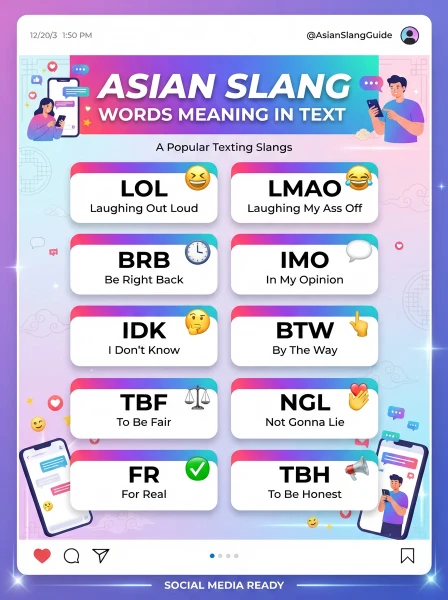
Asian slang (in texting): Informal words or phrases commonly used by people in Asian countries in online chats to express emotions, reactions, or everyday conversation.
Asian slang words are popular expressions, abbreviations, and internet phrases commonly used across different Asian countries and online communities. Many people search for asian slang words to better understand conversations on social media, messaging apps, gaming platforms, K-dramas, anime communities, and everyday chats.
Since Asia is home to dozens of languages and cultures, slang varies greatly between countries like Japan, South Korea, China, the Philippines, India, Singapore, Malaysia, and others.
Learning these slang terms helps you communicate more naturally, avoid misunderstandings, and better understand online trends. However, it’s equally important to know which expressions are friendly and which may sound rude or offensive depending on the situation.
Quick Answer
Asian slang words are informal words, phrases, or abbreviations commonly used in different Asian cultures and online communities. Their meanings depend on the country, language, and social context.
What Do Asian Slang Words Mean in Text?
In text messages, social media posts, and online chats, asian slang words are casual expressions that make conversations shorter, funnier, or more expressive. Unlike formal language, slang changes quickly as trends evolve.
Some slang words are unique to one country, while others become popular internationally through music, movies, anime, gaming, or social media.
Examples include:
- “Aigoo” (Korean expression of surprise)
- “Arigatou” shortened casually among friends
- “Paiseh” (Singaporean slang for feeling embarrassed)
- “Kiasu” (fear of missing out or losing)
- “GG” (gaming slang widely used in Asia and globally)
Definition
Unlike abbreviations, most asian slang words do not have a “full form.” Instead, they are informal expressions with cultural meanings.
However, some text abbreviations commonly used in Asian online communities do have expanded forms.
For example:
| Slang | Full Form | Meaning |
| GG | Good Game | Used after a match or when something is over |
| AFK | Away From Keyboard | Temporarily inactive |
| OP | Overpowered / Original Poster | Depends on context |
| LOL | Laugh Out Loud | Expressing laughter |
| BRB | Be Right Back | Leaving briefly |
Some regional slang has no full form because it originates from spoken language rather than abbreviations.
What Does Asian Slang Words Stand For?
When people ask “what does asian slang words stand for”, they usually mean what these expressions represent.
Asian slang often stands for:
- Emotions
- Reactions
- Humor
- Cultural identity
- Internet trends
- Friendship
- Sarcasm
- Gaming language
Rather than following dictionary definitions, slang reflects how people naturally communicate.
Is Asian Slang Words Rude, Offensive, or Neutral?
Most asian slang words are neutral or friendly.
However, context matters.
Neutral Examples
- Kiasu
- Aigoo
- Lah
- Meh
- Shiok
Friendly Slang
- Bro
- GG
- Senpai
- Oppa
- Unnie
Potentially Offensive Slang
Some slang terms can become offensive if:
- Used to insult someone
- Mock another culture
- Carry stereotypes
- Include profanity
Always understand the meaning before using unfamiliar slang.
Where Are Asian Slang Words Commonly Used?
You’ll frequently see asian slang words in:
- Text messages
- Instagram comments
- TikTok videos
- Facebook groups
- Discord servers
- Gaming chats
- YouTube comments
- Reddit discussions
- Anime communities
- K-pop fandoms
Young people especially use slang to communicate quickly and casually.
Real-Life Examples of Asian Slang Words Usage
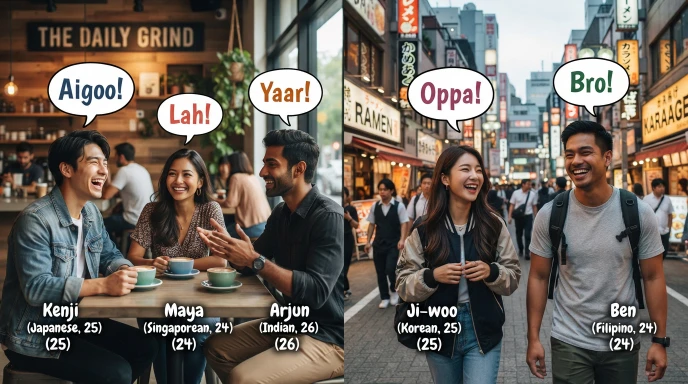
Friendly Conversation
Friend A: That new drama is amazing!
Friend B: Aigoo, I finished it in one day!
Casual Text
“I’ll be AFK for 10 minutes.”
Social Media
“That food looks shiok!”
Gaming
“GG everyone.”
Anime Community
“Senpai finally noticed me!”
K-pop Fan
“Oppa looks great today.”
Origin and Background of Asian Slang Words
Asian slang has many different origins.
Some come from:
- Local dialects
- Internet culture
- Gaming communities
- Television shows
- Anime
- K-pop
- Movies
- Youth culture
- Regional languages
For example:
- Korean slang spreads through K-pop and K-dramas.
- Japanese slang becomes popular through anime and manga.
- Singaporean slang mixes English, Malay, Chinese, and Tamil.
- Filipino slang often blends English with Tagalog.
- Indian internet slang combines English with Hindi and regional languages.
Because cultures constantly evolve, new slang appears every year.
Comparison with Similar Slang
| Slang | Country/Region | Meaning | Tone |
| Aigoo | Korea | Surprise or frustration | Friendly |
| Oppa | Korea | Older brother (used by females) | Friendly |
| Senpai | Japan | Senior or mentor | Respectful |
| Kiasu | Singapore | Fear of losing | Neutral |
| Lah | Singapore/Malaysia | Sentence emphasis | Casual |
| Shiok | Singapore/Malaysia | Very enjoyable | Positive |
| GG | Global/Asia | Good Game | Casual |
| AFK | Global | Away From Keyboard | Neutral |
When Should You Avoid Using Asian Slang Words?
Avoid slang when communicating in:
- Job interviews
- Business emails
- Academic writing
- Professional reports
- Legal documents
- Official presentations
Also avoid using slang if:
- You don’t fully understand it.
- It may offend someone’s culture.
- It includes profanity.
- The audience prefers formal language.
Respecting cultural context is more important than sounding trendy.
Polite Alternatives
If a slang word sounds too casual or offensive, use these alternatives.
| Slang | Better Alternative |
| GG | Well played |
| Bro | Friend |
| Dude | Everyone |
| WTF | What happened? |
| OMG | That’s surprising |
| Shut up | I disagree |
Professional communication benefits from polite wording.
Why Do People Use Asian Slang Words?
People use slang because it makes communication:
- Faster
- More expressive
- Fun
- Relatable
- Modern
- Emotional
- Community-focused
Slang also helps people feel connected with others who share similar interests, such as gaming, anime, music, or social media.
Many internet trends spread worldwide because slang is easy to remember and use.
Impact of Using Slang in Communication
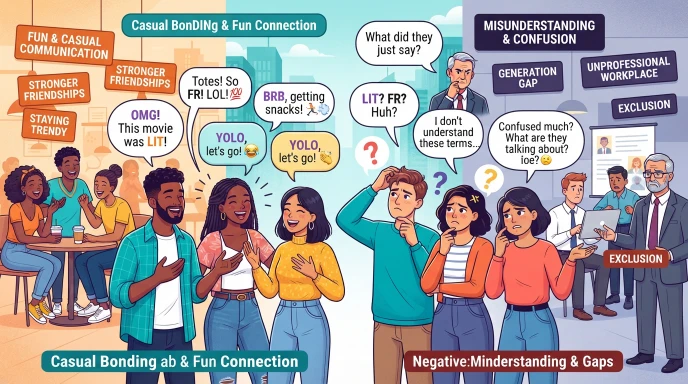
Using asian slang words can have both positive and negative effects.
Positive
- Makes conversations engaging
- Shows familiarity with online culture
- Builds friendships
- Creates humor
- Improves informal communication
Negative
- May confuse people unfamiliar with the slang
- Can sound unprofessional
- Risks cultural misunderstandings
- Some expressions become outdated quickly
The best approach is to match your language to your audience.
Is It Safe for Social Media?
Yes, most asian slang words are safe for social media when used respectfully.
Before posting:
- Check the actual meaning.
- Avoid offensive stereotypes.
- Respect cultural differences.
- Don’t misuse language from another culture simply because it’s trending.
- Avoid profanity if your audience includes children or professionals.
Responsible use helps keep online conversations respectful.
Examples of Asian Slang Words in Different Contexts
Friendly
“Thanks, senpai! You helped me a lot.”
Casual
“Aigoo, I forgot my wallet again.”
Argumentative
“GG, you ignored every point I made.”
Gaming
“AFK for five minutes.”
Social Media
“That street food looks absolutely shiok!”
Family Chat
“Lah, don’t worry so much.”
School Friends
“Don’t be so kiasu before the exam.”
Common Mistakes When Using Asian Slang Words
Many beginners make these mistakes:
- Assuming one slang word is used across all Asian countries.
- Using slang without understanding its cultural meaning.
- Mixing slang from different languages incorrectly.
- Using informal expressions in professional settings.
- Copying internet trends without knowing whether they’re respectful.
Taking a little time to learn the context can help you communicate more naturally and avoid misunderstandings.
FAQs
What does asian slang words mean in text?
It refers to informal words or expressions commonly used in different Asian countries and online communities during casual conversations.
What is the asian slang words full form?
Most asian slang words do not have a full form because they are informal expressions rather than abbreviations. Some internet terms like “GG” (Good Game) or “AFK” (Away From Keyboard) are exceptions.
Are asian slang words offensive?
Most are harmless and friendly. However, some expressions may be offensive depending on their meaning, cultural context, and how they are used.
Can I use asian slang words at work?
Generally, it’s better to avoid slang in professional communication. Use clear and formal language in workplaces unless you’re certain the context is informal and appropriate.
Why are asian slang words popular?
They’re popular because social media, gaming, anime, K-pop, movies, and messaging apps spread new expressions quickly across different countries.
Is it okay to learn slang from social media?
Yes, but always verify the meaning and cultural context before using unfamiliar expressions. Some trending slang may be outdated, misunderstood, or inappropriate in certain situations.
Conclusion
Understanding asian slang words can make online conversations, social media interactions, gaming, and cultural content much easier to follow. These informal expressions reflect the diversity of languages and communities across Asia, and their meanings often depend on context rather than strict dictionary definitions.
Whether you’re looking up asian slang words meaning slang, wondering about the asian slang words full form, or asking what does asian slang words stand for, the key is to use these expressions thoughtfully. Learning the cultural background, recognizing when slang is appropriate, and choosing respectful language will help you communicate naturally while avoiding misunderstandings.
Read more about!
What Does OMS Mean Slang Meaning in Text
What Does Guero Mean in Spanish Slang Meaning in Text

I am Alisha Abbas, a slang expert and language enthusiast specializing in modern slang, internet expressions, and everyday language trends. I study the meanings, origins, and cultural influences behind slang words to make them easy to understand for readers. My work focuses on exploring how language evolves and helping people communicate better in today’s fast-changing digital world.