Ireland slang refers to the informal words and expressions commonly used in everyday Irish English, such as “craic” for fun, “grand” for okay, and “eejit” for a foolish person.
Ireland’s slang is as lively and charming as its people, blending humor, warmth, and a touch of Gaelic heritage into everyday conversation.If you’re traveling to Dublin, Cork, or Galway, understanding these expressions will help you connect with locals instantly.
From casual greetings to unique idioms, Irish slang reflects the country’s storytelling tradition and easygoing culture. Words like “craic,” “eejit,” and “gas” carry meanings you won’t find in a standard English dictionary.
This guide breaks down the most common Irish slang words, their meanings, and real-life examples of how they’re used. It’s perfect for travelers, language learners, or anyone curious about Irish culture and communication style.
By the end of this article, you’ll be able to understand and even use popular Irish expressions like a true local. Get ready to dive into the fun, quirky, and heartfelt world of Irish slang!.
Quick Answer:
Irish slang includes everyday words like “craic” (fun/good times), “grand” (fine/okay), “eejit” (a foolish person), “gaff” (house), “deadly” (great/awesome), and “sound” (good, kind, or trustworthy): casual expressions commonly used across Ireland in everyday conversation.
What Does Ireland Slang Mean?
Ireland slang, also called Irish slang, refers to informal words, phrases, and expressions used in everyday conversations in Ireland.
Some Irish slang words are completely different from standard English, while others are familiar English words used in a distinctive Irish way. For example, “grand” usually means “fine” or “okay” in everyday Irish conversation rather than something magnificent.
Irish slang can be used with friends, family members, coworkers, and people in casual social situations. However, the meaning and tone of an expression can change depending on the context.
Irish Slang vs. Irish Language
It is important to understand that Irish slang is not the same as the Irish language.
The Irish language, known as Gaeilge, is a Celtic language. Irish English is a variety of English influenced by Ireland’s history, culture, and the Irish language.
Some Irish expressions have connections to Gaeilge, but most everyday Irish slang is used within English sentences.
Common Ireland Slang Words and Their Meanings
Ireland has many informal expressions, but some are especially recognizable and useful for visitors and English learners.
| Ireland Slang | Meaning | Example |
| Craic | Fun, entertainment, or enjoyable conversation | “What’s the craic?” |
| Grand | Fine, okay, or all right | “I’m grand.” |
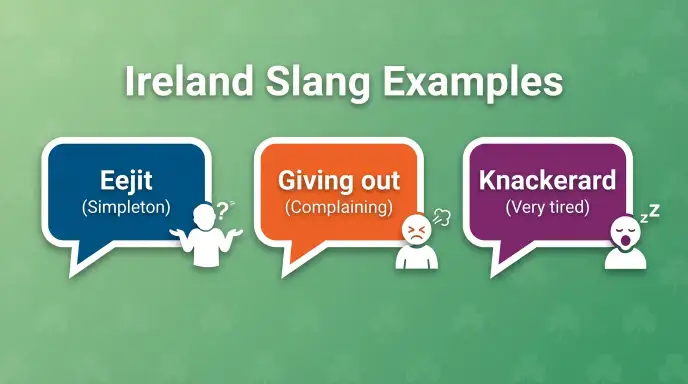
| Eejit | Foolish or silly person | “Don’t be an eejit.” |
| Gas | Funny or entertaining | “He’s gas.” |
| Deadly | Excellent or very good | “That was deadly.” |
| Banjaxed | Broken, exhausted, or worn out | “I’m completely banjaxed.” |
| Yoke | A thing or object | “Pass me that yoke.” |
| Knackered | Very tired | “I’m absolutely knackered.” |
| Kip | A sleep or place to sleep | “I’m going for a kip.” |
| Giving out | Scolding or telling someone off | “She was giving out to me.” |
These words are generally informal, so they are best understood as part of casual Irish English rather than formal vocabulary.
What Does “Craic” Mean?
“Craic” is one of the most famous Irish slang expressions. It generally refers to fun, entertainment, or enjoyable social conversation.
A common phrase is:
“What’s the craic?”
Depending on the situation, this can mean “What’s happening?”, “What’s new?”, or “How are things?”
Another common expression is:
“We had great craic last night.”
This means that the people involved had a very enjoyable or entertaining time.
The phrase “for the craic” can also mean doing something for fun or entertainment.
What Does “Grand” Mean in Irish Slang?
In Irish English, “grand” commonly means fine, okay, or all right.
For example:
“How are you?”
“I’m grand.”
Here, the person is simply saying that they are doing fine.
You may also hear:
“That’s grand.”
This can mean:
- That’s fine.
- That’s okay.
- No problem.
- That works for me.
This is one of the easiest Ireland slang terms to recognize once you understand the context.
What Does “Eejit” Mean?
“Eejit” is an informal term for a foolish, silly, or reckless person. It is closely related to “idiot,” but it often has a more humorous or playful tone.
For example:
“You forgot your phone again, you eejit!”
Among friends, this may be friendly teasing rather than a serious insult.
However, tone matters. Calling someone an eejit aggressively, especially someone you do not know, could be considered insulting.
What Does “Gas” Mean in Irish Slang?
In Ireland, “gas” can mean funny, amusing, or entertaining.
For example:
“He’s a gas man.”
This usually means that the person is very funny or entertaining.
You might also hear:
“That was gas.”
In this context, “gas” does not refer to fuel or a substance. It describes something that was amusing or enjoyable.
What Does “Giving Out” Mean?
“Giving out” is another expression that can confuse people unfamiliar with Irish English.
If someone is giving out to you, they are usually scolding you, criticizing you, or telling you off.
For example:
“My dad was giving out to me because I came home late.”
The expression is informal and is particularly useful to understand when listening to everyday Irish conversations.
Popular Irish Slang Phrases
Irish English contains many phrases that sound unusual when taken literally.
| Irish Phrase | Meaning | Example |
| What’s the craic? | What’s happening? / What’s new? | “Hey, what’s the craic?” |
| I’m grand | I’m fine / I’m okay | “Don’t worry, I’m grand.” |
| Fair play | Well done / good for you | “You passed the exam? Fair play!” |
| Give out to | Scold or criticize | “She gave out to him.” |
| Acting the maggot | Fooling around or behaving badly | “Stop acting the maggot.” |
| What’s the story? | What’s happening? / What’s going on? | “What’s the story with the trip?” |
| Sure look | An expression of acceptance or resignation | “Sure look, we’ll manage.” |
What Does “Fair Play” Mean?
“Fair play” is often used to express approval, praise, or recognition.
For example:
“You finished the whole project yourself? Fair play.”
In this context, it is similar to saying well done or good job.
It does not necessarily refer to fairness in the formal sense.
What Does “Acting the Maggot” Mean?
If someone is “acting the maggot,” they are behaving foolishly, messing around, or causing trouble.
For example:
“Stop acting the maggot and get ready.”
It is usually informal and can be humorous, especially among friends or family.
What Does “What’s the Story?” Mean?
“What’s the story?” can be used to ask what is happening or what the situation is.
For example:
“What’s the story with the party tonight?”
This could mean:
“What’s happening with the party tonight?”
The exact meaning depends on the conversation.
Irish Slang for Friends and People
Some Irish expressions are commonly used when talking about other people.
| Expression | General Meaning | Tone |
| Lads | Guys, friends, or a group | Casual |
| Yer man | That man / that guy | Informal |
| Yer one | That woman / that person | Informal |
| Eejit | Foolish person | Playful or insulting |
| Gobshite | Foolish or annoying person | Rude |
| Mate | Friend | Casual |
“Lads” is widely understood and can refer to a group of men or, depending on context, a group of friends.
“Yer man” and “yer one” are conversational expressions used when referring to a particular person.
Because some people-related slang can be insulting, it is best to understand the tone before using it.
Irish Slang for Being Tired, Broken, or Exhausted
Ireland slang also has several colorful ways to describe tiredness or something that is no longer working.
Banjaxed
“Banjaxed” can mean broken, damaged, exhausted, or worn out.
For example:
“My laptop is completely banjaxed.”
This suggests the laptop is broken.
You can also use it for a person:
“I’m absolutely banjaxed.”
Here, it means extremely tired.
Knackered
“Knackered” means very tired or exhausted.
For example:
“I was knackered after work.”
This expression is also found in other varieties of British and Irish English, so it is not exclusively Irish.
Kip
“Kip” can refer to sleeping or a place to sleep.
For example:
“I’m going for a kip.”
This means:
“I’m going to take a nap or sleep.”
It can also describe a place to sleep in informal conversation.
Is Ireland Slang Rude or Offensive?
Most Irish slang is not automatically rude or offensive. The meaning depends on the specific word, relationship between speakers, and tone.
For example:
- “Grand” is generally neutral.
- “Craic” is generally casual and positive.
- “Gas” is usually positive.
- “Fair play” is generally positive.
- “Eejit” can be playful or insulting.
- Stronger insults can be offensive.
A useful rule is to avoid using unfamiliar slang with strangers until you understand how it is normally used.
When Should You Avoid Irish Slang?
Irish slang is usually best suited to informal situations.
Avoid using strong or unfamiliar slang in:
- Job interviews
- Formal business emails
- Academic writing
- Official documents
- Professional presentations
- Serious customer-service conversations
For example, saying “I’m banjaxed” to a friend is perfectly casual, but saying it in a formal business report would sound inappropriate.
Irish Slang vs. British Slang
Irish English and British English share some vocabulary, but Irish slang has many expressions that are particularly associated with Ireland.
| Term | Irish Usage | British/General Usage |
| Craic | Very strongly associated with Irish English | Less common |
| Grand | Very common | Also used, but with different frequency |
| Eejit | Strongly associated with Irish English | Also understood in Britain |
| Banjaxed | Common Irish expression | Less common |
| Giving out | Common Irish English usage | Usually means something different |
| Knackered | Common | Common |
| Kip | Common | Common |
This comparison shows why not every informal expression heard in Ireland is exclusively Irish.
Real-Life Examples of Ireland Slang
The best way to understand slang is to see how it works in actual conversation.
Friendly Example
“What’s the craic, lads?”
Meaning: What’s happening, everyone?
Casual Example
“I’m grand. I’ll see you later.”
Meaning: I’m fine. I’ll see you later.
Humorous Example
“You’re some eejit!”
Meaning: You’re being very silly.
The expression could be friendly teasing depending on the relationship.
Social Media Example
“That video was gas.”
Meaning: That video was really funny.
Talking About a Party
“We had great craic last night.”
Meaning: We had a lot of fun last night.
Argumentative Example
“Stop giving out to me.”
Meaning: Stop scolding or criticizing me.
Tiredness Example
“I’m absolutely banjaxed after that journey.”
Meaning: I’m completely exhausted after the journey.
Talking About an Object
“Pass me that yoke over there.”
Meaning: Pass me that thing or object.
Why Do Irish People Use Slang?
Slang is a natural part of informal communication. People use it because it can make conversations more relaxed, expressive, humorous, and personal.
Irish slang can also help communicate local identity. Certain words and phrases immediately sound more conversational and culturally specific than formal English.
People may use slang to:
- Make conversations more relaxed
- Joke with friends
- Express emotions
- Show familiarity
- Create a sense of local identity
- Make speech more colorful
- Communicate ideas quickly
However, slang is not appropriate in every situation. Good communication means knowing when informal language works and when standard English is better.
Is Irish Slang Safe to Use on Social Media?
Most common Irish slang is safe for casual social media use, particularly words such as “craic,” “grand,” “gas,” and “fair play.”
However, some slang terms are insults or can have offensive meanings. Before using an unfamiliar term publicly, make sure you understand its meaning and tone.
Social media also brings together people from different countries. A word that sounds funny or harmless in one community may be misunderstood somewhere else.
For this reason, context is especially important when using Ireland slang online.
FAQs
What are some common Irish slang words?
Some of the most common Irish slang words include “craic” (fun or good times), “grand” (fine or okay), “eejit” (a foolish person), “gas” (funny or hilarious), “deadly” (excellent or great), “yer man/yer one” (referring to a person), and “gaff” (house). These words are used daily in casual conversations throughout Ireland.
What does “craic” mean in Irish slang?
“Craic” (pronounced “crack”) means fun, entertainment, or an enjoyable time. It’s most commonly used in the phrase “What’s the craic?” which means “What’s happening?” or “How are you?” You might also hear “The craic was mighty,” meaning everyone had a great time.
What does “grand” mean in Ireland?
In Irish slang, “grand” means fine, okay, or satisfactory. It’s used constantly in daily conversation, such as “I’m grand, thanks” (I’m doing well) or “That’s grand” (that’s fine/acceptable). It doesn’t refer to something large or impressive, as it might in American English.
What does “eejit” mean in Irish slang?
“Eejit” is a playful Irish way of saying “idiot,” but it’s usually lighthearted rather than harsh. It’s often used affectionately among friends and family, as in “Don’t be such an eejit” or “He’s a bit of an eejit, but he means well.”
What is the difference between Irish slang and Gaeilge?
Irish slang is informal English vocabulary used in Ireland (also called Hiberno-English), while Gaeilge refers to the Irish language itself, a distinct Celtic language with its own grammar and vocabulary. Some Irish slang words, like “craic” and “sláinte,” are actually borrowed from Gaeilge, but most slang is English-based with a distinctly Irish twist.
Conclusion
Ireland slang is an important part of everyday Irish English and includes many expressions that may sound unfamiliar to people from other English-speaking countries. Words such as craic, grand, eejit, gas, deadly, banjaxed, and knackered can add humor and personality to ordinary conversations.
The most important thing to remember is that slang depends on context, tone, and audience. A word such as “eejit” might be affectionate teasing between friends but could sound insulting when directed at a stranger.
If you are learning Ireland slang, start with common expressions such as “What’s the craic?”, “I’m grand,” and “fair play.” Once you understand how native speakers use them, you can recognize Irish English more easily and use informal expressions more naturally.
Key Insights!
Popular Spanish Slang Compliments Explained
What Does “Tosser” Mean in British Slang?

I am Alisha Abbas, a slang expert and language enthusiast specializing in modern slang, internet expressions, and everyday language trends. I study the meanings, origins, and cultural influences behind slang words to make them easy to understand for readers. My work focuses on exploring how language evolves and helping people communicate better in today’s fast-changing digital world.