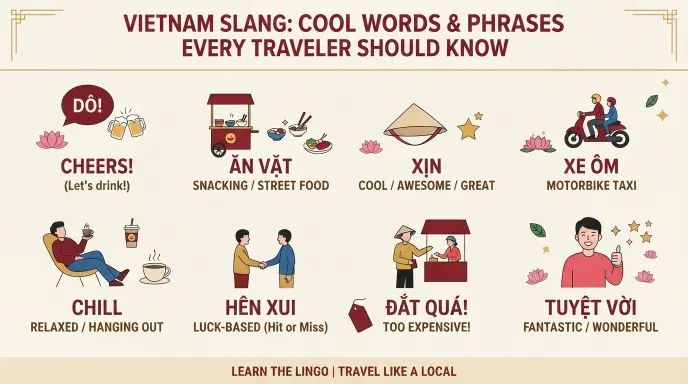
“Vietnam slang” refers to informal words and expressions used by Vietnamese people, especially youth, in everyday conversations that often don’t appear in formal language.
Vietnam slang refers to informal words and expressions used by Vietnamese people, especially youth, in everyday conversations that often don’t appear in formal language.
Vietnamese slang has evolved rapidly, blending traditional expressions with modern internet culture and pop trends. From casual greetings to playful insults, these words reflect how younger generations communicate differently from textbook Vietnamese. Understanding this slang gives you a more authentic feel for the language.
Many slang terms originate from social media, music, and everyday street conversations across Vietnam. Words often carry humor, sarcasm, or regional flavor that formal language simply can’t capture. Learning them helps travelers and language learners connect more naturally with locals.
This guide covers the most popular and widely used Vietnam slang terms, along with their meanings and context. Whether you’re planning a trip, learning the language, or just curious about Vietnamese culture, this article gives you a clear and practical reference.
Quick Answer:
Vietnam slang refers to informal Vietnamese words, abbreviations, expressions, and internet phrases used in casual communication. Their meaning often depends on context, relationship, tone, and the online community using them.
What Does Vietnam Slang Mean in Text?
Understanding Vietnamese slang
Vietnamese slang is informal language used in everyday conversations, especially among friends and younger speakers. It can appear in text messages, social media comments, online games, memes, and casual face-to-face conversations.
Some slang words are shortened versions of normal Vietnamese words. Others are playful expressions that developed through internet culture.
For example, you may see terms such as ib, rep, toang, xịn, đỉnh, or crush online. A beginner who only studies formal Vietnamese may not immediately recognize them.
Why slang can be difficult for learners
Slang does not always follow the straightforward meaning found in a dictionary.
A Vietnamese expression can have:
- A literal meaning
- A slang meaning
- A humorous meaning
- A sarcastic meaning
- A meaning that changes according to tone
For this reason, learning Vietnamese slang is not simply about memorizing vocabulary. You also need to understand when and how people use it.
Popular Vietnam Slang Words and Their Meanings
Common expressions you may see online
The following table gives a useful introduction to some widely encountered Vietnamese slang and informal expressions.
| Vietnamese slang | Approximate meaning | Typical use |
| Đỉnh | Awesome, excellent, top-level | Praise |
| Xịn | High-quality, cool, impressive | Casual conversation |
| Toang | Failed, ruined, things went badly | Humor or bad situations |
| Chill | Relaxed, take it easy | Casual/internet speech |
| Crush | Person you like romantically | Youth slang |
| Ib | Inbox / private message | Social media |
| Rep | Reply | Texting/social media |
| Vãi | Very/extremely, often emphatic | Very informal |
| Trời ơi | Oh my God / Oh wow | Surprise or frustration |
| Haha | Laughter | Texting/social media |
These expressions are not all slang in exactly the same way. Some are internet abbreviations, some are borrowed from English, and some are informal Vietnamese expressions.
Đỉnh
Đỉnh literally relates to the top or peak of something. In casual speech, it can mean excellent, amazing, impressive, or extremely good.
For example:
“Món này đỉnh quá!”
This can be understood as:
“This is so good!”
Someone might also describe a talented person as đỉnh when they are impressed by that person’s ability.
Xịn
Xịn is an informal expression commonly used to describe something as high-quality, cool, impressive, or premium.
For example:
“Điện thoại mới xịn quá!”
The speaker is saying that the new phone looks really good or impressive.
Because xịn is casual, it is much more natural in friendly conversation than in formal writing.
Toang
Toang is a popular informal expression used when something has gone wrong, failed, or been ruined.
It can be humorous rather than extremely serious.
For example:
“Quên làm bài rồi, toang!”
The general idea is:
“I forgot to do the assignment. I’m screwed!”
The exact English translation changes with the situation, but the feeling is usually that something has gone badly.
Vietnamese Internet Slang and Abbreviations
IB and inbox language
Ib is commonly used online as a shortened form related to inbox. You may see it when someone asks another person to send a private message.
For example:
“Ib mình nhé.”
This means something similar to:
“Message me privately.”
It is particularly common in social media and online buying and selling.
Rep
Rep is an informal abbreviation based on the English word reply.
Someone might write:
“Rep tin nhắn của mình nhé.”
The meaning is:
“Please reply to my message.”
This is a good example of how English influences modern Vietnamese internet language.
Is Vietnam Slang Rude or Offensive?
It depends on the expression
Not all Vietnamese slang is offensive. Words such as đỉnh, xịn, and chill are generally casual rather than insulting.
However, some slang can be vulgar, aggressive, or inappropriate in formal situations.
The safest approach is to consider:
- Who are you speaking to?
- How well do you know them?
- Is the conversation formal or casual?
- Is the expression commonly accepted in that group?
- Could the word be interpreted as insulting?
A slang word can sound perfectly normal among close friends but inappropriate when used with an older person or professional contact.
Strong language requires extra care
Some Vietnamese internet slang uses profanity or shortened forms of offensive expressions. These terms may appear frequently online, but that does not mean they are polite.
If you are learning Vietnamese, it is better to understand such expressions before using them yourself.
Knowing what an offensive word means is different from recommending that you use it.
Vietnam Slang in Social Media
Facebook, TikTok, and messaging
Vietnamese social media users frequently mix traditional Vietnamese vocabulary with abbreviations, English words, memes, and playful spelling.
Common online expressions can include:
- Ib — private message
- Rep — reply
- Crush — romantic interest
- Like — like
- Follow — follow
- Haha — laughter
- Chill — relax or relaxed
- Drama — controversy or conflict
Some of these expressions are borrowed directly from English and have become familiar in Vietnamese online communication.
Why young people use internet slang
Internet slang is often shorter and more expressive than formal language.
Instead of writing a complete sentence, someone can use an abbreviation that everyone in the conversation understands.
Slang can also communicate emotion. A simple word such as toang may express disappointment while also making the situation sound humorous.
Real-Life Examples of Vietnam Slang
Friendly example
Vietnamese:
“Hôm nay nhìn bạn xịn quá!”
Meaning:
“You look really cool today!”
Here, xịn is being used positively.
Casual example
Vietnamese:
“Cuối tuần chill không?”
Meaning:
“Want to chill this weekend?”
The expression is relaxed and suitable for casual conversation between friends.
Funny example
Vietnamese:
“Mai thi mà chưa học gì. Toang rồi!”
Meaning:
“The exam is tomorrow and I haven’t studied. I’m screwed!”
The speaker is describing a bad situation in a humorous way.
Social media example
Vietnamese:
“Có gì ib mình nhé.”
Meaning:
“If you need anything, message me privately.”
This kind of shortened language is common in online communication.
Compliment example
Vietnamese:
“Bạn chơi game đỉnh thật!”
Meaning:
“You’re really good at gaming!”
Here, đỉnh expresses strong approval.
Vietnam Slang Compared With Formal Vietnamese
Casual language vs formal language
One of the most important things for Vietnamese learners is knowing the difference between slang and standard language.
| Situation | Casual/slang style | More neutral approach |
| Talking to a close friend | “Ib mình nhé” | “Nhắn tin cho mình nhé” |
| Complimenting something | “Xịn quá!” | “Rất tốt/đẹp” |
| Describing failure | “Toang rồi!” | “Không ổn rồi” |
| Saying something is excellent | “Đỉnh quá!” | “Rất tuyệt” |
| Relaxing | “Chill thôi” | “Thư giãn thôi” |
The casual version may sound more natural among friends, while the neutral version is easier to use across different situations.
Vietnamese Slang vs English Internet Slang
Similarities between the two
Vietnamese internet culture has many similarities with English-speaking online communities.
| Vietnamese expression | Rough English equivalent | General idea |
| Đỉnh | Awesome | Strong praise |
| Xịn | Cool / high-quality | Approval |
| Toang | I’m screwed | Something went wrong |
| Chill | Relax | Calm situation |
| Crush | Crush | Romantic interest |
| Rep | Reply | Respond |
| Ib | DM/message | Private communication |
These are approximate equivalents, not perfect translations. The emotional meaning can change depending on the sentence.
Why direct translation can be misleading
Slang is closely connected to culture and context.
For example, translating every Vietnamese slang word literally may produce an English sentence that sounds strange. The better approach is to understand what the speaker is trying to communicate.
This is particularly important when learning Vietnam slang meaning in text.
Origin and Background of Vietnamese Slang
Traditional language meets internet culture
Vietnamese slang has developed from several sources.
Some informal expressions come from everyday spoken Vietnamese. Others have become popular through television, music, youth culture, memes, gaming, and social media.
The growth of smartphones and messaging platforms has accelerated this process.
People naturally create shorter ways of communicating when they spend a lot of time typing on phones.
English influence
English has also influenced Vietnamese internet slang.
Words such as crush, chill, like, follow, and rep demonstrate how English vocabulary can be adapted into Vietnamese conversations.
This does not mean Vietnamese speakers are replacing Vietnamese with English. Instead, online language often combines elements from both languages.
When Should You Avoid Vietnamese Slang?
Formal and professional situations
Avoid slang when speaking or writing to people in formal settings unless you already know that the expression is appropriate.
Be especially careful with slang in:
- Job interviews
- Business emails
- Academic writing
- Official documents
- Customer service
- Professional presentations
- Formal introductions
A neutral expression is usually safer.
When speaking with older people
Vietnamese communication places considerable importance on relationships, age, and social roles.
An expression that sounds perfectly normal between young friends may sound disrespectful or overly casual when directed toward an older person.
If you are uncertain, start with more polite language and become more casual only when the relationship makes it appropriate.
Why Do People Use Vietnam Slang?
Slang makes communication expressive
Slang can make a conversation feel more relaxed and personal.
People use it to:
- Show humor
- Express excitement
- Create a friendly atmosphere
- Save typing time
- Show group identity
- Follow online trends
- Make messages more emotional
A single slang word can sometimes communicate an entire emotional reaction.
Slang creates a sense of belonging
Online communities often develop their own vocabulary. Knowing these expressions can make members feel that they understand the culture of the group.
This is especially noticeable among gamers, social media users, students, and younger online communities.
Impact of Slang on Communication

The positive side
Slang can make communication:
- Faster
- More expressive
- More humorous
- More personal
- More natural among friends
It can help conversations feel less formal and more spontaneous.
The negative side
However, slang can also create problems.
It may:
- Confuse language learners
- Cause misunderstandings
- Sound disrespectful
- Become outdated
- Have different meanings in different groups
- Be inappropriate in professional situations
That is why understanding context is more important than simply memorizing slang words.
Is Vietnam Slang Safe for Social Media?
Think about meaning and audience
Using ordinary Vietnamese slang in a social media conversation is generally a matter of tone and appropriateness. However, individual platforms may have their own rules concerning harassment, abusive language, adult content, or other restricted material.
Before posting, consider whether your wording could be misunderstood or interpreted as offensive.
A good rule is simple:
If you would not say the expression to someone directly, think carefully before posting it publicly.
FAQs
What is the meaning of Vietnam slang?
Vietnam slang refers to informal Vietnamese words, expressions, abbreviations, and internet phrases used in casual communication. Their meaning often depends on context.
What are some Vietnamese slang words?
Popular Vietnamese slang words include “trẻ trâu” (immature person), “gấu” (girlfriend/boyfriend), “sương sương” (light/simple), and “cực” (extremely/very).
What does “du ma mai” mean?
“Du ma mai” is a vulgar Vietnamese swear phrase, generally used as a strong curse word, similar to offensive expressions in English: it’s considered rude and inappropriate in polite conversation.
What is a slang term for “Vietnamese”?
“Viet” or “Nam” are casual/informal short forms commonly used to refer to Vietnamese people or Vietnam itself.
What to call a girlfriend in Viet?
A girlfriend is commonly called “bạn gái,” while the slang term “gấu” (meaning “bear”) is also affectionately used.
What is “I love you” in Viet?
“I love you” in Vietnamese is “Anh yêu em” (male to female) or “Em yêu anh” (female to male).
What does “boom boom” mean in Vietnam?
“Boom boom” is slang sometimes used informally to refer to sexual activity: it’s considered crude and best avoided in respectful or formal conversation.
Conclusion
Understanding Vietnam slang can make Vietnamese texts, social media posts, comments, and conversations much easier to follow. Expressions such as đỉnh, xịn, toang, chill, crush, ib, and rep are examples of the informal language you may encounter online.
However, slang should never be understood in isolation. The same expression can sound friendly, funny, sarcastic, or inappropriate depending on the speaker, audience, relationship, and situation.
If you are learning Vietnamese, focus first on understanding the meaning and context of slang before using it yourself. For professional or formal communication, neutral Vietnamese is usually the better choice.
In short, Vietnam slang meaning in text is all about context, culture, and tone. Once you understand how Vietnamese speakers use informal expressions in real conversations, online communication becomes much easier to understand and much more natural.
Useful Resources!

Hi, I’m Rebecca Morris, a UK-based freelance writer and editor with a passion for creating clear, engaging, and well-researched content. I write about lifestyle, technology, travel, and consumer topics, with a focus on making complex information simple and useful for everyday readers. I enjoy producing accurate, practical, and trustworthy articles that help people make informed decisions. When I’m not writing, I love exploring the British countryside, discovering independent cafés, and staying up to date with the latest trends in digital media and online publishing