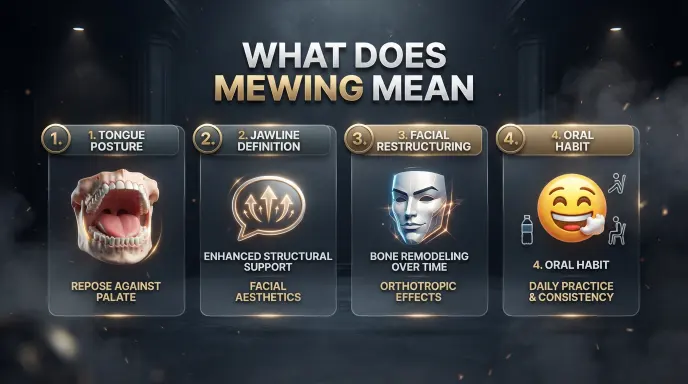
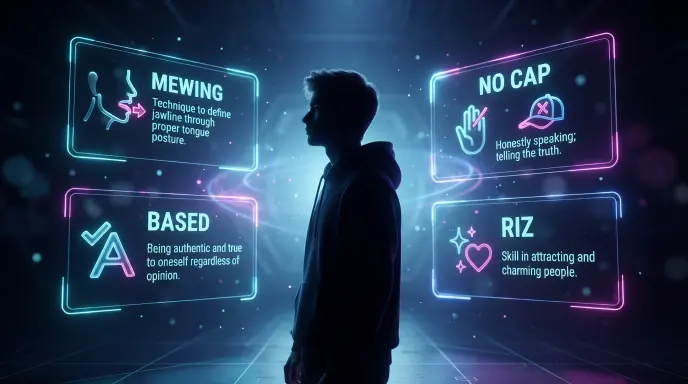
Mewing is a tongue-posture technique:pressing the tongue against the roof of the mouth that has become slang on social media for improving jawline definition.
“Mewing is a tongue-posture technique: pressing the tongue against the roof of the mouth that has become slang on social media for improving jawline definition.
This slang term refers to the practice of pressing your tongue flat against the roof of your mouth, believed by many on social media to sharpen the jawline over time.
The trend has taken over TikTok, Instagram, and YouTube as one of the most talked-about ‘self-improvement’ topics among teens and young adults. However, behind the viral videos and before-after transformations lies a real orthodontic concept with a name and a history.”
The term is named after British orthodontist Dr. John Mew, who first introduced this tongue posture technique decades ago as part of a broader theory called “orthotropics.”The term is named after British orthodontist Dr. John Mew, who first introduced this tongue posture technique decades ago as part of a broader theory called ‘orthotropics.’ Eventually, his son, Dr. Mike Mew, popularized it further, sparking the online slang usage we see today.”
In slang usage, “mewing” now refers loosely to the practice of holding proper tongue posture consistently, with claims ranging from a more defined jaw to better facial symmetry. It’s often used as a verb: “I’ve been mewing for 3 months.”
Quick Answer:
In internet slang, mewing usually refers to the viral practice or meme of positioning the tongue against the roof of the mouth, often associated online with improving the appearance of the jawline. It is also used humorously as a meme or reaction.
What Does Mewing Mean in Text?
Mewing slang meaning explained
“In online conversations, mewing usually refers to the viral internet trend involving tongue posture and the appearance of the jawline.
The term became widely recognized through social media videos where people demonstrated the supposed technique, often while making a serious facial expression. Over time, the word became a meme rather than simply a description of a physical practice.
For example, someone might comment:
“Bro is mewing again.”
In this sentence, the person is usually joking that someone is deliberately holding a certain facial expression or tongue position.
The word can therefore be used seriously, casually, or humorously.
Why people search for this slang
People commonly search what does mewing mean slang because they encounter the word in places such as:
- TikTok comments
- Instagram Reels
- YouTube Shorts
- Snapchat
- Gaming chats
- Memes
- Group messages
- Online jokes
Someone who has never encountered the trend may see “mewing” repeatedly and wonder if it is a new abbreviation, insult, or secret internet phrase.
It is mainly a viral slang term connected with online meme culture.
What Is the Full Meaning of Mewing?
What does mewing stand for?
Unlike abbreviations such as “LOL” or “BRB,” mewing is not an acronym. Therefore, it does not have a traditional “full form.”
The word comes from the name Mew, associated with the technique popularized online. The term was later transformed into a broader internet expression.
In slang, “mewing” can mean:
- Doing the viral tongue-positioning practice
- Trying to make the jawline look more defined
- Holding a particular facial expression for a meme
- Joking about someone’s jawline
- Pretending to be unable to speak because they are “mewing”
The exact interpretation depends on the context.
Mewing meaning vs literal meaning
The word “mewing” has another completely different meaning in ordinary English.
A cat can mew, meaning it makes a soft crying or calling sound.
Online slang, however, generally has nothing to do with cats when people are discussing jawlines, TikTok trends, or facial expressions.
| Meaning | Explanation | Typical context |
| Mewing as slang | Viral tongue-posture/jawline meme | TikTok, memes, social media |
| Mewing as a verb | Making a soft cat sound | Animals and ordinary English |
| Mewing as a joke | Pretending to focus on jawline appearance | Internet humor |
This is why the surrounding conversation is important.
Is Mewing Rude, Offensive, or Neutral?
Is the slang offensive?
Generally, mewing is not an inherently rude or offensive word.
It is usually used as a humorous internet expression. Someone might jokingly tell a friend that they are “mewing” because of the facial expression they are making.
However, context can change the tone.
For example:
“Why are you mewing in every picture?”
This could be playful teasing between friends.
But if someone repeatedly uses the term to mock another person’s appearance, it could become insulting.
When the word can sound negative
Mewing may become negative when it is used to make fun of someone’s:
- Face
- Jawline
- Appearance
- Self-confidence
- Efforts to change their appearance
The word itself is not necessarily offensive. The intention behind it matters more.
A good rule is to avoid using appearance-related slang to embarrass someone.
Where Is Mewing Slang Commonly Used?
Social media platforms
Mewing became especially popular through short-form video content.
You may encounter the word in:
- TikTok videos
- YouTube Shorts
- Instagram Reels
- Facebook memes
- Snapchat messages
- Online forums
Short videos helped turn “mewing” from a niche term into a recognizable internet meme.
Gaming and online communities
The word can also appear in gaming chats.
A player might jokingly write:
“Stop mewing and focus on the game.”
The statement is usually not literal. It is simply using a trending meme as part of casual conversation.
Gaming communities often adopt viral expressions quickly, so slang can spread from one platform to another.
Real-Life Examples of Mewing Slang
Friendly example
“Why are you mewing for the camera?”
A friend might say this jokingly when another person is posing seriously.
The tone is playful rather than insulting.
Casual texting example
“Bro has been mewing all day 😂”
This usually means the speaker is joking about someone’s facial expression or obsession with the trend.
Social media example
“The comments are all about mewing.”
Here, the writer is simply pointing out that people are discussing the viral trend.
Argumentative example
“Stop making fun of me for mewing.”
In this context, the word is still slang, but the conversation has become more serious.
Gaming example
“Bro is mewing instead of defending the team.”
This is likely a humorous meme reference rather than a literal statement.
Meme example
“When you start mewing and suddenly everyone wants to know your secret.”
This type of sentence uses “mewing” as part of internet humor.
Where Did Mewing Come From?
Origin of the term
The modern internet use of mewing comes from a technique associated with tongue posture and the work of British orthodontist John Mew and his son Mike Mew.
The concept became widely discussed online in connection with facial structure and jaw appearance.
Social media then transformed the subject into a viral trend.
Rather than remaining a niche discussion about tongue posture, “mewing” became a recognizable meme that people could use in jokes, videos, captions, and comments.
How the internet changed its meaning
Internet culture frequently takes a serious concept and turns it into entertainment.
Mewing is a good example.
The word originally referred to a particular practice, but online users began using it in exaggerated ways. Videos might show someone refusing to talk because they are supposedly “mewing,” while memes might exaggerate the idea of having an extremely sharp jawline.
This helped the word become part of everyday internet slang.
Comparision Between Intrnet And Mewing Slang
Mewing and looks-related slang
| Term | General meaning | Common online use |
| Mewing | Tongue-posture/jawline trend | Memes and appearance content |
| Glow up | Noticeable improvement in appearance or lifestyle | Social media |
| Looksmaxxing | Online appearance-improvement culture | Internet communities |
| Jawline | Shape of the lower face | Fitness/appearance discussions |
| Chad | Meme stereotype of an attractive/confident man | Memes |
These terms are related in some online communities, but they do not mean the same thing.
Mewing vs looksmaxxing
Mewing is a specific term associated with tongue posture and jawline-related internet culture.
Looksmaxxing is a much broader internet term describing attempts to improve one’s physical appearance.
Therefore:
Mewing = one specific trend
Looksmaxxing = broader appearance-focused culture
Understanding this difference can make online conversations much easier to follow.
Why Do People Use Mewing as Slang?
Humor is the biggest reason
The popularity of mewing is strongly connected to humor.
People often use the word because it is recognizable and easy to turn into a joke.
For example:
“Can’t talk right now. I’m mewing.”
Obviously, the statement is often exaggerated for comedic effect.
Viral trends spread quickly
Social media algorithms can make a phrase popular very quickly. Once enough creators use a word, viewers begin repeating it in comments and messages.
Mewing became especially effective as slang because it can be:
- Demonstrated visually
- Used in memes
- Turned into jokes
- Connected with facial expressions
- Easily recognized by younger internet users
Impact of Mewing Slang on Communication
Positive effects
Using a popular slang term can make a conversation feel:
- Casual
- Funny
- Current
- Friendly
- Connected to internet culture
If both people understand the meme, “mewing” can communicate an idea quickly without a long explanation.
Negative effects
The problem is that slang can become confusing when the reader does not know the trend.
Someone unfamiliar with internet culture might interpret “mewing” literally and think the speaker is talking about cats.
Slang can also become annoying if it is overused or used to mock people.
Therefore, good communication still depends on knowing your audience.
Mewing vs Other Common Internet Expressions
Quick comparison
| Expression | What it usually means | Tone |
| Mewing | Viral jawline/tongue-posture meme | Playful |
| LOL | Laughing | Casual |
| Based | Approval of an opinion | Casual/internet |
| Sus | Suspicious | Humorous |
| Cringe | Embarrassing or awkward | Informal |
| Slay | Doing something impressively | Positive |
Mewing is different because it refers to a specific viral trend rather than being a general reaction word.
When Should You Avoid Using Mewing Slang?
Formal communication
“Mewing” is not normally appropriate in:
- Academic essays
- Business reports
- Job applications
- Formal emails
- Official documents
- Professional presentations
If the topic genuinely requires discussion of the concept, explain it clearly rather than assuming every reader knows the slang.
When speaking to unfamiliar people
If you do not know if someone understands internet slang, a more direct explanation is safer.
Instead of saying:
“He’s mewing.”
You could say:
“He’s joking about the jawline trend.”
That removes ambiguity.
Is Mewing Safe for Social Media?
Understanding the meme
Using the word “mewing” in an ordinary joke or conversation is generally just a form of internet slang.
However, creators should be careful when discussions move from memes into claims about changing facial structure or improving health.
A viral trend should not automatically be treated as scientific or medical advice.
If a conversation involves health, orthodontics, facial development, or physical changes, reliable professional information is more appropriate than relying on social media claims.
Be respectful of appearance
Mewing memes are often harmless, but appearance-based jokes can affect people differently.
Avoid using the term to bully someone or repeatedly criticize their face.
A meme is fun when everyone involved understands the joke. It becomes harmful when it is used to embarrass or target someone.
FAQs
What does mewing mean slang?
In internet slang, mewing usually refers to the viral tongue-posture and jawline trend. It is also frequently used as a joke or meme on social media.
Where did the term “mewing” originate?
The term “mewing” originated from British orthodontist Dr. John Mew, who developed the tongue-posture technique in the 1970s as part of his “orthotropics” theory. His son, Dr. Mike Mew, later popularized it further, and the name eventually became internet slang.
What is mewing in Gen Z slang?
In Gen Z slang, “mewing” refers to the practice of keeping your tongue pressed against the roof of your mouth to supposedly improve jawline definition. It’s also used jokingly as a reaction word, similar to saying “focus” or “fix your posture.”
Why do kids say mewing?
Kids and teens say “mewing” mainly because of viral TikTok trends promising a sharper jawline without surgery. It’s also become a meme-worthy phrase used humorously in everyday conversations, often unrelated to actual jaw exercises
Who started the mewing trend?
Dr. John Mew started the original technique, but the online “mewing trend” exploded thanks to TikTok creators, YouTubers, and looksmaxxing communities who turned it into a viral self-improvement challenge around 2020.
When did mewing become a meme?
Mewing became a full-blown meme around 2020–2021, when TikTok users began using it humorously in unrelated contexts, turning a real orthodontic term into an internet joke and reaction phrase.
Is mewing good or bad?
Mewing itself (correct tongue posture) isn’t harmful, but there’s limited scientific evidence supporting dramatic jawline changes in adults. Experts say results, if any, are subtle and mostly effective during childhood growth years: not a guaranteed transformation.
How does Gen Z say “sorry”?
Gen Z often says “sorry” using slang alternatives like “my bad,” “oops,” “mb,” or simply “soz”: casual, quick expressions rather than formal apologies.
Conclusion:
The answer to what does mewing mean slang is fairly simple: online, mewing usually refers to the viral tongue-posture and jawline trend that became popular through social media and memes.
The word can also be used humorously to describe someone posing, making a serious facial expression, or joking about appearance. It is generally casual and is not automatically rude or offensive.
The most important thing to remember is context.”In a TikTok comment, ‘mewing’ may be a joke. During a conversation about cats, it can carry its ordinary English meaning. But in a serious discussion about facial development, the term may refer to the underlying practice rather than simply the meme.”
If you understand the platform, audience, and tone, the mewing slang meaning becomes much easier to recognize. Like most internet slang, it is best used casually, respectfully, and only when the people involved understand the reference.
Further Reading!

I am Alisha Abbas, a slang expert and language enthusiast specializing in modern slang, internet expressions, and everyday language trends. I study the meanings, origins, and cultural influences behind slang words to make them easy to understand for readers. My work focuses on exploring how language evolves and helping people communicate better in today’s fast-changing digital world.