Ecuadorian slang words are informal expressions and phrases used by locals in Ecuador, blending Spanish with unique regional flavor, cultural references, and everyday humor.
Whether you’re planning a trip to Ecuador, chatting with Ecuadorian friends online, or simply curious about Latin American culture, understanding local slang can make a huge difference. It helps you sound more natural and connect better with native speakers.
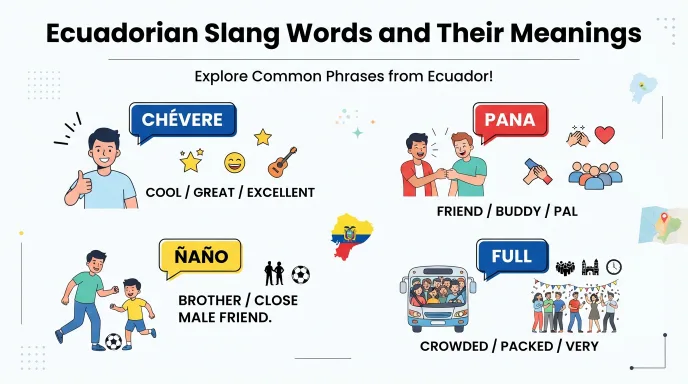
Ecuador has its own rich vocabulary that you won’t find in a standard Spanish textbook. Words like “chévere,” “pana,” and “ñaño” are used daily by people of all ages across the country.
In this guide, we’ll break down the most common Ecuadorian slang words and expressions, along with their real meanings and how to use them correctly. You’ll also learn the context behind each phrase, from casual greetings to expressions of surprise or frustration.
By the end of this article, you’ll be able to understand and even use Ecuadorian slang like a true local, whether you’re traveling, working, or just expanding your Spanish vocabulary.
Quick Answer:
Ecuadorian slang includes words like chévere (cool), pana (friend), ñaño/ñaña (bro/sis), full (very/a lot), chuta (darn/wow), and chucha (an informal exclamation of shock or anger) commonly used in everyday casual conversation across Ecuador.
What Are Ecuadorian Slang Words?
Ecuadorian slang words are informal expressions commonly used in everyday Ecuadorian Spanish. They are different from formal Spanish because they often reflect local culture, humor, relationships, and regional identity.
Some slang terms are used across much of Ecuador, while others are especially common in particular areas. For example, people in coastal cities may use expressions that sound different from those commonly heard in the Andes.
Slang is also flexible. The same word can have a positive, negative, or humorous meaning depending on the speaker’s tone and the situation.
Why Is Ecuadorian Spanish Different?
Ecuador has several geographical regions, including the Andes, the coast, the Amazon, and the Galápagos Islands. Because of this cultural and geographical diversity, Spanish has developed different local expressions.
You may hear a word among close friends that would sound unusual in a formal conversation. This does not necessarily mean the word is incorrect. It simply means that it belongs to informal language.
Ecuadorian Slang vs. Standard Spanish
| Ecuadorian Expression | Common Meaning in English | Formal/Standard Alternative |
| Ñaño / Ñaña | Brother, sister, close friend | Hermano / Hermana |
| Chiro | Broke, without money | Sin dinero |
| Pana | Friend, buddy | Amigo |
| Bacán | Cool, great | Genial |
| Chuchaqui | Hangover | Resaca |
| Yapa | Extra item or bonus | Extra |
| Camello | Job or work | Trabajo |
| Mande | Yes? / What did you say? | ¿Sí? / ¿Qué dijo? |
Common Ecuadorian Slang Words and Their Meanings
There are many Ecuadorian slang words worth learning, but a few appear frequently in casual conversations. Understanding these expressions can make Ecuadorian Spanish much easier to follow.
1. Ñaño and Ñaña
Ñaño generally refers to a brother, while ñaño can also be used informally for a close male friend. Ñaña can refer to a sister or a close female friend.
The meaning depends heavily on context.
For example:
“Mi ñaño viene mañana.”
This can mean, “My brother is coming tomorrow.”
Among friends, however, someone might use the word more casually to show closeness.
2. Pana
Pana means friend, buddy, or pal. It is one of the easiest Ecuadorian slang words to understand because it is commonly used in informal conversations.
Example:
“Él es mi pana.”
Meaning:
“He is my friend.”
You may hear pana when people talk about friends, classmates, coworkers, or people they know well.
3. Chiro
If someone says they are chiro, they usually mean they have little or no money.
For example:
“No puedo salir hoy, estoy chiro.”
This means:
“I can’t go out today; I’m broke.”
This is a useful expression to recognize because it may appear in jokes or casual conversations about spending money.
4. Bacán
Bacán means cool, awesome, great, or excellent.
Someone might say:
“¡Qué bacán!”
Depending on the situation, this could mean:
“That’s awesome!”
It is generally positive and can describe a person, experience, place, object, or idea.
5. Chuchaqui
One of the most recognizable Ecuadorian slang expressions is chuchaqui, which means hangover.
For example:
“Tengo chuchaqui.”
means:
“I have a hangover.”
This word is strongly associated with Ecuadorian Spanish and is particularly useful to know when listening to informal conversations.
6. Yapa
Yapa refers to something extra given as a bonus, especially when buying something.
Imagine buying food at a local market and receiving a little extra from the seller. That extra portion can be called a yapa.
Example:
“¿Me da una yapa?”
Depending on context, this can mean:
“Can you give me a little extra?”
The expression is connected to a wider Andean tradition of giving something additional beyond what was originally purchased.
7. Camello
In Ecuadorian informal Spanish, camello can refer to a job or work.
For example:
“Tengo que ir al camello.”
This can mean:
“I have to go to work.”
It is informal, so it is better suited to conversations with friends or people you know rather than formal professional writing.
8. Mande
Mande is an interesting expression because it does not have one simple English translation.
Someone may say mande? when they did not hear you or want you to repeat something. It can function similarly to:
- “Yes?”
- “What?”
- “Sorry?”
- “What did you say?”
Example:
“Mande, no escuché.”
Meaning:
“Sorry, I didn’t hear you.”
It is generally more polite than simply responding with “¿Qué?”
9. Guagua
Guagua is a word with Indigenous linguistic roots that is used in parts of Ecuador to mean baby or small child.
You may encounter it in everyday speech, particularly in contexts involving families and children.
For Spanish learners, this is a good example of how Ecuadorian Spanish can contain vocabulary influenced by Indigenous languages and local culture.
10. Taita and Mama
Taita can be used as a respectful term for father or an older/respected man, while mama can have cultural and regional meanings beyond simply “mother.”
These terms are especially interesting because Ecuadorian Spanish reflects interactions between Spanish and Indigenous cultures.
They may have different meanings depending on the community and context, so learners should avoid assuming that every Ecuadorian uses them in exactly the same way.
Ecuadorian Slang Words for Friends
If you are chatting with Ecuadorians online or meeting people socially, friendship-related expressions are especially useful.
Popular Friendly Expressions
| Slang Word | Meaning | Typical Feeling |
| Pana | Friend / buddy | Friendly |
| Ñaño | Brother / close friend | Very familiar |
| Bacán | Cool / awesome | Positive |
| Chévere | Cool / nice | Positive |
| Mijo | My son / dear | Affectionate |
| Mija | My daughter / dear | Affectionate |
The exact meaning can change depending on who is speaking and their relationship.
For example, mijo and mija may literally relate to “my son” or “my daughter,” but they can also be used affectionately toward someone who is not actually the speaker’s child.
Are These Words Safe to Use?
Most friendly expressions are relatively safe in casual conversations, but context matters.
Using pana with a friend is generally natural. Using very informal language in a job interview, official meeting, or formal email may sound inappropriate.
A good rule is simple: listen first and copy the level of formality used by the people around you.
Ecuadorian Slang Words You May Hear in Daily Life
Ecuadorian slang is not limited to friendship. People use informal expressions when talking about money, work, food, parties, family, and everyday situations.
Everyday Vocabulary Comparison
| Ecuadorian Slang | English Meaning | Example Situation |
| Chiro | Broke / no money | Talking about finances |
| Camello | Work / job | Talking about employment |
| Yapa | Extra / bonus | Buying something |
| Chuchaqui | Hangover | Talking after drinking |
| Pana | Friend | Talking about someone close |
| Bacán | Cool | Describing something enjoyable |
| Guagua | Baby / child | Talking about children |
| Mande | Sorry? / What? | Asking someone to repeat |
Learning these words can help you understand conversations that might otherwise seem confusing.
Ecuadorian Slang in Text Messages and Social Media
Slang becomes even more flexible when people communicate through WhatsApp, Instagram, TikTok, Facebook, or text messages.
People often shorten phrases, remove words, use emojis, or combine traditional slang with internet expressions.
How Slang Changes Online
Online Ecuadorian Spanish may include abbreviations and casual spellings that are not appropriate for formal writing.
For example, a friend might write:
“Qué bacán 😂”
The meaning is essentially:
“That’s so cool!”
The emoji adds emotion, making the message feel more playful.
When reading messages, do not translate every word separately. Instead, consider the whole sentence and the relationship between the speakers.
Formal vs. Informal Ecuadorian Spanish
| Situation | Better Style | Example |
| Job interview | Formal | “Buenos días, señor.” |
| Talking to a friend | Informal | “Hola, pana.” |
| Texting a close friend | Very casual | “Qué bacán 😂” |
| Speaking to a teacher | Respectful | Formal Spanish |
| Chatting with family | Casual | Local expressions are common |
Ecuadorian Slang That Can Sound Rude
Not every slang expression is friendly. Some words are vulgar, insulting, or appropriate only among people who know each other well.
This is important for Spanish learners. A word you see online may be presented as “funny Ecuadorian slang,” but using it with a stranger could create an uncomfortable situation.
Think About Context Before Using Slang
Before using an unfamiliar expression, consider three things:
- Who are you talking to?
- Where are you talking?
- What tone does the expression have?
A close friend may laugh at an informal expression, while the same expression could offend someone in a formal setting.
Why Learn Ecuadorian Slang Words?
Learning slang is not only about speaking Spanish more naturally. It can also help you understand Ecuadorian culture.
Slang Helps You Understand Real Conversations
Textbooks usually teach standard vocabulary first. That is useful, but real conversations often sound different.
If you know words such as pana, ñaño, chiro, bacán, yapa, and chuchaqui, you may understand conversations that previously seemed difficult.
Slang also gives you insight into how people express humor, friendship, affection, and local identity.
Slang Makes Travel Easier
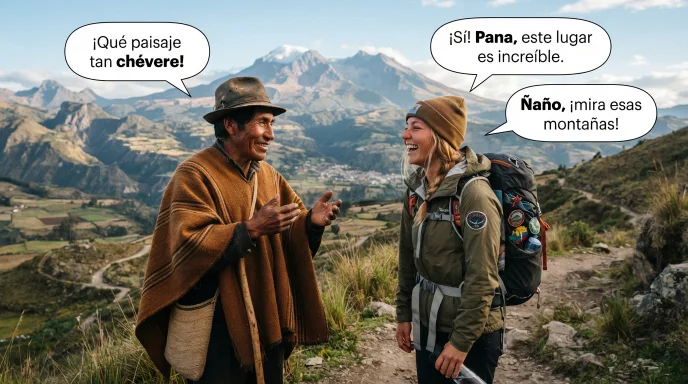
If you visit Ecuador, knowing a few local expressions can make everyday interactions more comfortable.
You do not need to use every slang word yourself. Simply recognizing them can be enough.
For example, if someone says “qué bacán”, you will know that they are expressing enthusiasm rather than saying something strange or confusing.
How to Learn Ecuadorian Slang Naturally
The best way to learn slang is through context instead of memorizing a giant vocabulary list.
Listen to Native Speakers
Pay attention to interviews, Ecuadorian movies, videos, podcasts, and everyday conversations.
Notice:
- Which words appear repeatedly
- Who uses them
- if the tone is friendly or rude
- if the expression is regional
- What words appear before and after it
Context is often more important than a dictionary definition.
Start With a Small Vocabulary
Do not try to memorize dozens of slang terms at once.
Start with five or six common words:
pana, ñaño, bacán, chiro, yapa, and chuchaqui.
Once you understand these, add more expressions gradually.
This approach makes the vocabulary easier to remember and reduces the chance of using an expression incorrectly.
FAQs:
What is the most common Ecuadorian slang word?
There is no single slang word that every Ecuadorian uses in every situation. Pana, ñaño, bacán, and other expressions are commonly recognized, but usage can vary by region, age, and social group.
What is “chuta” in Ecuador?
An exclamation of surprise, frustration, or annoyance, similar to “darn!” or “wow!”
What does “chucha” mean in Ecuador?
It’s a vulgar/informal exclamation of shock, anger, or frustration (considered mildly to strongly rude depending on tone and context).
What’s “what’s up” in Ecuadorian slang?
People commonly say “¿Qué más?” or “¿Qué hubo, pana?” as casual equivalents of “what’s up?”
What are some common Ecuadorian words and expressions?
Popular ones include chévere (cool), pana (friend), ñaño/ñaña (bro/sis), full (very/a lot), and jama (food).
conclusion:
Learning ecuadorian slang words is a great way to move beyond textbook Spanish and understand how people communicate in everyday Ecuadorian life. Words such as pana, ñaño, bacán, chiro, yapa, camello, and chuchaqui can make conversations easier to understand and give you a better sense of local culture.
The most important lesson is to remember that slang depends on context. A word can sound friendly between close friends but inappropriate in a professional environment. Regional differences also matter, so listening to native speakers is one of the best ways to learn.
You do not need to use every expression immediately. Start by recognizing the words, learn how native speakers use them, and then introduce the safest expressions into casual conversations.

I am Alisha Abbas, a slang expert and language enthusiast specializing in modern slang, internet expressions, and everyday language trends. I study the meanings, origins, and cultural influences behind slang words to make them easy to understand for readers. My work focuses on exploring how language evolves and helping people communicate better in today’s fast-changing digital world.