Cigarette in Spanish slang refers to informal, regional words used across Spanish-speaking countries to casually refer to a cigarette, often used in texting and everyday conversation.
If you’ve ever seen words like “pucho” or “frajo” in a text message or chat with Spanish-speaking friends, you might have wondered what they actually mean. These aren’t standard dictionary words they’re slang.
Spanish slang for cigarette varies widely by country and region, making it tricky for learners to keep up. What’s common in Mexico might sound completely unfamiliar in Argentina or Spain.
In this guide, we’ll cover the most popular slang terms for cigarette across different Spanish-speaking countries, along with their meanings and how they’re typically used in text.
By the end of this article, you’ll be able to recognize and understand these slang terms confidently, if you’re texting, traveling, or just expanding your Spanish vocabulary
Quick Answer:
In Spanish slang, “cigarette” is commonly referred to as pucho (South America), frajo (Mexico/Central America), or simply cigarro/cigarrillo in casual texting and everyday conversation across Spanish-speaking countries.
What Does “Cigarette in Spanish Slang” Mean in Text?
When someone searches for cigarette in spanish slang, they are usually looking for the informal word a Spanish speaker would use instead of the standard cigarrillo.
There is no single slang term that works everywhere in the Spanish-speaking world. Spanish is spoken across Spain and many countries in Latin America, and everyday vocabulary can differ considerably from one region to another.
For example:
- Cigarrillo: standard and widely understood.
- Cigarro: common everyday word for a cigarette.
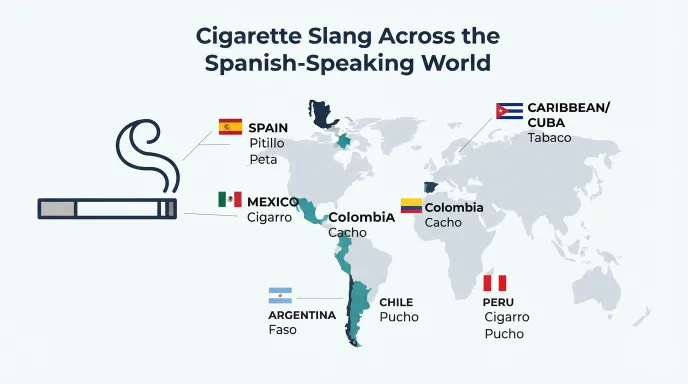
- Pucho : informal regional term used in several Latin American countries.
- Pitillo : an informal term used in some Spanish-speaking regions.
- Tusa : a regional word that can refer to a cigarette made from a corn leaf in Andalusia and Cuba.
This regional variation is why translating slang word-for-word can sometimes cause confusion.
Cigarette in Spanish Slang: The Simple Meaning
If you see pucho in an informal Spanish conversation, it may mean cigarette.
For example:
“¿Tienes un pucho?”
In a country where pucho means cigarette, the sentence means:
“Do you have a cigarette?”
However, ASALE also records pucho as meaning the cigarette butt or remaining end in a number of countries.
Why Context Matters
The same slang term can have different meanings in different Spanish-speaking countries.
This is especially important with informal vocabulary because dictionaries may list several regional meanings for one word. A person from Argentina, Chile, Peru, Colombia, Spain, or Mexico may not always choose the same word for an everyday object.
So, if you are reading a Spanish message, always consider:
- The country of the speaker
- The surrounding sentence
- If the conversation is formal or casual
- If the person is talking about a cigarette or a cigarette butt
Cigarette in Spanish Slang Full Form and Definition
There is no “full form” for cigarette in Spanish slang because it is not an acronym. It is simply a phrase describing informal Spanish vocabulary for cigarettes.
The standard terms are more straightforward.
| Spanish word | English meaning | Style |
| Cigarrillo | Cigarette | Standard |
| Cigarro | Cigarette/cigar | Common |
| Pucho | Cigarette or cigarette butt, depending on region | Slang/colloquial |
| Pitillo | Cigarette | Informal/regional |
| Tusa | Corn-leaf cigarette in some regions | Regional |
The Real Academia Española’s historical dictionary defines cigarrillo as a small cigar wrapped in cigarette paper, while ASALE’s Diccionario de americanismos records the regional meanings of pucho.
Is “Pucho” Rude, Offensive, or Neutral?
Pucho is generally an informal or colloquial word rather than an offensive insult.
Its tone depends on where it is used. In a casual conversation among friends, it can sound completely natural. In a formal document, professional email, academic paper, or official announcement, cigarrillo would normally be a safer choice.
ASALE marks several meanings of pucho as popular or colloquial and identifies different regional uses.
Therefore:
- Cigarrillo → neutral and standard
- Cigarro → common and generally neutral
- Pucho → informal/colloquial
- Pitillo → informal or regional
- Tusa → highly regional
A slang word is not automatically rude. It is simply less formal.
When “Pucho” Can Sound Very Casual
Imagine two friends talking:
“Vamos afuera por un pucho.”
The phrase sounds casual and conversational.
A more formal version would be:
“Vamos afuera a fumar un cigarrillo.”
The second sentence sounds more neutral and appropriate for formal communication.
Where Is “Pucho” Commonly Used?
One of the most interesting things about cigarette in spanish slang is the regional variation.
According to ASALE, pucho can mean a cigarette in parts of Colombia, Peru, Bolivia, Chile, Argentina, Paraguay, and Uruguay. It can also mean a cigarette butt in several other countries.
That means you should not assume that every Spanish speaker uses pucho in exactly the same way.
The word has an interesting history as well. ASALE gives its origin as the Quechua puchu, associated with the idea of something left over, a remainder, or residue.
This helps explain why pucho can refer to both a cigarette and, in some regions, the remaining end of a cigarette.
Real-Life Examples of Cigarette Slang in Spanish
Here are natural examples showing how these words can appear in everyday communication.
Friendly Example
“¿Quieres un pucho?”
Meaning:
“Do you want a cigarette?”
The sentence is casual and friendly.
Casual Example
“Voy a fumarme un cigarro.”
Meaning:
“I’m going to smoke a cigarette.”
Here, cigarro is being used in ordinary conversation.
Informal Example
“Me queda un pucho.”
Depending on the country and context, this may mean:
“I have one cigarette left.”
However, in some regions, pucho may refer specifically to the leftover end of a cigarette, so context matters.
Social Media Example
A Spanish-speaking user might post:
“Un café y un pucho.”
The intended meaning can be understood as:
“A coffee and a cigarette.”
The expression has a casual, conversational feel.
Argumentative Example
“Te dije que no dejaras los puchos en la mesa.”
Meaning:
“I told you not to leave the cigarette butts on the table.”
Here, context is especially important because pucho can refer to the remaining portion of a cigarette in some varieties of Spanish.
Comparison: Spanish Words for Cigarette
Different words can sound natural in different regions.
| Term | Basic meaning | Formality | Regional variation |
| Cigarrillo | Cigarette | Neutral | Low |
| Cigarro | Cigarette/cigar | Neutral-casual | Medium |
| Pucho | Cigarette/cigarette butt | Casual | High |
| Pitillo | Cigarette | Casual | High |
| Tusa | Specific regional cigarette term | Casual/regional | Very high |
The safest choice for learners is cigarrillo because it is clear and standard.
If you are trying to sound natural in a particular country, however, learning the local informal vocabulary can make your Spanish sound more authentic.
Origin and Background of Spanish Cigarette Slang
Spanish cigarette vocabulary has developed through ordinary speech, regional traditions, and contact between languages.
The word cigarrillo comes from cigarro and uses the diminutive ending -illo. The RAE’s dictionary records cigarrillo as a small cigar made with tobacco and wrapped in smoking paper.
The story of pucho is different. ASALE identifies it as coming from Quechua puchu, meaning something like a leftover or residue. Over time, it developed several regional meanings connected with cigarettes and cigarette remains.
Another interesting example is tusa. The RAE records it as a cigarette made from a corn leaf in Andalusia and Cuba.
These examples show why Spanish slang is so diverse.
Similar Slang Terms You May See
If you are searching for cigarette in spanish slang meaning, you may encounter several related terms.
| Spanish term | Possible English meaning | Important note |
| Pucho | Cigarette / cigarette butt | Strongly regional |
| Cigarrillo | Cigarette | Standard term |
| Cigarro | Cigarette / cigar | Meaning depends on context |
| Pitillo | Cigarette | Regional/informal |
| Tusa | Corn-leaf cigarette | Regional meaning |
| Colilla | Cigarette butt | Refers to the part left after smoking |
The distinction between cigarette and cigarette butt is important. The RAE defines colilla as the part of a cigarette or cigar that remains unconsumed.
So, if someone says “tira la colilla”, they mean:
“Throw away the cigarette butt.”
They are not asking someone to throw away an entire unused cigarette.
When Should You Avoid Cigarette Slang?
Slang is useful, but it is not suitable for every situation.
Use the standard word cigarrillo when you are writing:
- A school assignment
- A professional article
- A formal report
- A medical or public-health document
- A business email
- An official notice
- Content for an international Spanish-speaking audience
Slang is better suited to:
- Friendly conversations
- Text messages
- Informal social media posts
- Movies and dialogue
- Fictional conversations
- Casual online communities
If you do not know the audience’s country, a standard word is usually the clearest choice.
Polite and Neutral Alternatives
If you want to avoid regional slang, use cigarrillo.
For example:
Very informal:
“¿Me das un pucho?”
More neutral:
“¿Me das un cigarrillo?”
Both can communicate the same basic idea in the right context, but the second is more universally understandable.
Another useful option is cigarro, although learners should remember that the exact meaning can vary depending on context.
Why Do People Use Cigarette Slang?
People use slang because everyday language is naturally shorter, more expressive, and more connected to local culture.
There are several reasons someone might use a slang term:
- It sounds natural among friends.
- It reflects their regional identity.
- It is shorter than the standard term.
- They learned it from family or their local community.
- It fits the tone of texting and social media.
- It can make dialogue sound more authentic.
This is true for many areas of language, not only cigarette vocabulary.
For a Spanish learner, understanding slang can therefore be just as useful as learning formal vocabulary.
Impact of Slang in Communication
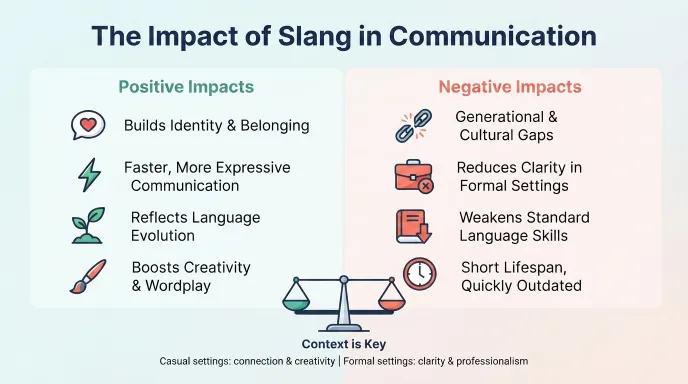
Slang can make communication feel more personal and natural, but it can also create misunderstandings.
For example, if a learner knows that pucho means “cigarette,” they may assume every Spanish speaker uses the word that way. That is not necessarily true.
Regional vocabulary can change the meaning.
A good language learner should therefore learn both:
- The standard word.
- The regional or informal alternatives.
This approach helps you understand conversations without forcing slang into situations where it does not belong.
Is Cigarette Slang Safe for Social Media?
Words such as pucho, cigarrillo, and cigarro are ordinary vocabulary terms. They are not automatically offensive simply because they refer to smoking.
However, social-media platforms can have their own rules concerning tobacco promotion, advertising, or age-restricted content. If you are publishing commercial content, check the current rules of the platform and the laws that apply to your audience.
For language-learning content, explaining what the slang means is different from promoting tobacco use.
Common Mistakes About Cigarette in Spanish Slang
Mistake 1:
Spanish is spoken across many countries, so there is no universal slang word for cigarette.
Better approach: Learn the standard term first and then study regional slang.
Mistake 2:
ASALE records pucho with multiple meanings, including cigarette and cigarette butt, depending on country and context.
Better approach: Read the complete sentence before translating it.
Mistake 3:
A slang term can sound unnatural in a professional or academic setting.
Better approach: Choose cigarrillo when you need neutral Spanish.
FAQs
What is the most common Spanish word for cigarette?
Cigarrillo is a standard and widely understood Spanish word for cigarette. Cigarro is also commonly used in everyday speech.
What is the Spanish slang term for cigarettes?
Common Spanish slang terms for cigarettes include “pucho,” “frajo,” and “cigarro.”
What are slang terms for cigarettes?
Popular slang terms include “pucho” (South America), “frajo” (Mexico/Central America), and “cig” or “smoke” in English.
What is slang for smoking a cigarette?
Common slang phrases include “fumar un pucho,” “prender un frajo,” or simply “encender un cigarro.”
How do you say “a cigarette” in Spanish?
The standard word is “un cigarrillo” or “un cigarro,” with “pucho” and “frajo” as common slang alternatives.
Final Comparison: Which Word Should You Use?
| Situation | Best choice | Why |
| Learning basic Spanish | Cigarrillo | Clear and standard |
| Formal writing | Cigarrillo | Neutral |
| General conversation | Cigarro / cigarrillo | Commonly understood |
| Casual regional conversation | Pucho or local slang | Sounds natural in the right region |
| Talking about the leftover end | Colilla / regional pucho | Refers to a cigarette butt |
| International audience | Cigarrillo | Least likely to cause confusion |
Conclusion
The phrase cigarette in spanish slang does not point to one universal slang word. Spanish speakers use different expressions depending on their country, community, and conversation style. The safest standard word is cigarrillo, while cigarro is also common in everyday speech.
If you encounter pucho, remember that it is a regional and colloquial term. ASALE records it as “cigarette” in several countries and as “cigarette butt” in others, which makes context especially important.Other regional expressions, such as tusa, also have specific geographic meanings.
So, when someone asks what does cigarette in spanish slang mean, the best answer is: there are several possibilities, but cigarrillo is the clear standard term, while words like pucho are informal and region-specific. Understanding both standard Spanish and local slang will help you read texts, understand social media, and follow real conversations more accurately.

I am Alisha Abbas, a slang expert and language enthusiast specializing in modern slang, internet expressions, and everyday language trends. I study the meanings, origins, and cultural influences behind slang words to make them easy to understand for readers. My work focuses on exploring how language evolves and helping people communicate better in today’s fast-changing digital world.