Southern California slang refers to the casual, laid-back expressions and terms commonly used by people from SoCal, often influenced by surf culture, Spanish, and diverse urban communities.
Southern California has a slang style all its own, shaped by decades of beach culture, Hollywood influence, and a rich mix of communities from LA to San Diego. If you’ve ever heard someone say “hella,” “bet,” or “the 405,” you’ve encountered SoCal slang in action.
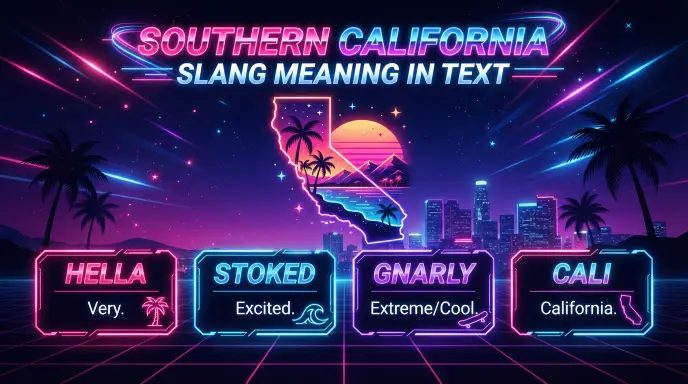
Much of this slang blends surfer lingo with everyday urban speech, creating a vibe that feels relaxed yet expressive. Words like “stoked,” “gnarly,” and “sesh” reflect the region’s deep connection to beach and skate culture.
SoCal slang also reflects the area’s strong Mexican-American and Latino influence, with terms like “órale” or “no manches” mixing naturally into English conversations. Freeway references, like calling roads “the 5” or “the 10,” are another unique local quirk.
In this article, we’ll explore the most popular Southern California slang terms, their meanings, and how locals use them in everyday text and conversation: helping you sound like a true SoCal native.
Quick Answer:
Southern California slang is informal language associated with the region, including expressions such as “dude,” “hella” in some communities, “the 405,” “SoCal,” “gnarly,” and “the beach.” The meaning of a specific term depends on context and the community using it.
Southern California Slang Full Form and Definition
There is no single Southern California slang full form because Southern California slang is a broad category rather than one abbreviation.
“Southern California” is commonly shortened to SoCal, which is itself one of the most recognizable regional terms.
SoCal = Southern California
The term generally refers to the southern portion of California, including major areas such as Los Angeles, Orange County, San Diego, Riverside, and surrounding communities.
Southern California slang developed from the area’s distinctive lifestyle and multicultural population. Surfing, skateboarding, music, entertainment, automobiles, beaches, and local neighborhoods have all influenced the way people speak.
Common Southern California Slang Terms
| Slang Term | Meaning | Common Context |
| SoCal | Southern California | General conversation |
| Dude | Person, friend, or informal address | Everyday speech |
| Gnarly | Extreme, difficult, impressive, or intense | Surfing, sports, casual talk |
| Stoked | Very excited | Surfing, events, plans |
| Sick | Very good or impressive | Youth/casual slang |
| The 405 | Interstate 405 freeway | Los Angeles/Orange County |
| The 5 | Interstate 5 freeway | Southern California |
| NorCal | Northern California | Regional comparison |
| The beach | Often used casually for a local beach trip | Everyday conversation |
Is Southern California Slang Rude, Offensive, or Neutral?
Most Southern California slang is informal and neutral, rather than offensive.
Words such as “dude,” “stoked,” and “gnarly” can be perfectly normal in casual conversation. However, some expressions can become rude depending on tone, context, or the community in which they are used.
For example, calling someone “dude” among friends can sound friendly. Using the same word in an extremely formal workplace conversation may sound overly casual.
Some slang can also have cultural meanings that outsiders may not fully understand. It is better to learn the context before using unfamiliar expressions.
Tone Matters
The same expression can communicate different emotions depending on how it is delivered.
- Friendly: “Dude, that was awesome!”
- Excited: “I’m so stoked for tomorrow.”
- Surprised: “Dude, seriously?”
- Annoyed: “Dude, stop doing that.”
Therefore, the words alone do not always determine if an expression sounds positive or negative.
Where Is Southern California Slang Commonly Used?
Southern California slang can be heard across many parts of the region, although individual communities have their own vocabulary.
It is particularly common in:
- Los Angeles
- Orange County
- San Diego
- Inland Empire
- Beach communities
- Surfing and skateboarding communities
- High schools and colleges
- Casual social media conversations
- Music and entertainment communities
The internet has also helped spread Southern California expressions far beyond California. A person may use “dude” or “stoked” without actually living in Southern California.
This means that not every person using these expressions is necessarily from the region.
Real-Life Examples of Southern California Slang
Learning slang through examples makes it easier to understand how people use these expressions naturally.
Friendly Example
“Dude, you have to come to the beach with us this weekend.”
Here, “dude” is being used as a friendly way to address another person.
Casual Example
“I’m totally stoked for the concert tonight.”
“Stoked” means very excited or enthusiastic.
Surfing Example
“Those waves were gnarly this morning.”
“Gnarly” can describe something extreme, challenging, impressive, or intense.
Argumentative Example
“Dude, you said you were going to be here an hour ago.”
In this example, “dude” is still informal, but the speaker’s tone is frustrated.
Social Media Example
“SoCal sunsets are different.”
Here, “SoCal” simply means Southern California.
Gaming or Online Example
“That was a sick move!”
In casual slang, “sick” can mean impressive or excellent rather than unhealthy.
Origin and Background of Southern California Slang
The history of Southern California slang is closely connected to the region’s diverse cultural development.
Surf culture had a particularly strong influence on informal Southern California vocabulary. Words such as “stoked” and “gnarly” became associated with surfing and extreme experiences before becoming more widely used.
Skateboarding, punk music, hip-hop, car culture, television, movies, and youth communities also helped spread regional expressions.
Southern California’s multicultural population has contributed another major layer to local speech. English used in the region can be influenced by different cultural and linguistic communities, creating vocabulary that varies considerably between neighborhoods.
The Influence of Surf Culture
Surfing helped popularize expressions describing waves, excitement, difficulty, and experiences.
For example, “stoked” can describe strong excitement, while “gnarly” can describe something extreme or challenging.
Over time, these words moved beyond surfing and became part of broader casual English.
Southern California Slang vs Standard English
Southern California slang is generally more relaxed than standard formal English.
| Southern California Expression | Standard English | Meaning |
| Dude | Friend/person | Informal way to address someone |
| Stoked | Excited | Very enthusiastic |
| Gnarly | Extreme/intense | Difficult, impressive, or intense |
| Sick | Excellent | Very impressive |
| SoCal | Southern California | Regional abbreviation |
| The 405 | Interstate 405 | A major freeway |
Using slang does not necessarily mean a person does not know standard English. Most speakers naturally change their vocabulary depending on the situation.
Southern California Slang vs Northern California Slang
California has strong regional identities, and speech can vary between Southern and Northern California.
| Feature | Southern California | Northern California |
| Regional abbreviation | SoCal | NorCal |
| Major cultural influence | Surf, beach, entertainment | Tech, Bay Area culture |
| Common casual address | Dude | Dude also common |
| Regional freeway references | The 405, the 5 | Bay Area freeway terminology |
| Vocabulary | Often influenced by beach and youth culture | Often influenced by Bay Area communities |
There is considerable overlap, so these differences should not be treated as strict rules.
Similar Slang Terms and Their Meanings
Some Southern California expressions have meanings similar to slang used elsewhere.
| Southern California Slang | Similar Expression | Basic Meaning |
| Stoked | Pumped | Very excited |
| Gnarly | Intense | Extreme or difficult |
| Sick | Awesome | Very good |
| Dude | Bro | Informal address |
| Chill | Relax | Calm or relaxed |
The exact meaning can change according to the speaker and situation.
When Should You Avoid Southern California Slang?
Southern California slang is usually best suited to informal situations.
You may want to avoid heavy slang when writing:
- Business emails
- Academic assignments
- Job applications
- Legal documents
- Professional reports
- Formal presentations
- Official complaints
For example, instead of saying:
“That presentation was sick!”
in a professional environment, you could say:
“That presentation was excellent.”
Likewise, “dude” may be perfectly natural with a friend but unnecessarily informal when addressing a customer or senior professional.
Polite Alternatives to Southern California Slang
You do not need to completely avoid slang. The important thing is knowing when a more neutral expression is appropriate.
| Casual Slang | Polite or Formal Alternative |
| Dude | Friend / person / name |
| Stoked | Excited |
| Sick | Excellent / impressive |
| Gnarly | Extreme / challenging |
| Chill | Relaxed / calm |
| What’s up? | How are you? |
Using the alternative does not change the basic message. It simply makes the communication more suitable for formal audiences.
Why Do People Use Southern California Slang?
People use regional slang for several reasons.
First, it makes communication feel relaxed and natural. Friends may use slang because it reflects their shared environment and social identity.
Second, slang can create a sense of belonging. Expressions associated with surfing, beaches, local neighborhoods, or California culture can help communicate a connection to the region.
Third, slang is efficient. Saying “I’m stoked” is a quick and expressive way to communicate excitement.
Finally, entertainment and social media have made Southern California expressions popular worldwide.
Impact of Slang on Communication
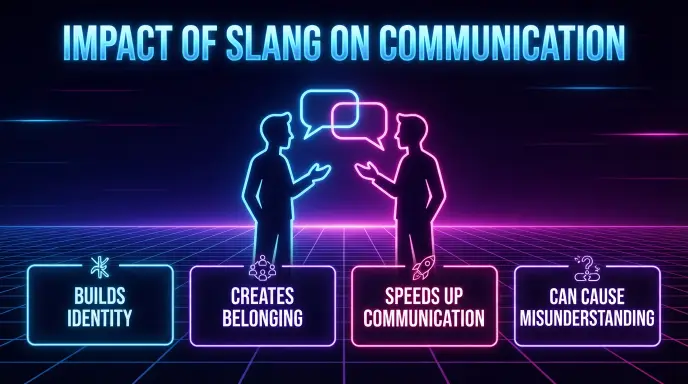
Slang can make conversations more expressive, but it can also create misunderstandings.
Someone familiar with Southern California culture may immediately understand:
“That wave was gnarly.”
Someone unfamiliar with the expression might interpret “gnarly” negatively because its literal association can suggest something unpleasant.
Context helps listeners understand the intended meaning.
Benefits of Slang
- Makes conversations feel natural.
- Builds familiarity between speakers.
- Expresses emotions efficiently.
- Communicates regional identity.
- Adds personality to social media posts.
Possible Drawbacks
- Can confuse people from other regions.
- May sound too informal in professional situations.
- Some terms can change meaning over time.
- Certain expressions may have different meanings in different communities.
Is Southern California Slang Safe for Social Media?
Generally, yes. Most Southern California slang is harmless and commonly used in casual online communication.
Expressions such as “SoCal,” “dude,” “stoked,” and “gnarly” are generally safe when used appropriately.
However, social media users should always consider the audience. Some slang may have different meanings outside Southern California, while certain culturally specific expressions should not be copied casually without understanding their background.
Best Social Media Practice
Use slang when:
- Your audience understands it.
- The post is casual.
- The expression matches your tone.
- You understand the term’s meaning and context.
For professional social media content, neutral language is usually a safer choice.
Common Mistakes With Southern California Slang
One common mistake is assuming that every expression associated with Southern California is used by everyone in the region.
Southern California is extremely diverse. A surfer in San Diego may use different expressions from a professional in downtown Los Angeles or a teenager in Orange County.
Another mistake is treating slang as a fixed dictionary. Slang changes constantly through music, social media, entertainment, and youth culture.
Remember the Context
If someone says:
“That was gnarly!”
they might mean:
- The experience was difficult.
- The event was extreme.
- Something impressive happened.
- Something dangerous occurred.
The situation determines the intended meaning.
FAQs
What is slang for Southern California?
Southern California is commonly nicknamed “SoCal”: a widely used, casual short form popular in conversation, social media, and pop culture.
What is the meaning of “Southern California”?
“Southern California” refers to the southern region of the U.S. state of California, including major cities like Los Angeles, San Diego, and Orange County: known for its beaches, entertainment industry, and laid-back culture.
What are California slang words?
Popular California slang words include “hella” (very), “stoked” (excited), “gnarly” (extreme/cool), “bomb” (amazing), “sick” (awesome), and “the 405” (referring to a freeway by number instead of name).
How do you say California in slang?
Locals and slang users often refer to California simply as “Cali”: a casual, widely recognized nickname used in conversation, music, and social media.
What are 10 slang words?
Ten common slang words include: hella, stoked, gnarly, bet, sus, lit, salty, extra, vibe, and fam : each carrying its own casual meaning in everyday conversation.
What is LA slang for?
“LA” is commonly used as slang for Los Angeles, California: a quick, informal way to refer to the city in texting, social media, and everyday speech.
What is “L” in Gen Z slang?
In Gen Z slang, “L” stands for “Loss,” used to describe a failure, embarrassing moment, or disappointing outcome (the opposite of a “W,” which means “Win”).
What does “La Girl” mean?
“LA Girl” typically refers to a woman associated with the Los Angeles lifestyle: often linked to fashion, beauty trends, or confidence; it’s also the name of a popular cosmetics brand, “LA Girl Cosmetics.”
What are 5 slang words?
Five common slang words include: lit, salty, sus, extra, and vibe: each used to express excitement, mood, suspicion, or personality in casual conversation.
Conclusion
Southern California slang is a broad collection of informal expressions influenced by the region’s beaches, surf culture, entertainment industry, youth communities, multicultural population, and everyday lifestyle.
Terms such as SoCal, dude, stoked, gnarly, sick, and chill can make conversations sound more relaxed and expressive. However, their meanings can change depending on the speaker, location, and situation.
The most important thing is context. A phrase that sounds perfectly natural among friends may be inappropriate in a formal workplace or academic setting.
If you are learning Southern California slang meaning, focus not only on the dictionary definition but also on how people actually use the expression. Understanding the tone, audience, and cultural background will help you use regional slang naturally and respectfully.
Recommended Reading!
What Is a Snowbunny? Slang Meaning in Text Explained

I am Alisha Abbas, a slang expert and language enthusiast specializing in modern slang, internet expressions, and everyday language trends. I study the meanings, origins, and cultural influences behind slang words to make them easy to understand for readers. My work focuses on exploring how language evolves and helping people communicate better in today’s fast-changing digital world.