In Spanish slang, “what’s up?” can be said as “¿Qué onda?”, “¿Qué tal?”, or “¿Qué pasa?”, depending on the country and situation.
Spanish slang for “what’s up” varies a lot depending on the country and region you’re talking about. Each version carries its own tone, popularity, and cultural flavor.
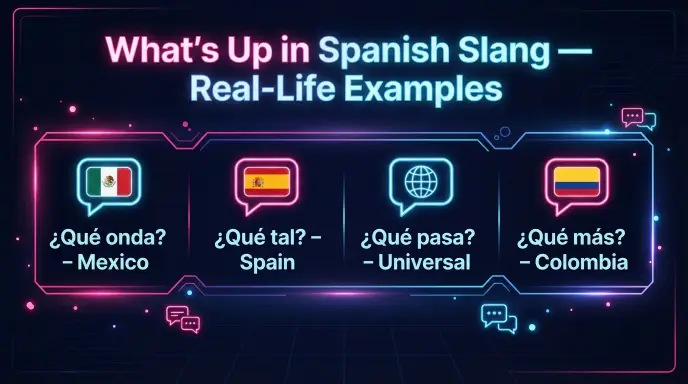
“¿Qué onda?” is extremely popular in Mexico and Central America. It’s casual, friendly, and commonly used among friends or peers in everyday conversation.
“¿Qué tal?” is more universal and used across Spain and Latin America. It works in both semi-formal and informal situations, making it a safe, widely understood option.
Other regional versions like “¿Qué más?” (Colombia) or “¿Qué hay?” (Spain) show how Spanish slang shifts by country, giving learners a fuller picture of real, spoken language
Quick Answer:
“What’s up” in Spanish slang is most commonly expressed as “¿Qué onda?” (Mexico/Central America), “¿Qué tal?” (universal/Spain), “¿Qué pasa?” (widely used), or “¿Qué más?” (Colombia): all casual greetings meaning roughly “what’s up” or “what’s going on.”
What Does “What’s Up?” Mean?
“What’s up?” is a casual way to ask someone how they are or what they are doing. Spanish has several natural ways to say it, and the best choice can change by country.
You may hear these phrases in everyday conversations, texts, social media comments, and among friends. They are usually relaxed rather than formal.
Common Spanish Slang for “What’s Up?”
¿Qué onda? is a very common casual expression, especially in Mexico and some other parts of Latin America. It can mean “What’s up?”, “What’s going on?”, or simply “Hey, what’s up?”
¿Qué pasa? literally means “What is happening?” but people often use it like “What’s up?” or “What’s going on?”
¿Qué tal? is another common way to greet someone. It can mean “How are you?”, “How’s it going?”, or “What’s up?”
¿Qué hay? can also be used like “What’s up?” It is similar to saying “What’s happening?” in a casual way.
Which One Sounds Most Casual?
If you want a friendly and casual phrase, ¿Qué onda? is a great choice in Mexican Spanish.
For a more general greeting, ¿Qué tal? is easy to use and widely understood.
¿Qué pasa? can also work, but depending on your tone, it may sometimes sound like you are asking if something is wrong.
“What’s Up?” in Mexican Spanish
In Mexico, ¿Qué onda? is one of the most recognizable casual ways to say “What’s up?”
For example:
¡Hola! ¿Qué onda?
This can simply mean:
“Hey! What’s up?”
A friend might also say:
¿Qué onda contigo?
This can mean something like:
“What’s up with you?”
The phrase is informal, so it works best with friends, classmates, or people you know casually.
“What’s Up?” in Spain
In Spain, ¿Qué tal? is a very natural casual greeting.
For example:
Hola, ¿qué tal?
This can mean:
“Hey, how’s it going?”
You may also hear ¿Qué pasa? in casual conversations.
The exact phrase people choose depends on the person, region, and situation.
“What’s Up?” in Latin America
Spanish-speaking countries do not all use the same slang.
You may hear ¿Qué onda? in Mexico and some other Latin American settings. In other countries, people may prefer ¿Qué tal?, ¿Qué pasa?, or a local expression.
This is why there is no single Spanish slang phrase that perfectly matches “what’s up?” everywhere.
What’s the Difference Between “¿Qué onda?” and “¿Qué tal?”
¿Qué onda? is more slangy and casual. It feels similar to “What’s up?” or “What’s going on?”
¿Qué tal? is more general. It can mean “How are you?” or “How’s it going?”
For example:
¿Qué onda, amigo?
This sounds very casual.
Hola, ¿qué tal?
This sounds friendly and natural without being as slang-heavy.
What’s the Difference Between “¿Qué pasa?” and “¿Qué onda?”
Both can be used to ask what is going on, but they do not always feel exactly the same.
¿Qué onda? usually feels like a relaxed greeting.
¿Qué pasa? can be a greeting, but it can also sound like you are asking about a problem.
For example:
¿Qué pasa? ¿Estás bien?
This means:
“What’s wrong? Are you okay?”
So, if you simply want to greet a friend, ¿Qué onda? or ¿Qué tal? may be clearer.
How Do You Reply to “¿Qué Onda?”
You can answer in a simple and friendly way.
For example:
Todo bien. ¿Y tú?
This means:
“All good. And you?”
You could also say:
Nada, aquí.
This means something like:
“Nothing, just here.”
Another casual answer is:
Todo tranquilo.
That means:
“Everything’s good” or “All chill.”
Is “¿Qué Onda?” Rude?
Usually, no.
It is a casual expression, so it is best for relaxed conversations. You would normally use it with friends, people your age, or people you already know.
For formal situations, such as speaking to a boss, teacher, or official, a more polite greeting is usually better.
Is “¿Qué Onda?” Used by Young People?
Yes, it is commonly associated with casual speech and is especially familiar in Mexican Spanish.
You may see it in texts, memes, comments, and conversations between friends.
Still, slang varies by person and region. Not every Spanish speaker uses the same expressions.
What Does “Qué Onda” Literally Mean?
The word onda can literally refer to a “wave,” but ¿Qué onda? is not normally understood by taking each word literally.
As an expression, it works more like:
“What’s up?”
or:
“What’s going on?”
This is a good example of why slang cannot always be translated word for word.
Real-Life Examples
Example 1: Text Message
Luis: “Ey, ¿qué onda?”
Carlos: “Todo bien. ¿Y tú?”
Here, Luis is simply saying, “Hey, what’s up?”
Example 2: Meeting a Friend
Sofia: “¡Hola! ¿Qué tal?”
Mia: “Muy bien.”
Here, “¿Qué tal?” works like “How’s it going?” rather than a direct slang translation of “What’s up?”
Example 3: Asking About a Problem
Diego: “¿Qué pasa?”
Mateo: “Nada, estoy cansado.”
Here, “¿Qué pasa?” means something closer to “What’s wrong?” or “What’s happening?”
Example 4: Casual Mexican Spanish
Ana: “¿Qué onda, bro?”
Leo: “Nada, aquí con mis amigos.”
This is a relaxed exchange between friends.
Common Mistakes
Mistake 1: Translating “What’s up?” word for word
Spanish does not have one perfect word-for-word translation. Natural expressions include ¿Qué onda?, ¿Qué tal?, and ¿Qué pasa?
Mistake 2: Using slang in every situation
Slang is casual. If you are speaking to someone in a formal setting, choose a more polite greeting.
Mistake 3: Assuming every country uses the same phrase
Spanish varies across countries. A phrase that sounds very natural in Mexico may not be the most common choice somewhere else.
Mistake 4: Thinking “¿Qué pasa?” always means “What’s up?”
It can, but it can also mean “What’s wrong?” or “What’s happening?” Tone and context matter.
Quick Comparison
| Spanish phrase | Common English meaning | Tone |
| ¿Qué onda? | What’s up? | Very casual |
| ¿Qué tal? | How’s it going? / What’s up? | Casual |
| ¿Qué pasa? | What’s up? / What’s happening? | Casual |
| ¿Qué hay? | What’s up? / What’s new? | Casual |
What Emoji Goes With “What’s Up?” in Spanish?
There is no special emoji for these phrases.
For a friendly text, people might use:
- 👋 for a simple greeting
- 😄 for a cheerful tone
- 😂 for joking
- 👀 for curiosity
- 🤙 for a relaxed vibe
For example:
¿Qué onda? 👀
This can make the message feel playful and curious.
Is “¿Qué Onda?” Still Used?
Yes, ¿Qué onda? remains a familiar casual expression, especially in Mexican Spanish.
But slang is personal and regional. Some speakers may prefer ¿Qué tal?, ¿Qué pasa?, or another local greeting.
There is no need to force slang into every conversation. The most natural phrase is the one that fits the person and situation.
Can You Use “¿Qué Onda?” With Anyone?
It is safest with friends and casual conversations.
If you are meeting someone for the first time, ¿Qué tal? is often an easier choice because it is friendly without being strongly slangy.
For formal situations, use a polite greeting instead.
Key Takeaways
- ¿Qué onda? is a casual way to say “What’s up?”, especially in Mexican Spanish.
- ¿Qué tal? means “How’s it going?” and is widely useful.
- ¿Qué pasa? can mean “What’s up?” but may also ask what is wrong.
- Spanish slang changes from country to country.
- Use casual expressions with friends and in relaxed settings.
- Context and tone can change the meaning.
FAQs
How do you say “what’s up” in slang Spanish?
The most common way is “¿Qué onda?”, widely used in Mexico and Central America. Other casual options include “¿Qué tal?” and “¿Qué pasa?”, both understood across the Spanish-speaking world depending on the country you’re in.
How do you say “what’s up dude” in Spanish slang?
You could say “¿Qué onda, güey?” in Mexican slang, where “güey” means “dude” or “man.” In Spain, a similar vibe would be “¿Qué pasa, tío?”, with “tío” being the local equivalent of “dude.”
How do you say “hi, what’s up” in Spanish?
A natural way to say this is “Hola, ¿qué tal?” or “Hola, ¿qué onda?” Combining a greeting with a casual follow-up question is common in everyday Spanish, especially among friends or peers.
How do you say “yo, what’s up” in Spanish?
This informal greeting is often expressed as “¡Oye, ¿qué onda?!” or simply “¿Qué onda?” on its own, since the tone of “yo” is already built into the casual phrasing of the Spanish slang itself.
Does “qué pasa” mean “what’s up”?
Yes. “¿Qué pasa?” literally translates to “what happens?” or “what’s going on?”, but in everyday use, it functions exactly like the English “what’s up”: a casual, friendly way to check in with someone.
Conclusion
There is more than one natural way to say “what’s up?” in Spanish. The phrase you choose depends on the country, the people you are talking to, and how casual you want to sound.
¿Qué onda? is a popular casual expression, especially in Mexican Spanish. ¿Qué tal? is a friendly and widely useful greeting, while ¿Qué pasa? can mean “What’s up?” or “What’s happening?”
The main thing to remember is that Spanish slang is not the same everywhere. A phrase that sounds natural in Mexico may not be the first choice in Spain or another Spanish-speaking country.
If you are talking with friends, casual expressions are fine. If you are in a formal situation, choose a more polite greeting. That small difference can make your Spanish sound much more natural.
Additional Resources!
Asian Slang Words Meaning in Text
Popular Spanish Slang Compliments Explained

I am Alisha Abbas, a slang expert and language enthusiast specializing in modern slang, internet expressions, and everyday language trends. I study the meanings, origins, and cultural influences behind slang words to make them easy to understand for readers. My work focuses on exploring how language evolves and helping people communicate better in today’s fast-changing digital world.