“Snail trail” is slang with two main meanings. It can be a vulgar term for a visible trail of sexual fluid, or, in some regions, a line of hair running from the lower stomach toward the pubic area. The meaning depends on the conversation, speaker, and region.
If you searched “what is a snail trail slang,” you probably saw the phrase in a text, comment, meme, or conversation and were not sure what it meant.
The phrase has two main slang meanings. The more vulgar meaning describes a visible trail of sexual fluid. Another meaning refers to the strip of hair that can grow from the belly button toward the pubic area. This hair is also commonly called a happy trail or treasure trail.
That second meaning can make the phrase confusing. Someone may use “snail trail” to talk about body hair, while another person may understand it as sexual slang.
So, context is very important. Knowing which meaning fits can help you avoid misunderstanding a joke, text message, social-media comment, or conversation.
Quick Answer Table
| Question | Answer |
| What does it mean? | Usually vulgar sexual slang, but it can also mean abdominal hair |
| Is it slang? | Yes |
| Tone | Informal, crude, joking, or sexual |
| Who uses it? | Mostly people using casual slang |
| Where can you see it? | Texts, chats, forums, memes, and social media |
| Is it rude? | It can be |
| Is it offensive? | Depending on how it is used |
| Safe for work? | Usually best avoided |
The important detail is that “snail trail” does not have one universal slang meaning. If you are reading it online, look at the words around it before deciding what the person means.
What Does “Snail Trail” Mean in Slang?
The most common vulgar slang meaning refers to a visible wet trail associated with vaginal lubrication or sexual fluid.
The expression comes from the image of a snail leaving a shiny trail behind as it moves. The phrase is therefore a crude comparison.
There is also a second slang meaning. In some English-speaking communities, “snail trail” refers to a line of abdominal hair below the belly button.
For this meaning, people may also say:
- Happy trail
- Treasure trail
- Stomach hair
- Abdominal hair
If you see “snail trail” in a sexual conversation, the first meaning is more likely. If the conversation is about grooming, body hair, or appearance, the second meaning may be intended.
Snail Trail Pronunciation
Snail trail is pronounced:
/sneɪl treɪl/
It sounds exactly like the ordinary words “snail” and “trail.”
There is no special slang pronunciation.
Why Is It Called a Snail Trail?
The name comes from the way a snail can leave a thin, shiny trail of mucus as it moves.
Slang speakers use this visual idea as a metaphor. The phrase can describe something that looks like a trail or streak.
The exact date when the slang meanings first appeared is not clear. It is safer to say that the expression developed from the literal image of a snail trail than to claim a specific inventor or first-use date.
The Two Main Meanings
| Meaning | What it refers to | Typical context |
| Sexual slang | A visible trail of sexual fluid | Sexual jokes or private conversations |
| Body-hair slang | Hair between the lower stomach and pubic area | Grooming or body discussions |
This is why a dictionary-style definition without context can be confusing.
If someone says, “She left a snail trail,” the sexual meaning is likely.
If someone says, “He has a dark snail trail,” they may be talking about abdominal hair.
Where “Snail Trail” Is Used
“Snail trail” does not have a special meaning on one particular social-media platform. Its meaning usually stays the same across platforms.
| Platform | Typical use | Context |
| TikTok | Jokes or slang comments | Depends on the video |
| Casual or suggestive comments | Often depends on the caption | |
| Snapchat | Private slang | Usually informal |
| Discord | Jokes and casual chat | Depends on the group |
| Slang discussions and jokes | Regional meanings may appear | |
| Private conversations | Usually depends on the people chatting | |
| YouTube | Comments | Context is especially important |
| X | Jokes or informal discussion | Meaning depends on the post |
There is no strong reason to assume that every person using the phrase on these platforms means the same thing.
Regional Differences
Regional use is one of the most interesting parts of this slang term.
Some speakers, particularly in British and Australian English, may use “snail trail” to refer to the line of abdominal hair.
Other English speakers are more likely to understand the phrase as vulgar sexual slang.
That means two people can hear the same phrase and have completely different interpretations.
If someone uses the term and you are unsure, asking what they mean is safer than guessing.
Is “Snail Trail” Rude?
It can be.
The sexual meaning is vulgar and can sound crude. Even when someone is joking, the phrase may be inappropriate around people who do not know them well.
The body-hair meaning is less explicit, but it is still informal.
For professional, school, or formal conversations, clearer words are better.
For example, say “abdominal hair” if you are talking about the body-hair meaning.
Is “Snail Trail” Offensive?
The phrase is not automatically offensive, but the way it is used can make it offensive or embarrassing.
For example, making a sexual comment about another person’s body without permission can be inappropriate.
A private joke between friends is different from saying the same thing to a stranger or coworker.
So the safest rule is simple:
Use the phrase only when the context is clearly casual and the people involved are comfortable with slang.
Is “Snail Trail” Positive or Negative?
“Snail trail” is not naturally a positive or negative word.
Its tone depends on the situation.
It might be:
- A crude joke
- A sexual comment
- A neutral discussion of slang
- A regional term for body hair
- An embarrassing comment about someone’s body
The phrase itself does not tell you the speaker’s attitude.
Is “Snail Trail” a Formal Term?
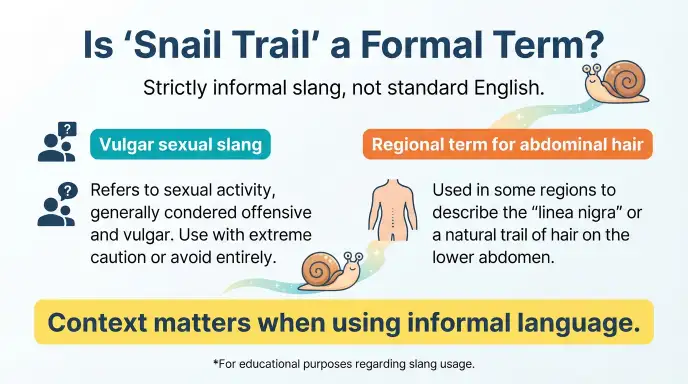
No.
“Snail trail” is informal slang.
It is not a good choice for a formal report, workplace email, school assignment, medical discussion, or professional conversation.
If you need a neutral term, use the specific meaning instead.
For example:
- Abdominal hair for the body-hair meaning
- Vaginal lubrication when discussing the sexual meaning in a health or educational context
These terms are much clearer.
Snail Trail vs. Happy Trail
These two phrases can sometimes refer to the same thing, but they are not always understood in the same way.
| Term | Common meaning | Tone |
| Snail trail | Sexual-fluid trail or, regionally, abdominal hair | Vulgar/informal |
| Happy trail | Line of hair below the belly button | Informal/playful |
| Treasure trail | Line of abdominal hair | Informal |
| Abdominal hair | Hair on the stomach area | Neutral |
If you are talking specifically about body hair, “happy trail” or “abdominal hair” is less likely to cause confusion.
Real-Life Examples
Text Message
Nadia: “What does ‘snail trail’ mean?”
Maya: “It has two meanings. One is sexual slang, and the other can mean stomach hair.”
This is a good example of why context matters.
Social Media Comment
Leo: “Wait, I thought a snail trail meant the hair below your belly button.”
Here, the speaker clearly means the body-hair definition.
Private Chat
Jordan: “That phrase sounds innocent until you know the slang meaning.”
The joke comes from the difference between the harmless literal image of a snail and the vulgar slang meaning.
Casual Conversation
Sam: “Isn’t that usually called a happy trail?”
This suggests the conversation is about abdominal hair rather than sexual slang.
Asking for Clarification
Ava: “When you say snail trail, which meaning do you mean?”
This is the safest response when the context is unclear.
Common Mistakes
Assuming there is only one meaning
There are at least two established slang uses. Context matters.
Thinking it always means body hair
Some people use it for body hair, but other speakers understand it as vulgar sexual slang.
Thinking it always means sexual fluid
That is also too broad. Regional usage can refer to abdominal hair.
Using it in professional settings
Even if you know the body-hair meaning, someone else may understand the sexual meaning.
Treating slang websites as perfect authorities
User-generated slang websites can show how people use a term, but they can also contain jokes, rare meanings, regional expressions, and conflicting definitions.
Assuming social-media usage creates a new meaning
Seeing a word on TikTok, Instagram, Reddit, or another platform does not automatically mean that platform created its meaning.
Key Takeaways
- “Snail trail” has more than one slang meaning.
- Its vulgar meaning refers to a visible trail associated with sexual fluid.
- In some regions, it can mean the line of abdominal hair.
- “Happy trail” and “treasure trail” can describe the body-hair meaning.
- Context, region, and conversation type determine the intended meaning.
- It is generally best avoided in formal or professional settings.
FAQs
What is meant by snail trail?
A snail trail is slang for a thin, dried residue mark left on skin, underwear, or bedding: usually referring to bodily fluid residue. It’s an informal, everyday term rather than a clinical one, so you won’t find it in medical textbooks, but it’s widely understood in casual conversation, forums, and slang dictionaries.
What is a snail trail for a guy?
For men, people often confuse “snail trail” with the “happy trail”: the strip of hair running from the belly button down to the groin area. This happy trail is a normal, genetically determined hair growth pattern and has nothing to do with fluid residue. In slang usage though, “snail trail” for a guy can also refer to dried semen residue, similar in concept to how the term is used for girls.
What does a snail mean in slang?
On its own, “snail” in slang usually points to something slow-moving or sluggish (like “moving at a snail’s pace”). But in the specific phrase “snail trail,” the meaning shifts entirely: it’s borrowed imagery from how a real snail leaves a visible, glistening streak behind it, applied here to bodily fluid residue instead.
What is the point of a snail trail?
There isn’t really a deliberate “point” to it: it’s simply a natural side effect of the body’s normal fluid production and lubrication process, not something that serves a purpose on its own. It’s more of a byproduct than a function.
What does a snail trail mean for a girl?
For girls and women, a snail trail typically refers to visible residue from vaginal discharge. Discharge plays an important role in reproductive and vaginal health: it helps clear out old cells and bacteria, keeping the area naturally clean and balanced.
Is it normal for girls to have snail trails?
Yes, completely normal. Vaginal discharge (and any trace it leaves behind) is a routine, healthy bodily function, and its amount or texture can change with your menstrual cycle, hormone levels, hydration, or arousal. It only becomes a concern if it’s paired with a strong odor, unusual color (like green or grey), itching, or discomfort: in that case, it’s worth checking in with a gynecologist, as those can be signs of an infection like bacterial vaginosis or a yeast infection.
Conclusion
If you were wondering “what is a snail trail slang?”, the short answer is that it has more than one meaning.
The phrase can be vulgar sexual slang for a visible trail associated with sexual fluid. In some English-speaking communities, it can also refer to the line of hair below the belly button, which many people call a happy trail or treasure trail.
That difference is important because the same phrase can sound completely different depending on who says it and where they are from.
When you see “snail trail” in a text, comment, meme, or chat, check the surrounding words before deciding what it means. If you need to use the term yourself, choose a clearer phrase when possible. “Abdominal hair” is much clearer for the body-hair meaning, while a neutral health term is better for sexual or medical discussions.
Continue Reading!

I am Alisha Abbas, a slang expert and language enthusiast specializing in modern slang, internet expressions, and everyday language trends. I study the meanings, origins, and cultural influences behind slang words to make them easy to understand for readers. My work focuses on exploring how language evolves and helping people communicate better in today’s fast-changing digital world.